What Is Compound Interest and How Does It Work?
Last updated: December 2025
If there is one financial concept that quietly separates people who struggle with money from those who build real wealth over time, it is compound interest. Many beginners hear this term early on, but few truly understand how powerful it is — especially when combined with time, consistency, and patience.
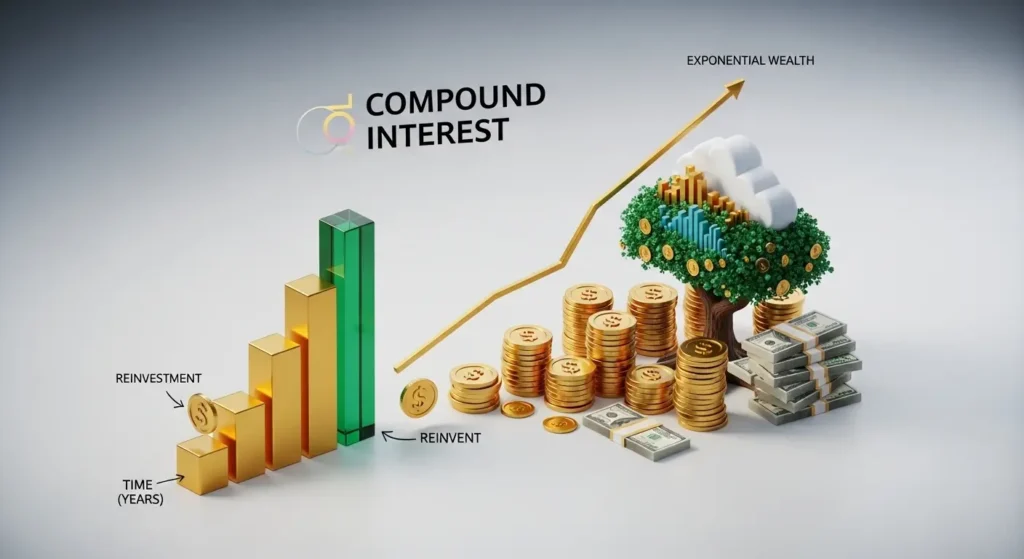
Compound interest is often called “the eighth wonder of the world” because it allows your money to grow on itself. Instead of earning returns only on your original investment, you earn returns on both your initial money and the interest it has already generated. Over time, this creates a snowball effect that can dramatically increase your wealth.
In this guide, you will learn exactly what compound interest is, how it works in practice, and why it plays such a critical role in long-term investing, even if you are starting with a small amount of money.
What Is Compound Interest?
Compound interest is the process by which your investment earns interest not only on the original principal but also on the accumulated interest from previous periods.
In simple terms, your money starts making money — and then that money also starts making money.
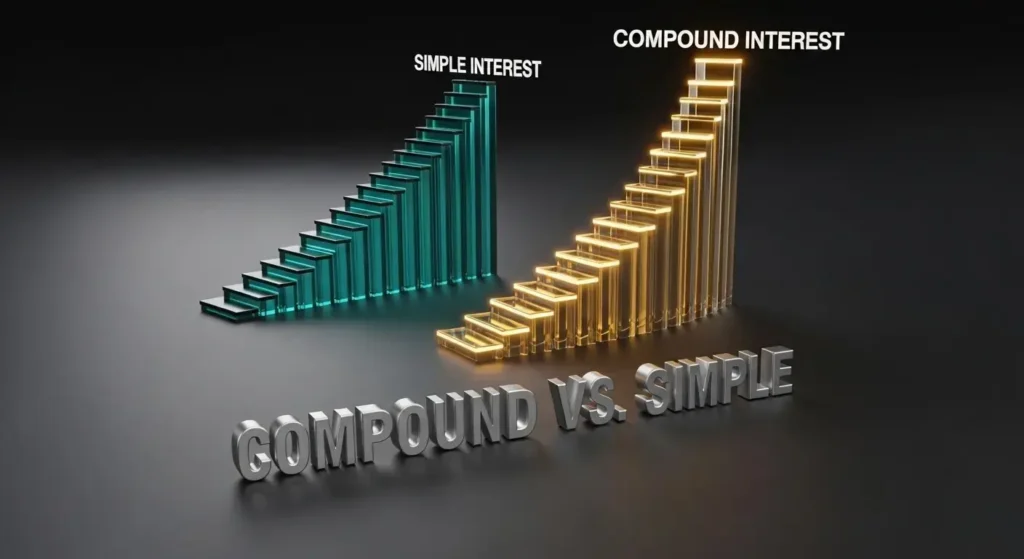
This is very different from simple interest, where interest is calculated only on the initial amount you invest. With compound interest, growth accelerates over time because each interest payment increases the total amount on which future interest is calculated.
For example, if you invest money and earn interest, that interest gets added to your balance. In the next period, interest is calculated on this larger balance. The longer this process continues, the faster your money grows.
👉 Investopedia – Compound Interest
Compound Interest vs. Simple Interest
To truly understand compound interest, it helps to compare it with simple interest.
Simple interest is straightforward.
You earn interest only on your original investment.
The growth is linear and predictable.
Compound interest, on the other hand, is exponential. As your balance grows, the interest earned each period becomes larger, even if the interest rate stays the same.
This difference might seem small at first, but over many years, compound interest can result in dramatically higher returns. The longer the time horizon, the more powerful compounding becomes.
How Does Compound Interest Work?
Compound interest works by reinvesting earnings so they can generate additional returns over time.
Each compounding period follows the same cycle:
You start with a balance.
Interest is applied.
The interest is added to your balance.
The next period’s interest is calculated on the new total.
This process repeats continuously, creating accelerated growth. The key factors that influence compound interest are the interest rate, the frequency of compounding, and the length of time your money remains invested.
Even small contributions can grow significantly if they are left to compound over many years.
The Compound Interest Formula Explained Simply
While you do not need to be a math expert to benefit from compound interest, understanding the basic formula can be helpful.
The compound interest formula looks like this:
A = P × (1 + r/n)^(n×t)
Where:
P is the initial principal
r is the annual interest rate
n is the number of times interest compounds per year
t is the number of years
A is the final amount
What matters most is not memorizing the formula, but understanding that time and consistency have a bigger impact than trying to chase high returns.
Why Time Is the Most Important Factor

Time is the most powerful ingredient in compound interest
The earlier you start, the more time your money has to grow.
Someone who starts investing early can contribute less money overall and still end up with more wealth than someone who starts later with higher contributions. This happens because compounding needs time to work its magic.
Delaying investing by even a few years can significantly reduce your long-term results. This is why compound interest rewards patience far more than short-term strategies.
How Compounding Frequency Affects Growth
Compounding frequency refers to how often interest is calculated and added to your balance.
Common compounding periods include annually, quarterly, monthly, and daily.
The more frequently interest compounds, the faster your investment grows. However, the difference between monthly and daily compounding is much smaller than the difference between yearly and monthly compounding.
In practical terms, consistency and long-term investing matter far more than obsessing over small differences in compounding frequency.
Real-Life Examples of Compound Interest
Consider two people investing in the stock market.
The first person starts early, invests a small amount regularly, and lets the money compound over decades.
The second person starts later, invests more aggressively, but has less time.
In many cases, the first investor ends up with more wealth, despite contributing less money overall.
This demonstrates the power of compounding combined with time.
Compound interest rewards discipline, patience, and consistency — not luck or perfect timing.
How Compound Interest Applies to Investing
Compound interest is the foundation of long-term investing. It plays a crucial role in stocks, index funds, ETFs, retirement accounts, and even certain savings accounts.
When dividends are reinvested or returns are left untouched, compounding begins to work automatically.
Over time, gains accelerate as your portfolio grows larger.
This is why long-term investors focus on staying invested rather than trying to time the market.
Compound Interest in the Stock Market
In the stock market, compound interest works through reinvested dividends and capital appreciation.
When companies pay dividends and you reinvest them, those dividends buy more shares.
Those additional shares then generate more dividends in the future.
Over decades, this compounding effect can account for a large portion of total returns, especially when investing in broad market index funds.
Compound Interest and Long-Term Wealth Building

Compound interest is not about getting rich quickly
It is about building sustainable wealth over time.
The process may feel slow in the beginning, but growth accelerates in later years.
Many investors experience the most significant gains in the final stages of their investing journey, not the first few years.
This is why staying invested and avoiding unnecessary withdrawals is so important.
Common Mistakes That Kill Compound Growth
Several common mistakes can prevent compound interest from working effectively.
Frequently withdrawing money disrupts compounding.
Trying to chase short-term gains often leads to emotional decisions that hurt long-term returns.
Another major mistake is waiting too long to start.
Time lost can never be recovered, even with higher contributions later.
Understanding these pitfalls helps investors stay focused on long-term growth.
Compound Interest and Inflation
Inflation reduces the purchasing power of money over time.
If your investments do not grow faster than inflation, you are effectively losing money.
Compound interest helps counter inflation by allowing your money to grow at a rate that can outpace rising prices.
This is why investing is often more effective than leaving money in low-interest savings accounts.
Why Compound Interest Matters for Beginners
For beginners, compound interest removes the pressure to start with large amounts of money.
What matters most is starting early, contributing consistently, and allowing time to work in your favor.
Even modest investments can grow into significant sums when given enough time.
This makes compound interest one of the most beginner-friendly concepts in finance.
How Small Investments Grow Over Time
Small investments may not seem impressive at first, but compounding transforms them over the long term.
Regular contributions, even with limited amounts, add up over years.
Each contribution benefits from compounding, reinforcing the importance of consistency over size.
This approach aligns perfectly with beginner investors who are building habits rather than chasing quick profits.
The Psychological Side of Compound Interest
Compound interest also has a psychological benefit.
Seeing your money grow motivates continued investing and reinforces positive financial habits.
As balances increase, confidence grows, making it easier to stay committed during market fluctuations.
This emotional resilience is a key part of long-term success.
How to Take Advantage of Compound Interest
To benefit from compound interest, focus on starting early, staying invested, reinvesting earnings, and avoiding unnecessary withdrawals.
Consistency matters more than perfection. A simple, disciplined approach often outperforms complex strategies over time.
The goal is not to maximize short-term returns, but to allow compounding to work uninterrupted.
Compound Interest and Financial Independence

Compound interest plays a major role in achieving financial independence
By reinvesting returns and maintaining a long-term mindset, investors can gradually reduce their reliance on active income.
Over time, compounded investments can generate enough growth to support financial goals, from retirement to lifestyle freedom.
Why Patience Beats Timing
Trying to time the market often leads to missed opportunities and emotional decisions.
Compound interest favors those who remain invested, regardless of short-term volatility. Time in the market consistently outperforms attempts to predict market movements.
Patience allows compounding to unfold naturally.
The Role of Discipline in Compounding
Discipline ensures that compounding continues uninterrupted.
Regular investing, resisting emotional reactions, and sticking to a plan are all essential. Without discipline, compounding loses its power.
Successful investors focus on process, not daily market noise.
How Compound Interest Builds Momentum
Over time, compound interest creates momentum. Growth becomes noticeable, and each year adds more value than the last.
This momentum is why long-term investing often feels slow at first but accelerates later.
Understanding this curve helps investors stay committed during the early stages.
🎥 BONUS
If you want to understand how compound interest works in real life and why starting early makes such a big difference,this video explains the concept in a simple and beginner-friendly way.
Conclusion
Compound interest is one of the most powerful concepts in personal finance and investing.
It rewards time, consistency, and patience more than any other factor.
By understanding how compound interest works and applying it through long-term investing,
even beginners can build meaningful wealth over time.
You do not need perfect timing, large sums of money, or complex strategies.
You only need to start, stay consistent, and give your money time to grow.
Want more financial insights delivered to you? Subscribe to our newsletter
and get weekly articles with practical strategies to grow your wealth sent straight to your inbox.
Obs: Sign up for our newsletter and receive a free Finance For Beginner eBook.
Disclaimer: This article is for educational purposes only. Diversification does not guarantee profits or protect against all losses. Consider your financial situation, risk tolerance, and investment timeline before making investment decisions.
—— End of Article ——