How to Build Multiple Income Streams: Diversify Your Earnings
Last updated: March 2026
Your job pays you once a month.
That’s one income stream. One source. One employer. One risk.
What happens if you lose that job? Your income stops immediately.
Your entire financial life collapses.
But what if you had TWO income sources? THREE? FIVE?
What if one dried up, but four others kept flowing?
That’s the power of multiple income streams.
Most people never build them.
They get comfortable with their job and assume it will always be there.
Then one day, they lose it—and they panic.
The wealthy think differently. They don’t rely on ONE paycheck.
They build MULTIPLE sources deliberately and strategically.
A doctor earning $200,000/year is more financially vulnerable than someone earning $40,000 from eight different sources.Why? Because when ONE source fails, the other SEVEN keep paying.
In this guide, you’ll learn exactly what multiple income streams are, why they matter more than you think, the different types of income streams, how to build each type strategically, how much each can earn, how to start without quitting your job, and most importantly—how to create income that doesn’t depend on your time.
By the end, you’ll have a plan to diversify your earnings and build real financial security.
Let’s build your income fortress.
What Are Multiple Income Streams?
Multiple income streams are different sources of money flowing into your life from different places.
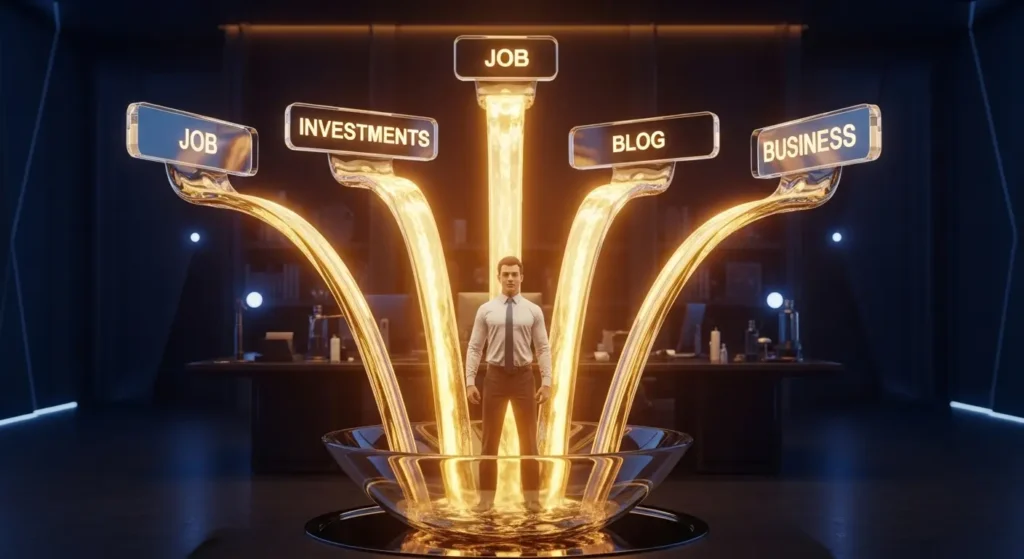
Instead of one job, you have several sources: your job, a side business, investments, rental income, etc.
The Visual Example
Single Income Stream (Vulnerable):
Job → $3,000/month → Bills paid → DoneIf job disappears = income gone = disaster.
Multiple Income Streams (Secure):
Job → $2,000/month
Side gig → $500/month
Blog → $300/month
Investments → $200/month
Total → $3,000/month
If job disappears = still have $1,000/month from other sources. Problem solved.
Income Stream Components
Each income stream has:
- Source (where money comes from)
- Amount (how much monthly)
- Effort required (active vs passive)
- Growth potential (can it increase?)
- Sustainability (can it last long-term?)
Why One Income Stream Isn’t Enough
This is critical to understand.
The Math of Vulnerability
Scenario: Single income earner
- Job: $50,000/year ($4,166/month)
- 100% dependent on job
- Job loss = immediate financial crisis
- Recovery time: 3-6 months minimum
- Damage: Massive (debt, stress, family crisis)
Scenario: Multiple income earner
- Job: $30,000/year ($2,500/month)
- Side gig: $10,000/year ($833/month)
- Blog/affiliate: $6,000/year ($500/month)
- Investments: $4,000/year ($333/month)
- Total: $50,000/year
- Job loss = still have $11,000/year ($916/month)
- Recovery time: Can find new job without panic
- Damage: Minimal (temporary income reduction)
Same total income. Vastly different security.
The Wealth-Building Advantage
Single income:
- Earn $50,000
- Save 20% = $10,000/year
- Invest $10,000/year
- Takes 50 years to build $500,000
Multiple income:
- Earn $50,000 primary
- Earn $15,000 from side sources
- Total: $65,000
- Save 20% = $13,000/year
- Invest $13,000/year
- Takes 38 years to build $500,000
Multiple income = faster wealth building.
The Peace of Mind Factor
Single income:
- Constant fear: “What if I lose my job?”
- Always stressed about security
- Decisions driven by fear, not opportunity
- Can’t take risks (need job security)
Multiple income:
- Confident: “Even if job ends, I have other income”
- Calm about future
- Decisions driven by opportunity, not fear
- Can take calculated risks
The Different Types of Income
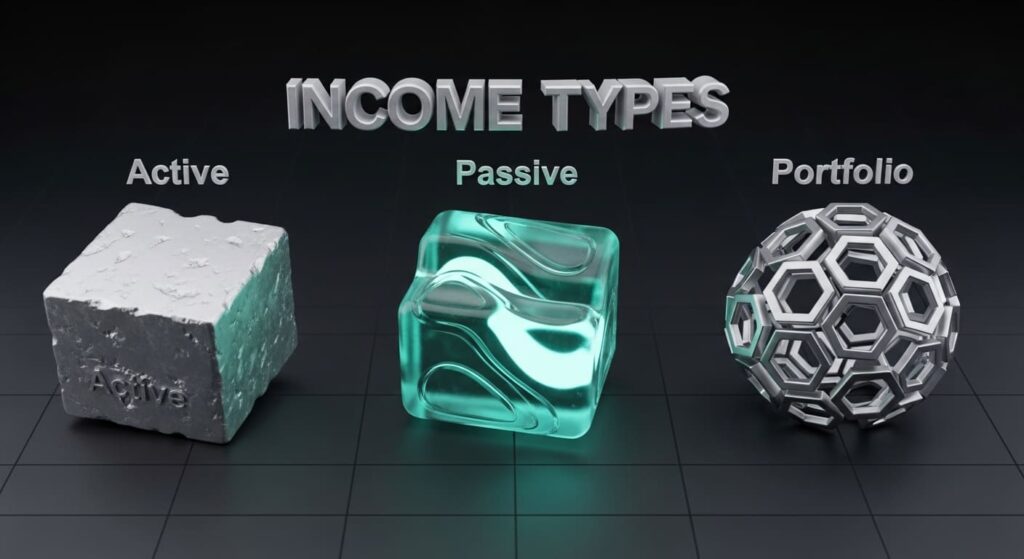
Understand the categories before building
Type 1: Active Income (Trading Time for Money)
What it is: You work, you get paid. Stop working, money stops.
Examples:
- Your job/salary
- Freelance work
- Hourly consulting
- Service-based business
Pros:
- Reliable and predictable
- Easiest to start
- Immediate income
Cons:
- Time-limited (only 24 hours/day)
- Can’t scale infinitely
- Tied to your effort
Best for: Foundation income, starting out
Type 2: Passive Income (Money Without Work)
What it is: Set it up once, money flows without ongoing effort.
Examples:
- Investment dividends
- Rental property income
- Book royalties
- App revenue
Pros:
- Scales without more effort
- Works while you sleep
- True financial freedom
Cons:
- Takes time to set up
- Requires money or expertise upfront
- Takes months/years to generate income
Best for: Long-term wealth, sustainability
Type 3: Semi-Passive (Hybrid)
What it is: Initial effort high, then mostly passive.
Examples:
- YouTube channel (film + upload, then ads)
- Online course (create once, sell forever)
- Blog with ads (write articles, passive ads)
- Digital products (create once, sell multiple times)
Pros:
- Good balance of effort and income
- Can scale
- Generates real income
Cons:
- Requires consistent initial effort
- Takes months to generate income
- Need audience/traffic
Best for: Most people (best of both worlds)
Active Income Streams (Money for Time)

These generate money immediately but require ongoing effort
Active Stream 1: Your Primary Job
The foundation.
- Income: $30,000-$100,000+/year
- Time: 40 hours/week
- Effort: Full-time commitment
- Growth: Raises, promotions, salary negotiation
How to maximize:
- Get raises annually
- Seek promotions
- Negotiate salary
- Develop valuable skills
Active Stream 2: Side Gig/Freelance
Quick additional income.
Options:
- Freelance writing ($25-100/hour)
- Virtual assistant ($15-50/hour)
- Tutoring ($20-60/hour)
- Consulting ($50-200/hour)
- Gig work (delivery, rideshare) ($15-25/hour)
For finding freelance opportunities and building your side income,
platforms like Fiverr and Upwork connect you with clients worldwide.
Income potential: $200-2,000/month
Time required: 5-20 hours/week
How to start: Fiverr, Upwork, local services
Active Stream 3: Service-Based Business
More advanced but scalable.
Examples:
- Freelance agency
- Coaching/consulting
- Repair/handyman services
- Photography business
Income potential: $500-5,000/month
Time required: 20-40 hours/week
How to start: Start small, build reputation
Passive Income Streams (Money Without Work)
These take time to build but generate money on autopilot.
Passive Stream 1: Investment Dividends
Let your money work for you.
How it works:
- Invest $10,000 in dividend stocks
- Receive 3-4% annually in dividends
- $300-400/year passive income
- Grows as portfolio grows
Income potential: $200-1,000+/month (depending on portfolio size)
Effort required: Initial setup, annual monitoring
Timeline to income: Immediate (dividends paid quarterly)
Best for: Long-term wealth builders
Passive Stream 2: Rental Property Income
Real estate that pays you.
How it works:
- Buy property for $200,000
- Rent it for $1,500/month
- After expenses: $500-800/month passive
- Property appreciates over time
Income potential: $300-1,000+/month
Effort required: Property management, maintenance
Timeline to income: 1-3 months (after purchase)
Capital required: $20,000-50,000+ down payment
Best for: Those with capital to invest
Passive Stream 3: Digital Products
Create once, sell forever.
Examples:
- eBook ($10-50 each)
- Online course ($50-200 each)
- Stock photos/videos ($1-20 per download)
- Templates/tools ($5-50 each)
Income potential: $100-1,000+/month
Effort required: High upfront (create product), low ongoing
Timeline to income: 3-6 months to first sales
Capital required: Minimal
Best for: Creative people
Semi-Passive Income Streams (Hybrid Approach)
The best of both worlds: effort required but great income potential.
Semi-Passive Stream 1: Blog with Ads
Write articles, earn from ads.
How it works:
- Write 1-2 articles/week
- Build audience over months
- Place ads (Google AdSense, Mediavine)
- Earn $0.50-5 per 1,000 views
- Eventually passive (old articles keep earning)
To monetize your blog with ads, Google AdSense provides free tools to earn money from your website traffic.
Income potential: $100-5,000+/month
Effort required: 5-10 hours/week initially, 2-3 hours/week ongoing
Timeline to income: 3-6 months
Capital required: Domain + hosting ($100-200/year)
Best for: Writers, educators
Semi-Passive Stream 2: YouTube Channel
Create videos, earn from ads and sponsorships.
How it works:
- Create videos on your topic
- Build subscriber base
- Monetize with ads (YouTube Partner)
- Earn sponsorships
- Videos generate income forever
Income potential: $500-10,000+/month
Effort required: 5-20 hours/week initially, ongoing content
Timeline to income: 6-12 months (to monetization)
Capital required: Camera (smartphone works), editing software
Best for: Communicators, performers
Semi-Passive Stream 3: Online Course
Create course, students pay to take it.
How it works:
- Create video course (20-100 hours initial work)
- Host on Teachable, Udemy, Thinkific
- Market course
- Students pay $50-500 per course
- Earn money from past work
Income potential: $200-3,000+/month
Effort required: 100+ hours to create, 5-10 hours/month marketing
Timeline to income: 2-4 months to first sale
Capital required: $0-500 (platform costs)
Best for: Experts with knowledge to teach
The Best Income Streams for Beginners

Start here if you’re building your first additional streams
Stream 1: Freelancing (Easiest Start)
Why beginners:
- Start earning immediately
- No upfront capital
- Use existing skills
- Scale by getting higher rates
How to start:
- Create profiles on Fiverr, Upwork
- List your skills (writing, design, admin, etc)
- Underbid slightly to get first clients
- Build reputation
- Raise rates
Income timeline: 1-2 weeks to first payment
Realistic income: $200-500/month starting
Stream 2: Blog + AdSense (My Recommendation)
Why it’s great:
- Low startup cost
- Semi-passive (articles keep earning)
- Builds authority
- Scales with content
How to start:
- Get domain + hosting ($100-200/year)
- Create blog on WordPress
- Write articles on your expertise
- Apply for Google AdSense
- Build audience
- Earn from ads
Income timeline: 3-6 months to first earnings
Realistic income: $100-500/month (with consistent posting)
Stream 3: YouTube Channel (Fun + Income)
Why it works:
- Fun to create
- Builds personal brand
- Multiple income sources (ads + sponsorships)
- Evergreen content earns forever
How to start:
- Pick a topic you know well
- Create consistent videos (1-2/week)
- Use smartphone camera (quality improving)
- Build subscriber base
- Apply for monetization
- Earn from ads
Income timeline: 6-12 months to monetization
Realistic income: $200-1,000/month (once monetized)
Stream 4: Affiliate Marketing (No Product Creation)
Why it’s smart:
- Promote others’ products
- Earn commission per sale
- No product creation
- Passive (links keep earning)
How it works:
- Write reviews/recommendations
- Include affiliate links
- Earn 5-40% commission per sale
- No customer support needed
Income timeline: 1-3 months to first commission
Realistic income: $100-1,000/month
How to Start Without Quitting Your Job
The safe approach.
The Strategy
Phase 1: Build (Months 1-6)
- Keep job ($3,000/month)
- Build side stream 5-10 hours/week
- No pressure to earn immediately
- Focus on quality
Phase 2: Earn (Months 6-12)
- Side stream earning $200-500/month
- Job still primary ($3,000/month)
- Total: $3,200-3,500/month
- Growing confidence
Phase 3: Diversify (Year 2)
- Side stream earning $500-1,000/month
- Start second stream (different source)
- Job still solid income
- Total: $3,500-4,000+/month
Phase 4: Leverage (Year 3+)
- Multiple streams earning $1,000-2,000/month
- Job still paying bills
- Extra income investing or spending
- Building real wealth
Why this works:
- ✅ No financial pressure
- ✅ Can focus on quality
- ✅ Job security maintained
- ✅ Gradual growth
The Income Diversification Strategy
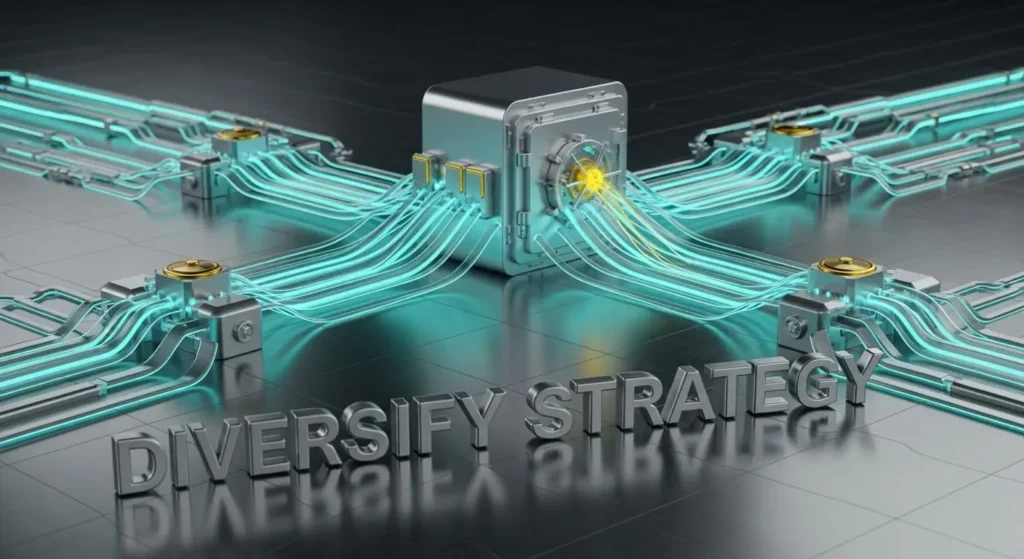
How to build your complete system
Your Income Portfolio
Target breakdown (long-term):
- Primary job: 50% ($2,500/month if $5,000 total)
- Active side income: 20% ($1,000/month)
- Semi-passive income: 20% ($1,000/month)
- Passive income: 10% ($500/month)
Why this balance:
- Job provides stability
- Active income provides flexibility
- Semi-passive grows over time
- Passive compounds indefinitely
Building Your Streams
Year 1: Establish foundation
- Keep primary job strong
- Add one active side stream ($200-500/month)
- Start one semi-passive project (blog, YouTube)
Year 2: Diversify further
- Maintain job + side income
- Scale semi-passive to $300-500/month
- Add passive income (dividend investing)
Year 3+: Compound growth
- Job provides salary
- Multiple active streams ($1,000+/month total)
- Semi-passive streams fully mature ($500-1,000/month)
- Passive income growing ($200-500/month)
Common Mistakes When Building Streams
Learn from others’ failures.
❌ Mistake 1: Building Too Many Too Fast
The error:
- Start YouTube, blog, freelancing, course all at once
- Get overwhelmed
- Quit all of them
The solution:
- Start ONE stream
- Build to $200-300/month
- THEN add second stream
- One at a time
❌ Mistake 2: Quitting Job Too Soon
The error:
- Side stream earning $500/month
- Quit $3,000/month job
- Panic when stream dips
The solution:
- Side income should be 50%+ of job income MINIMUM
- Ideally have 6 months emergency fund
- Only quit when truly secure
❌ Mistake 3: Expecting Money Immediately
The error:
- Start blog, expect $1,000/month in month 1
- Get discouraged when earning nothing
- Quit after 3 months
The solution:
- Blog: 3-6 months to first earnings
- YouTube: 6-12 months to monetization
- Course: 2-4 months to first sale
- Know the timeline and be patient
❌ Mistake 4: Only Building Active Income
The error:
- Work side gig for years
- Trade time for money
- Never build passive income
- Stuck in rat race
The solution:
- Balance active + semi-passive + passive
- Eventually semi-passive and passive do most work
- You trade money for time (not forever)
❌ Mistake 5: Poor Income Tracking
The error:
- Multiple income sources
- Don’t know total income
- Can’t see what’s working
- Can’t optimize
The solution:
- Track every income source
- Monthly spreadsheet: Source | Amount | Growth
- See what’s working
- Double down on winners
Frequently Asked Questions – FAQ 👈
Q: Can I really build multiple income streams while working full-time?
A: Yes. It’s how most people start. 5-10 hours/week of side work is achievable. You just need to sacrifice some entertainment time.
Q: Which income stream should I start with?
A: Start with what you already know. If you write well, start blog. If you like talking, start YouTube. If you have skills, start freelancing. Your first stream should build on existing strengths.
Q: How long until multiple streams pay off?
A: 1-2 years to have real additional income. Most people see results in 6-12 months but need to be consistent.
Q: What if all my streams fail?
A: You still have your job. That’s the point of starting slowly. Multiple streams is about security, not quick riches.
Q: Can I start with passive income only?
A: You can, but it’s harder. Passive income requires either money upfront (investments) or months of work with no income (blog, YouTube). Most people combine active + semi-passive first, then add passive.
Q: Should I do all streams or just one?
A: Ideally 2-3 streams total. One primary (job), one active side (freelance), one semi-passive (blog or YouTube). More than that gets too complicated.
🎥 BONUS
Want to see real examples of how people built multiple income streams?
This video shows different people and their income diversification journeys:
FINAL THOUGHTS: Your Income Fortress
Here’s what the wealthy understand that most don’t:
One income stream = vulnerability.
Multiple income streams = security.
The person earning $100,000 from one job is more financially vulnerable than the person earning $60,000 from five different sources.
Why? Because diversification protects you.
When one source dips, the others keep flowing.
When one ends, four more continue paying.
But here’s the truth: Building multiple income streams takes TIME.
There’s no hack. No shortcut. No “get rich quick.”
It takes:
- Discipline (5-10 hours/week of side work)
- Patience (6-12 months before real income)
- Consistency (showing up even when tired)
- Strategy (building the right combination)
But here’s the payoff:
After 2-3 years of building, you have:
- Security (multiple income sources)
- Freedom (choices based on opportunity, not desperation)
- Wealth (multiple streams compound into real money)
- Peace of mind (calm about future)
You don’t build this overnight. But you do build it.
Start with one stream. Build it to real income. Add a second.
Then a third. In 3 years, you’re in a completely different position.
The question isn’t “Should I build multiple income streams?”
The question is: “How soon do I want to start?”
INTERESTING TOPICS
Ready to learn how to negotiate a raise to increase your primary income stream?
Want to discover how to build financial goals that incorporate multiple income streams?
Need to understand how to invest your multiple income into wealth-building assets?
Want more financial insights delivered to you? Subscribe to our newsletter
and get weekly articles with practical strategies to grow your wealth sent straight to your inbox.
Obs: Sign up for our newsletter and receive a free Finance For Beginner eBook.
Disclaimer: This article is for educational purposes only and should not be considered financial advice. Budgeting approaches should be tailored to individual circumstances, income levels, and financial goals. The examples provided are for illustrative purposes and may not reflect your specific situation. The 50/30/20 rule is a guideline and may need adjustment based on your cost of living, debt obligations, and personal priorities. Consider consulting with a financial advisor for personalized guidance on managing your finances and creating a budget that works for your unique situation.
—— End of Article ——