The Power of Financial Goals: How to Plan and Achieve Them
Last updated: February 2026
You know all the techniques now.
You understand compound interest? You know how to build an emergency fund?
You’ve learned how to diversify? You can read stock charts? You know how to negotiate raises?
Don’t worry, because we have all these topics in carefully prepared and separated articles for your learning.
Check out the “Categories” guide.
But you’re still stuck.
Because you’re missing something critical: You don’t know WHERE you’re going.
It’s like having a perfect car, a full tank of gas, and excellent driving skills—but no destination. You just drive in circles.
Most people fail at building wealth not because they lack knowledge. They fail because they lack DIRECTION.
Without clear financial goals, it’s impossible to stay motivated. You save money but don’t know why. You invest but lack purpose. You work hard but can’t see the finish line.
But here’s what happens when you SET financial goals:
Everything changes. Suddenly, every dollar saved has PURPOSE. Every raise negotiated has MEANING. Every investment decision has CONTEXT. You’re not just following someone else’s system—you’re building YOUR life.
In this guide, you’ll learn exactly what financial goals are, why they’re essential, the different types of goals, how to set goals that actually work, how to create your personal financial roadmap, how to stay motivated, how to track progress, and most importantly—how to actually achieve them.
By the end, you’ll have a clear map to your financial future.
Let’s build your destiny.
What Are Financial Goals? (And Why They Matter)
A financial goal is a specific, measurable target for your money that you want to achieve by a specific date.
In simpler terms: A clear destination for your wealth.
Examples of Real Financial Goals
Short-term (Next 1-3 years):
- Save $5,000 emergency fund by December 2026
- Pay off $10,000 credit card debt by June 2027
- Save $3,000 for vacation by summer 2026
- Build $2,000 side income by end of 2026
Medium-term (3-10 years):
- Save $50,000 for house down payment by 2028
- Build $100,000 investment portfolio by 2030
- Pay off car loan by 2029
- Get certified in new field by 2027 (for raise)
Long-term (10+ years):
- Retire at 55 with $2 million portfolio
- Build $1 million by age 45
- Own home free and clear by 60
- Leave $500,000 to children
Why Goals Matter More Than Technique
Without goals:
- You save $200/month but feel empty
- You invest but feel lost
- You work hard but feel stuck
- Motivation disappears after weeks
With goals:
- $200/month toward specific target = POWERFUL
- Investing toward house down payment = PURPOSEFUL
- Working toward financial freedom = MOTIVATING
- You can measure progress and celebrate wins
The difference between struggling financially and succeeding isn’t knowledge—it’s DIRECTION.
Why Most Financial Goals Fail
Before we build YOUR goals, understand why others fail.
Failure Reason 1: Goals Are Too Vague
Bad goal: “Save more money”
- No target amount
- No deadline
- Can’t measure success
- Will definitely fail
Good goal: “Save $10,000 by December 2026”
- Specific amount: $10,000
- Clear deadline: December 2026
- Measurable: Can track monthly
- Achievable: Can calculate monthly amount needed
Failure Reason 2: Goals Are Unrealistic
Bad goal: “Turn $1,000 into $1,000,000 in one year”
- Mathematically impossible
- 100,000% return doesn’t exist
- Sets you up for failure
- Destroys motivation
Good goal: “Build $100,000 portfolio in 10 years”
- At 8% return = achievable
- Requires $650/month savings
- Realistic timeline
- Builds momentum
Failure Reason 3: No Monthly Milestone
Bad goal: “Save $50,000 by 2030”
- Too far away to feel real
- Hard to stay motivated
- Can’t celebrate progress
- Easy to quit after 3 months
Good goal: “Save $50,000 by 2030 = $417/month”
- Monthly milestone: $417
- Can celebrate every month
- Can track progress
- Stays motivating
Failure Reason 4: No “Why”
Bad goal: “Invest $100,000”
- Why? No answer
- Just a number
- No emotional connection
- Motivation dies
Good goal: “Build $100,000 investment portfolio to fund my retirement and travel the world at 55″
- Clear WHY
- Emotional connection
- Something to work toward
- Motivation stays strong
Failure Reason 5: No Plan
Bad goal: “Get rich”
- No strategy
- No steps
- No timeline
- 100% will fail
Good goal: “Build $500,000 net worth by age 50 by: (1) saving $500/month, (2) investing in diversified portfolio, (3) negotiating raises annually, (4) building side income”
- Clear strategy
- Specific steps
- Measurable actions
- Actually achievable
The Different Types of Financial Goals
Understand goal categories so you can balance them.
Category 1: Protection Goals
What they are: Preventing financial disaster
Examples:
- Build 6-month emergency fund
- Get adequate insurance
- Eliminate high-interest debt
- Protect against job loss
Timeline: 6-24 months Priority: HIGH (do these first)
Why they matter:
- Foundation for everything else
- One emergency destroys wealth without these
Category 2: Independence Goals
What they are: Freedom from paycheck dependency
Examples:
- Build passive income ($500/month)
- Side business generating $10,000/year
- Investment portfolio generating income
- Freelance income covering expenses
Timeline: 1-10 years Priority: HIGH (transforms life)
Why they matter:
- Passive income = real freedom
- Not dependent on boss anymore
- Security and peace of mind
Category 3: Wealth Goals
What they are: Building substantial net worth
Examples:
- $100,000 net worth by 30
- $500,000 net worth by 45
- $1 million net worth by 55
- Multi-million dollar portfolio
Timeline: 5-30 years Priority: MEDIUM-HIGH (long-term)
Why they matter:
- Creates real wealth
- Enables everything else
- Builds legacy
Category 4: Lifestyle Goals
What they are: Improving quality of life
Examples:
- Take annual vacation
- Own nice home
- Drive nice car
- Work from anywhere
Timeline: Varies Priority: MEDIUM (balance with wealth)
Why they matter:
- Life is about living, not just accumulating
- Financial freedom means nothing if never enjoy it
- Must balance savings with living
Category 5: Legacy Goals
What they are: Leaving wealth for others
Examples:
- Leave $250,000 to children
- Fund grandchildren education
- Charity donations
- Family business continuity
Timeline: 20+ years Priority: MEDIUM (after wealth built)
Why they matter:
- Gives wealth deeper meaning
- Creates family security
- Leaves positive impact
The Science of Goal Setting That Works
Not all goal-setting works. This does.
The SMART Framework
For research-backed goal-setting strategies and science on goal achievement, psychology resources from the American Psychological Association provide evidence-based insights.
S = Specific
- Not: “Save money”
- Yes: “Save $10,000”
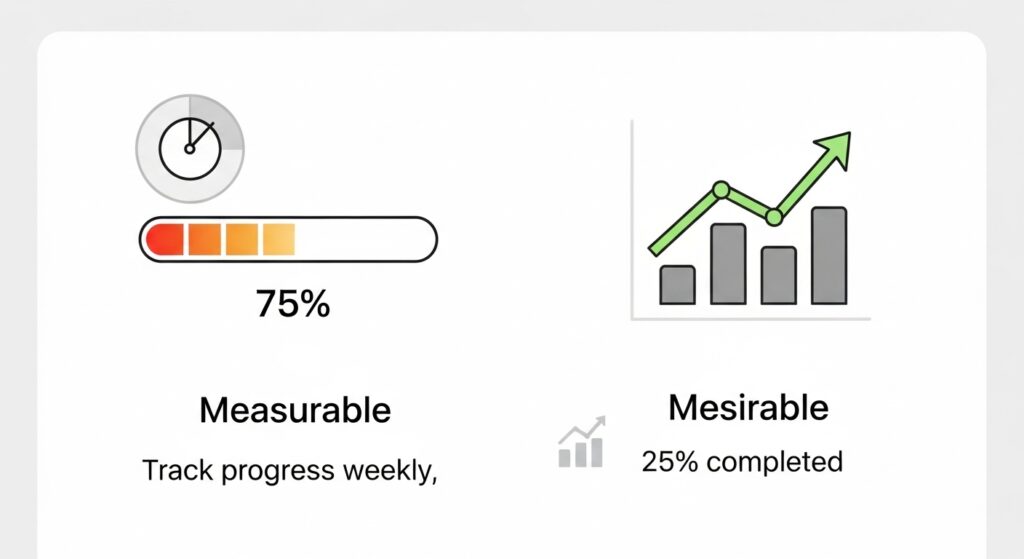
M = Measurable
- Not: “Get better at investing”
- Yes: “Build $100,000 portfolio”
A = Achievable
- Not: “Turn $1K into $1M in one year”
- Yes: “Turn $1K into $10K in five years at 8% return”
R = Relevant
- Not: “Become astronaut” (if you’re 60)
- Yes: “Build financial independence by 50”
T = Time-bound
- Not: “Save for retirement someday”
- Yes: “Accumulate $1M by age 55”
Example: Apply SMART Framework
Vague goal: “Get rich”
SMART goal: “Build $500,000 net worth by December 31, 2035 (age 45) through: (1) saving $600/month, (2) investing at 8% annual return, (3) negotiating annual 5% raises, (4) building $5,000/year side income”
This works because: Specific ($500K), Measurable (can track), Achievable (math checks out), Relevant (realistic for your situation), Time-bound (specific date).
How to Set Goals That Stick
Step-by-step process.
Step 1: Clarify Your Values
Ask yourself:
- What matters most to you?
- What would make you happy?
- What legacy do you want?
- What does success look like?
Common answers:
- Family security
- Freedom/independence
- Comfort/lifestyle
- Helping others
- Building something
Your values shape your goals. Don’t set goals that contradict your values.
Step 2: Assess Your Current Situation
Know where you start:
- Current income: $_______
- Current debt: $_______
- Current savings: $_______
- Current net worth: $_______
- Current expenses: $_______
Why it matters: Can’t plan future without knowing present.
Step 3: Brainstorm Dream Goals
No limits. No judgment.
- What would you do if money wasn’t an issue?
- What would make you proud?
- What would make you feel secure?
- What legacy would you leave?
Write them all down. Don’t filter.
Step 4: Categorize Goals by Timeline
Short-term (1-3 years):
- Emergency fund
- Debt payoff
- First investments
- Skill building
Medium-term (3-10 years):
- Down payment
- Career advancement
- Side business
- Net worth milestones
Long-term (10+ years):
- Retirement
- Wealth building
- Legacy planning
- Financial independence
Step 5: Assign Numbers and Dates
Get specific:
- Goal: $10,000 emergency fund
- Deadline: December 31, 2026
- Monthly requirement: $833/month
Make it measurable.
Step 6: Create Action Plan
How will you achieve it?
Example goal: “Save $10,000 by December 2026”
Action steps:
- Open high-yield savings account (this week)
- Set up automatic transfer $833/month (this week)
- Cut expenses by $100/month (find area to cut)
- Earn extra $200/month (side income)
- Track progress monthly (create spreadsheet)
No goal without plan.
Creating Your Personal Financial Roadmap
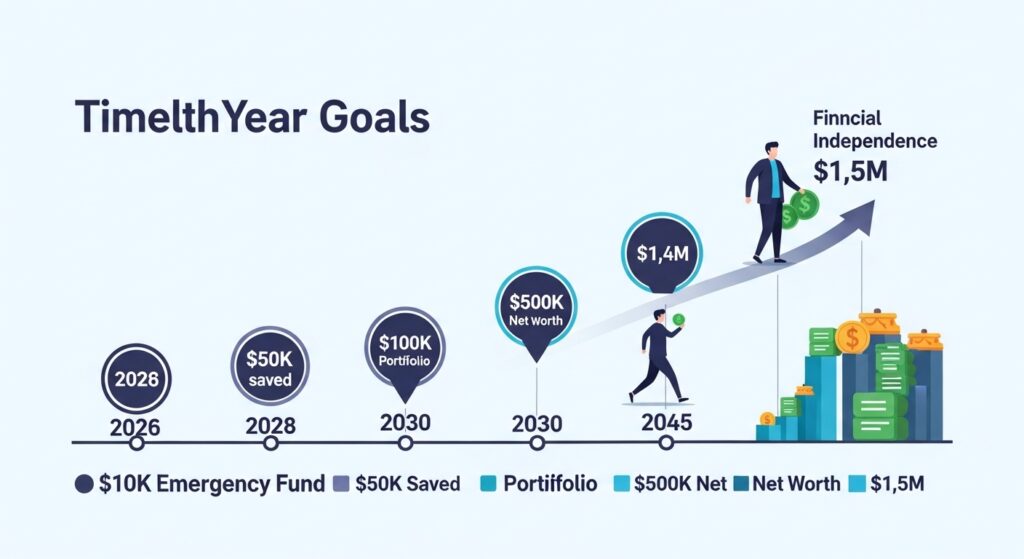
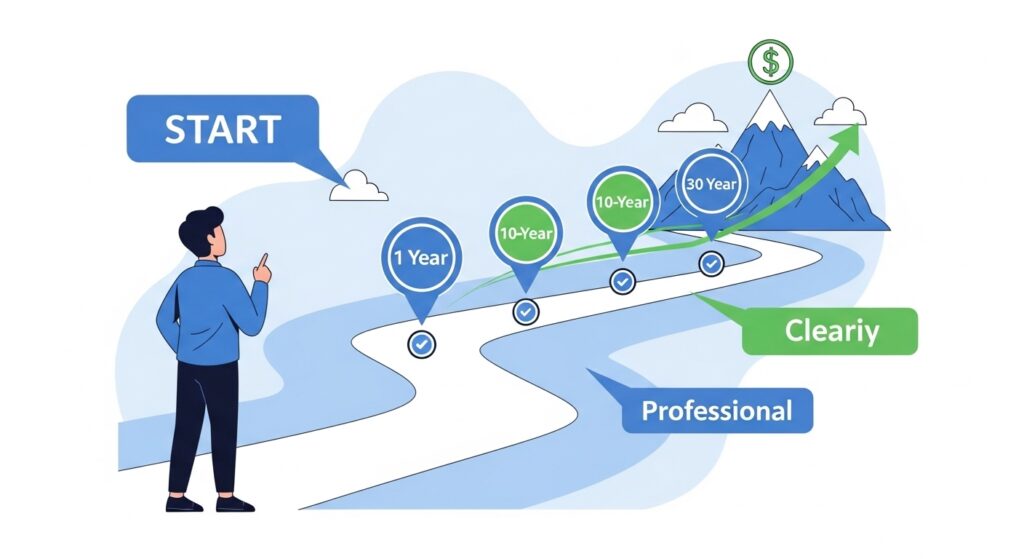
Your complete financial journey visualized.
The Roadmap Template
Age/Year | Goal | Amount | How | Status
Example:
- 2026 | Emergency fund | $10,000 | Save $833/month | In progress
- 2027 | Pay off credit cards | $15,000 | Monthly payments | Not started
- 2028 | Investment portfolio | $25,000 | $300/month investing | Not started
- 2030 | House down payment | $50,000 | Save + side income | Planning phase
- 2035 | Net worth | $500,000 | Consistent investing | Long-term
- 2045 | Financial independence | $1.5M | Portfolio generates income | Vision
Why Visual Roadmap Works
Without roadmap:
- Goals scattered in head
- Easy to forget
- Hard to track progress
- No clear path
With roadmap:
- All goals visible
- Easy to track
- See progress
- Know exactly where you are
Creating Your Roadmap
Action this week:
- Write all your financial goals
- Assign timeline to each
- Assign dollar amount to each
- Create one-page visual roadmap
- Put it somewhere you see daily
You’ll be amazed at clarity this brings.
Short-Term Goals: Build Momentum
Next 1-3 years. Critical for motivation.
Why Short-Term Goals Matter
Psychology:
- Long-term goals feel distant
- Easy to ignore or delay
- Motivation dies after 2 weeks
- Short-term goals give quick wins
Momentum:
- Achieving short-term goal = confidence boost
- Confidence boost = motivation for next goal
- Motivation = action
- Action = results
Best Short-Term Goals
Emergency fund (if missing):
- Target: $5,000-$10,000
- Timeline: 6-12 months
- How: $400-$800/month
High-interest debt payoff:
- Target: Pay off credit cards
- Timeline: 12-24 months
- How: Aggressive payments + cut expenses
First investment:
- Target: $5,000-$10,000 in portfolio
- Timeline: 12 months
- How: $400-$800/month investing
Skill/certification:
- Target: Get certified (for raise)
- Timeline: 6-12 months
- How: Dedicate time + money
Side income launch:
- Target: $500/month extra
- Timeline: 6-12 months
- How: Start small, grow systematically
Why these work:
- All achievable in 1-3 years
- All build foundation for bigger goals
- All give quick wins
- All build momentum
Medium-Term Goals: Strategic Progress
3-10 years. Where real progress happens.
Best Medium-Term Goals
Down payment for house:
- Target: $40,000-$100,000
- Timeline: 5-10 years
- How: Monthly savings + side income
Build investment portfolio:
- Target: $100,000-$250,000
- Timeline: 5-10 years
- How: Dollar-cost averaging + raises invested
Career advancement:
- Target: Promotion, new field, or business
- Timeline: 3-7 years
- How: Education, skill building, networking
Passive income stream:
- Target: $1,000-$5,000/month passive
- Timeline: 5-10 years
- How: Build rental property, investments, or business
Net worth milestone:
- Target: $250,000-$500,000
- Timeline: 5-10 years
- How: Consistent saving + investing
Why these work:
- Achievable but challenging
- Build real wealth
- Give sense of progress
- Create foundational security
Long-Term Goals: Your Legacy
10+ years. Where lifetime vision happens.
Best Long-Term Goals
Retirement/financial independence:
- Target: $1.5M-$3M portfolio
- Timeline: 25-40 years
- How: Consistent investing + raises + compound interest
Generational wealth:
- Target: Leave $500K-$2M to children
- Timeline: 30-50 years
- How: Build wealth + estate planning
Dream lifestyle:
- Target: Work optional by 50/55
- Timeline: 20-30 years
- How: Build passive income + net worth
Legacy business:
- Target: Build business to sell or pass down
- Timeline: 15-30 years
- How: Start now, grow systematically
Charitable impact:
- Target: Donate $X to causes
- Timeline: Varies
- How: Build wealth first, then give
Why these work:
- Give life meaning
- Motivate daily actions
- Create long-term vision
- Build lasting impact
Tracking Progress and Staying Motivated
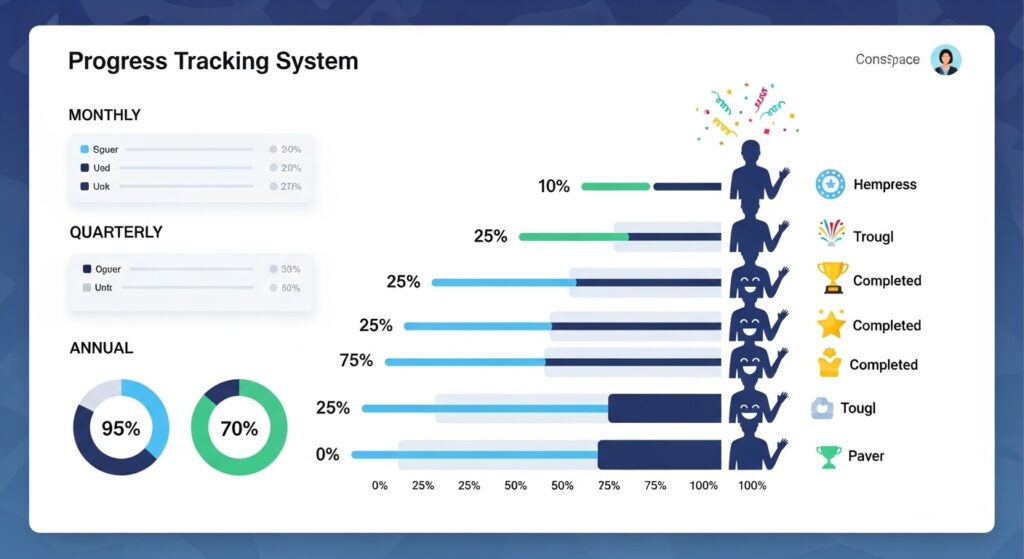
How to maintain momentum for years.
Monthly Review (15 minutes)
First Sunday of each month:
- Check current balance
- Compare to goal
- Calculate % progress
- Celebrate wins (even small)
- Adjust if needed
Example:
- Emergency fund goal: $10,000
- Current: $7,500
- Progress: 75%
- Next month target: $8,333
- Celebration: “We’re 3/4 there!”
Quarterly Review (30 minutes)
Every 3 months:
- Review all goals
- Assess progress on each
- Celebrate completed goals
- Adjust goals if needed
- Plan next quarter actions
Annual Review (1-2 hours)
Every January 1 or December 31:
- Complete comprehensive review
- Celebrate year’s progress
- Analyze what worked/what didn’t
- Set goals for next year
- Update financial roadmap
Motivation Maintenance
To stay motivated 10+ years:
1. Track visible progress
- Spreadsheet showing growth
- Chart showing wealth increase
- Dashboard showing milestones
2. Celebrate every milestone
- Hit $10K goal? Celebrate!
- Hit $50K net worth? Celebrate!
- Don’t wait for big goals
3. Connect goals to lifestyle
- “I’m saving for house” (visualize living there)
- “I’m building retirement” (visualize freedom)
- “I’m creating legacy” (visualize impact)
4. Join community
- Find people with similar goals
- Share progress
- Learn from others
- Stay accountable
Adjusting Goals When Life Changes
Life happens. Goals change. That’s okay.
When to Adjust Goals
Income changes:
- Lost job → Reduce targets temporarily
- Got raise → Increase monthly contributions
- New income → Add new goals
Life changes:
- Got married → Combine goals
- Had children → Adjust timeline
- Health issue → Reassess priorities
- Inheritance → Accelerate goals
Market changes:
- Market crashed → Stay course, don’t panic
- Market soaring → Reassess timeline
- Economy changing → Update strategy
How to Adjust Healthily
Don’t:
- ❌ Abandon goals in panic
- ❌ Become obsessive
- ❌ Ignore changing circumstances
- ❌ Set unrealistic new goals
Do:
- ✅ Reassess quarterly
- ✅ Adjust calmly and rationally
- ✅ Keep core vision, adjust timeline
- ✅ Celebrate progress regardless
Example:
- Original goal: $100K by 2030
- Market crash: Adjust to $85K by 2031
- Still on track, just different timeline
- Continue working plan
Frequently Asked Questions – FAQ 👈
Q: What if I don’t know my goals?
A: Start with one goal. Something you want in next 3 years. Then build from there. Goals become clearer as you progress.
Q: What if my goals seem too far away?
A: Break them into smaller milestones. $1M in 30 years = $667/month at 8% return. Smaller milestone = more achievable.
Q: Should I share my goals with others?
A: Yes! Studies show public goals are more likely to be achieved. Tell family/friends. Creates accountability.
Q: What if I achieve goal early?
A: Celebrate! Then set new goal. If saved $10K emergency fund in 8 months instead of 12, celebrate and immediately start next goal.
Q: How many goals should I have?
A: 3-5 goals maximum. One main goal per timeframe (short/medium/long). Too many = scattered focus.
Q: Should my goals be ambitious or realistic?
A: Both. Ambitious enough to excite you. Realistic enough to achieve. Sweet spot = challenges you but feels possible.
🎥 BONUS
Want to see how real people set and achieve financial goals?
This video shows step-by-step process and success stories:
FINAL THOUGHTS: Your Goals Are Your Map
Here’s what separates people who build wealth from those who don’t:
Poor people have no goals. Rich people have clear ones.
It’s not about how much money they start with. It’s about knowing exactly where they want to go.
With clear goals, suddenly everything makes sense:
- Every dollar saved has PURPOSE
- Every raise negotiated has MEANING
- Every investment decision has CONTEXT
- Every sacrifice is WORTH IT
Without goals, you’re just saving money without knowing why. With goals, you’re building your life.
This is the most important article you’ve read so far.
Not because it teaches you a new technique. But because it ties EVERYTHING together. All the previous articles—about emergency funds, investing, negotiating—they all serve your GOALS.
Your goals are your North Star. Without them, you’re just following someone else’s plan.
For comprehensive financial planning resources and goal-setting guidance, the National Foundation for Credit Counseling provides free information and educational materials.
So stop reading. Start planning.
Write down your goals. Make them specific. Give them deadlines. Create your roadmap.
Your future self will thank you.
INTERESTING TOPICS
Ready to learn how to build an emergency fund as your first goal?
Want to discover how compound interest helps you achieve wealth goals faster?
Need to understand how to invest toward your goals with the right strategy?
Want more financial insights delivered to you? Subscribe to our newsletter
and get weekly articles with practical strategies to grow your wealth sent straight to your inbox.
Obs: Sign up for our newsletter and receive a free Finance For Beginner eBook.
Disclaimer: This article is for educational purposes only. Diversification does not guarantee profits or protect against all losses. Consider your financial situation, risk tolerance, and investment timeline before making investment decisions.
—— End of Article ——