How to Build Emergency Fund: The Complete Step-by-Step Guide
Last updated: February 2026
It’s 2 AM and your phone rings.
Your car broke down. The transmission is shot. The repair bill is $5,000.
Your heart sinks. You have $800 in savings. You have no emergency fund.
Now you’re facing a choice: Credit card debt, family loan, or financial stress?
This is the moment emergency funds exist for.
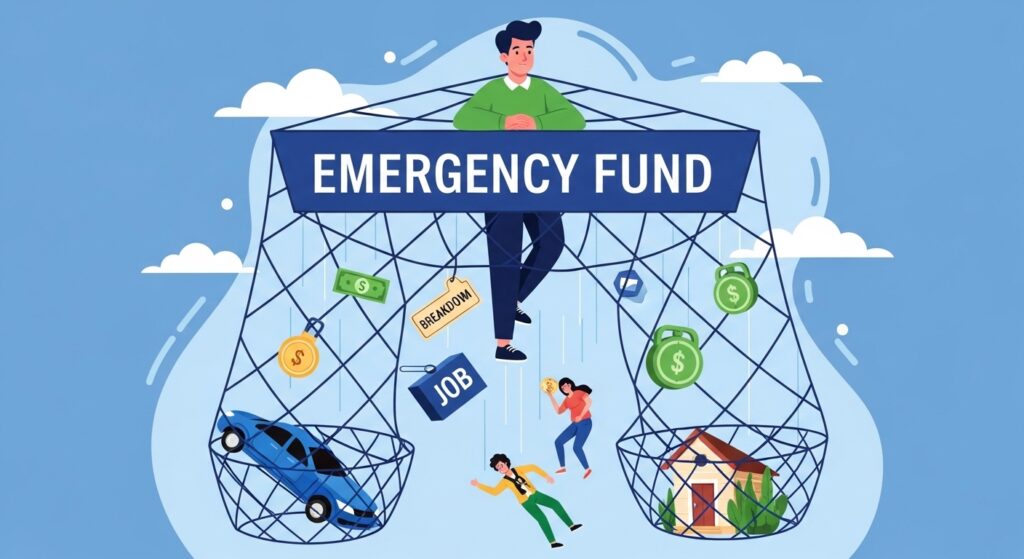
An emergency fund isn’t boring or unnecessary. It’s the difference between a temporary setback and a financial disaster. It’s the safety net that keeps you from derailing your entire wealth-building plan.
But here’s what most people don’t understand: Having an emergency fund is useless if you don’t know HOW to build one.
You know you SHOULD have one. You know you NEED one. But how much? Where do you keep it? How fast should you build it? What counts as an emergency?
These questions paralyze most people, so they never build one at all.
In this guide, you’ll learn exactly what an emergency fund is, why it’s essential before investing, how much you actually need (the real answer, not vague), where to keep your emergency fund, how to build it step-by-step, how to avoid common mistakes, what counts as emergency vs what doesn’t, and how to maintain it once built.
By the end, you’ll have a concrete plan to build your safety net.
Let’s protect your wealth.
What is an Emergency Fund? (And Why It Matters)
An emergency fund is money set aside specifically for unexpected expenses, kept in an easily accessible account, separate from your regular spending money.
In simpler terms: Cash for unexpected bad things.
Why It Exists
Life happens:
- Car breaks down ($2,000-$8,000)
- Medical emergency ($1,000-$10,000+)
- Job loss (months of expenses)
- Home repair ($500-$5,000+)
- Family emergency (unpredictable cost)
Without emergency fund:
- You go into debt
- You derail wealth building
- You stress about finances
- You panic make bad decisions
With emergency fund:
- You cover unexpected costs
- You stay debt-free
- You keep wealth building on track
- You stay calm
The Real Impact
Scenario: Job loss without emergency fund
- Lose job
- No income coming
- Bills still due
- Can’t pay mortgage/rent
- Go into debt
- Takes years to recover
- Wealth building delayed 5+ years
Scenario: Job loss with 6-month emergency fund
- Lose job
- Bills covered for 6 months
- Time to find new job without panic
- No debt incurred
- Resume wealth building
- Crisis becomes temporary inconvenience
Difference: Years of delayed wealth building.
Why Emergency Funds Come BEFORE Investing
Critical rule: Build emergency fund BEFORE aggressive investing.
The Logic
If you invest without emergency fund:
- Emergency happens
- You need money fast
- You must sell investments
- Stock market is down 30% (Murphy’s Law)
- You lock in losses
- You can’t recover
If you have emergency fund:
- Emergency happens
- You use emergency fund
- Investments stay invested
- They keep growing
- You recover from emergency
The Priority Order
1. Minimum emergency fund ($1,000) — Start here 2. Pay off high-interest debt — Credit cards, payday loans 3. Build full emergency fund (3-6 months) — Get to goal 4. Then invest aggressively — Now you’re protected
Do NOT: Skip emergency fund to invest. This backfires.
Real Example
You with $10,000:
Wrong approach:
- Invest all $10,000 in stocks
- Emergency happens (medical bill $3,000)
- Market is down 25%
- You must sell $4,000 of investments to get $3,000
- You lock in losses
- You’re down to $7,000 and still have emergency
Right approach:
- Keep $3,000 in emergency fund
- Invest $7,000 in stocks
- Emergency happens
- You use emergency fund ($3,000)
- Investments stay invested and keep growing
- You’re protected
Difference: Hundreds or thousands in losses avoided.
How Much Do You Actually Need?
This is where most advice gets vague. Let me be specific.
The Standard Answer
Financial experts recommend: 3-6 months of expenses
But what does that mean?
The Real Calculation
Step 1: Calculate your monthly expenses
Add up ALL monthly costs:
- Rent/mortgage
- Utilities
- Food
- Insurance
- Transportation
- Phone
- Subscriptions
- Everything else
Example:
- Rent: $1,200
- Utilities: $150
- Food: $400
- Insurance: $200
- Transportation: $150
- Other: $200
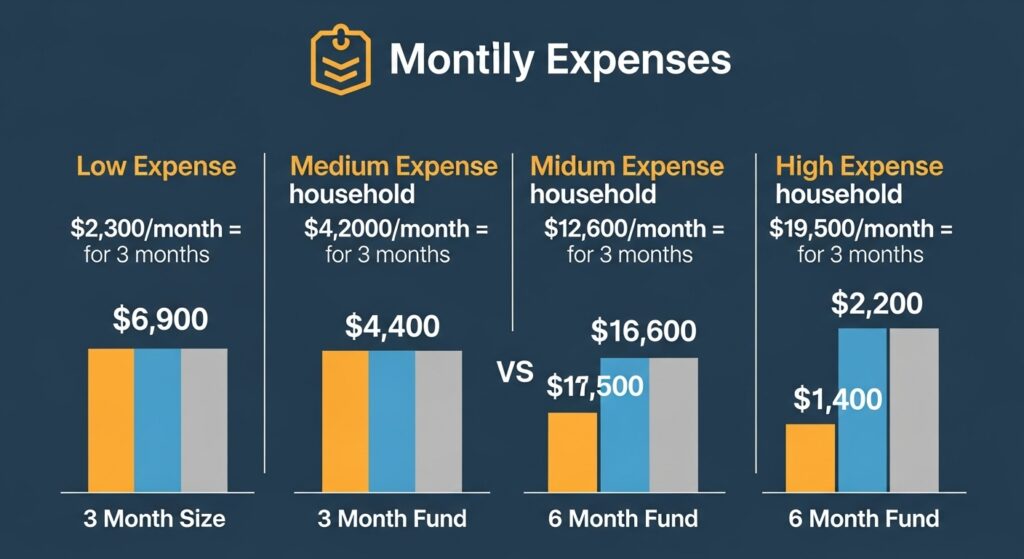
- Total monthly: $2,300
Step 2: Multiply by 3-6 months
Conservative (3 months):
- $2,300 × 3 = $6,900
Recommended (6 months):
- $2,300 × 6 = $13,800
Step 3: Pick your target
Who should aim for 3 months:
- Stable, secure job
- Dual income household
- Low expenses
- Young and flexible
Who should aim for 6 months:
- Self-employed
- Single income household
- Higher expenses
- Multiple dependents
- Industry at risk of layoffs
- Older (recovery harder if job lost)
Real Numbers by Income Level
$50,000/year income:
- Monthly expenses: ~$2,500-$3,000
- 3-month fund: $7,500-$9,000
- 6-month fund: $15,000-$18,000
$75,000/year income:
- Monthly expenses: ~$3,500-$4,500
- 3-month fund: $10,500-$13,500
- 6-month fund: $21,000-$27,000
$100,000/year income:
- Monthly expenses: ~$5,000-$6,500
- 3-month fund: $15,000-$19,500
- 6-month fund: $30,000-$39,000
The Honest Truth
Most people have ZERO emergency fund.
Starting with $1,000 is better than perfect $6,900. Having $5,000 is better than having zero. Progress beats perfection.
Where to Keep Your Emergency Fund
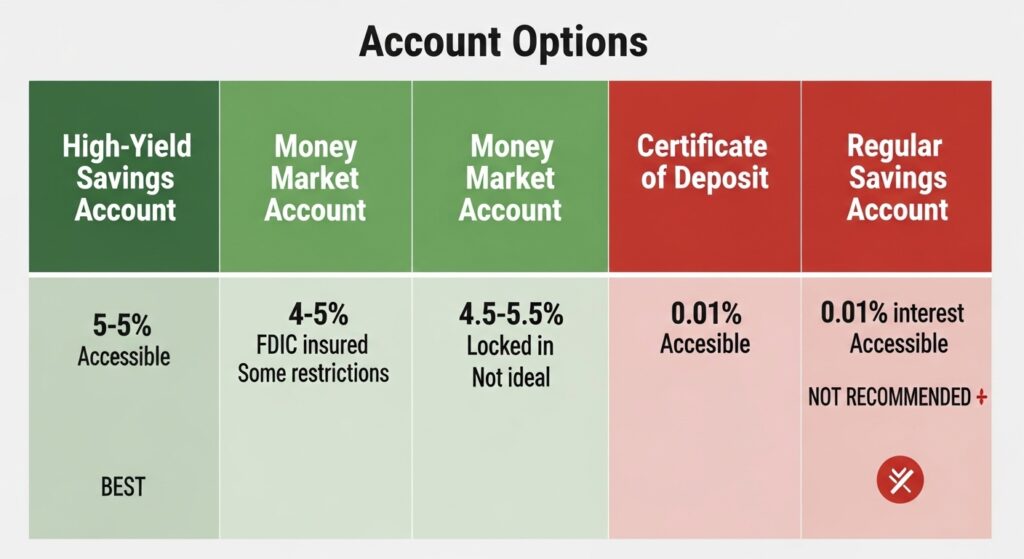
Critical rule: NOT in stocks. NOT in long-term investments. In CASH or CASH EQUIVALENT.
Option 1: High-Yield Savings Account (BEST)
What it is: Savings account with competitive interest rate
Interest rate: 4-5% annually (2026 rates)
Why it’s best:
- Completely safe (FDIC insured)
- Earns interest (beats inflation slightly)
- Accessible (withdraw anytime)
- No risk whatsoever
- No fees if you find right bank
Banks offering high-yield savings:
- Marcus by Goldman Sachs
- Ally Bank
- American Express Personal Savings
- Discover Bank
The Federal Deposit Insurance Corporation provides information about account protection and which banks offer FDIC insurance for your emergency fund safety.
Example: $10,000 at 4.5% = $450/year interest (better than 0%)
Option 2: Money Market Account
What it is: Hybrid between checking and savings
Interest rate: 4-5% annually
Pros:
- FDIC insured
- Earns interest
- Check-writing available
- More accessible than savings
Cons:
- May require higher minimum
- Limited check-writing
Option 3: Certificate of Deposit (CD)
What it is: Fixed-term savings with guaranteed rate
Interest rate: 4-5.5% annually
Pros:
- FDIC insured
- Highest interest rates
- Guaranteed return
Cons:
- Money locked in for term (3, 6, 12 months)
- Penalty if withdraw early
- Not ideal for emergency (need to access NOW)
Use for: Part of emergency fund after you exceed 3-month goal
Option 4: Regular Savings Account (NOT IDEAL)
What it is: Standard bank savings account
Interest rate: 0.01% – 0.05% (pathetic)
Pros:
- Accessible
- FDIC insured
Cons:
- Almost zero interest
- Losing money to inflation
- Only use if no other option
❌ Where NOT to Keep Emergency Fund
❌ Checking account — Too tempting to spend
❌ Stocks/investments — Not accessible, too risky
❌ Crypto — Way too volatile
❌ Under your mattress — No interest, not safe
❌ Tied up in long-term CD — Can’t access in emergency
Keep it LIQUID and SAFE.
The Complete Step-by-Step Building Plan
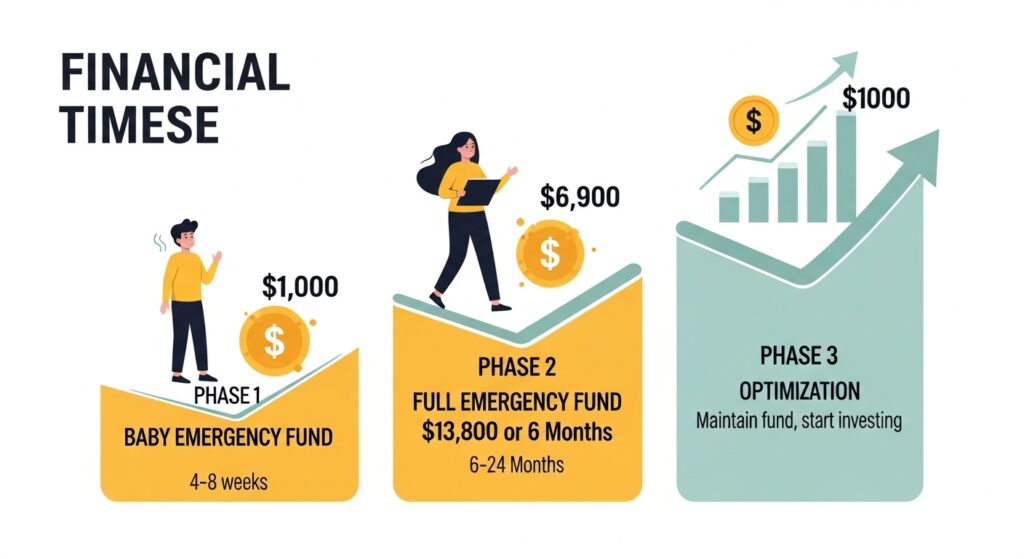
Exact plan to build your emergency fund.
Phase 1: Baby Emergency Fund ($1,000)
Why start with $1,000:
- Covers most common emergencies
- Builds confidence
- Gives psychological boost
- Takes weeks, not months
How to build:
- Set goal: Save $1,000
- Timeline: 4-8 weeks (doable!)
- Method: Cut expenses or side income
- Place: High-yield savings account
Example:
- Current: $200 saved
- Target: $1,000
- Gap: $800
- Monthly goal: $200/month
- Timeline: 4 months
Once you hit $1,000: Celebrate! You’re protected from most emergencies.
Phase 2: Full Emergency Fund (3-6 months)
After baby fund is built:
Decision: 3 months or 6 months?
- Secure job? → 3 months ($6,900 example)
- Self-employed? → 6 months ($13,800 example)
How to build:
- Continue monthly savings
- Direct percentage of income to fund
- Example: 10% of paycheck goes to emergency fund
- Don’t touch baby fund (already safe)
Timeline:
- $1,000 baby fund already done
- Building to $6,900 (3-month goal)
- Need $5,900 more
- At $200/month: 30 months
- At $400/month: 15 months
- At $600/month: 10 months
Speed depends on income and discipline.
Phase 3: Optimization (After Fund Built)
Once you have 3-6 month fund:
Option A: Keep building to 6 months (if only at 3)
- Continue saving monthly
- Grow fund gradually
Option B: Start investing (if at 6 months)
- Emergency fund is complete
- Now invest additional money
- Dollar-cost averaging into diversified portfolio
Option C: Split approach (hybrid)
- 6 months in savings account
- Additional savings go to investments
- Best of both worlds
How Fast Should You Build It?
It depends on your situation.
Timeline by Situation
Urgent (Build in 3-6 months):
- You have zero emergency fund
- You just started job
- You’re terrified of emergency
- Action: Aggressive saving, side income
Normal (Build in 6-12 months):
- You have some savings
- Stable job
- Normal expenses
- Action: Steady monthly savings
Comfortable (Build in 12-24 months):
- You already have $3,000+
- Multiple income streams
- Can contribute slowly
- Action: Consistent monthly savings
The Math by Monthly Contribution
$1,000 baby fund target:
- $100/month: 10 months
- $200/month: 5 months
- $300/month: 3-4 months
$6,900 full fund target (3 months):
- $200/month: 35 months (3 years)
- $300/month: 23 months (2 years)
- $500/month: 14 months (1 year)
- $700/month: 10 months
$13,800 full fund target (6 months):
- $500/month: 28 months (2+ years)
- $700/month: 20 months
- $1,000/month: 14 months
Real talk: Even at $200/month, you can build full emergency fund in 3-4 years. That’s acceptable.
What Counts As an Emergency?
Clear guidelines on what IS emergency.
✅ REAL Emergencies
Medical:
- Unexpected surgery
- Emergency room visit
- Urgent care
- Prescription medications
- Dental emergency
Job/Income:
- Job loss (covered by fund)
- Unexpected furlough
- Business failure
- Disability/injury preventing work
Home:
- Major home repair (furnace, roof, plumbing)
- Sudden appliance failure (water heater)
- Structural damage
- Urgent safety issue
Car:
- Engine failure
- Transmission issue
- Accident (after insurance)
- Urgent safety repair
Family:
- Death in family (travel costs)
- Family emergency (helping relative)
- Unexpected dependent needs
What Does NOT Count As Emergency
These are NOT emergencies. Don’t use fund for these.
❌ FAKE Emergencies
Wants, not needs:
- ❌ New phone (old one still works)
- ❌ Vacation (fun but not emergency)
- ❌ New car (current one works)
- ❌ Designer clothes
- ❌ Concert tickets
- ❌ Gaming computer
Planned expenses:
- ❌ Annual car insurance
- ❌ Holiday gifts
- ❌ Back-to-school shopping
- ❌ Wedding (you’re planning it)
- ❌ Predictable expenses
Impulse purchases:
- ❌ Retail therapy
- ❌ Food cravings
- ❌ Subscription you want
- ❌ Upgrade you feel like getting
Debt payments:
- ❌ Credit card payment (use regular income)
- ❌ Loan payment (use regular income)
- ❌ Don’t use emergency fund for normal debt
Financial mistakes:
- ❌ Investment loss
- ❌ Bad decision
- ❌ Expensive habit
Rule of thumb: If you can plan for it or avoid it, it’s not emergency.
Maintaining Your Emergency Fund
Once built, how to maintain it.
Rule 1: Don’t Touch It Unless REAL Emergency
The hardest rule to follow.
Temptations you’ll face:
- “I can use it for this investment!”
- “I’ll rebuild it later”
- “This is kind of an emergency”
- “I need just $500 of it”
Don’t. Do. This.
The moment you tap it for non-emergency, it stops being emergency fund and becomes available money. You’ll keep tapping it.
Keep it sacred.
Rule 2: Replenish After Using
If you use emergency fund:
- Acknowledge the emergency was real
- Access funds you need
- Don’t feel guilty (that’s why it exists!)
- Rebuild it ASAP
Example:
- Medical emergency costs $3,000
- You had $6,900 fund
- Now have $3,900
- Rebuild to $6,900 at $300/month
- Takes 10 months to replenish
Rule 3: Review Annually
Once per year:
- Check balance
- Verify it’s still adequate
- Adjust if income changed
- Move to better rate if available
Example:
- Built 3-month fund when earning $50K
- Now earning $75K
- Expenses higher
- May need to bump to 6 months
- Update goal
Rule 4: Keep It Accessible
Verify anytime:
- Emergency fund account accessible
- Can withdraw in 1-2 business days
- Not locked in long-term CD
- Not in illiquid investments
Test it: Once per year, verify you can access it within 24-48 hours.
Common Mistakes to Avoid
Learn from others’ mistakes.
❌ Mistake 1: No Emergency Fund at All
The cost:
- Emergency happens
- Go into debt
- Years of financial stress
- Derails wealth building
Solution: Start with $1,000 today. Right now.
❌ Mistake 2: Fund Too Small
The problem:
- $500 emergency fund
- Car repair costs $2,000
- Still need to go into debt
- Fund was almost useless
Solution: Aim for at least 3 months expenses. Real protection.
❌ Mistake 3: Money in Wrong Place
The problem:
- Keep emergency fund in stocks
- Emergency happens
- Market is down 30%
- Lose money getting your money
- Defeat the purpose
Solution: High-yield savings account. Safe, accessible, earning interest.
❌ Mistake 4: Keep Tapping It for Non-Emergency
The problem:
- “Need new phone”
- Tap emergency fund
- “Rebuild it later”
- Never rebuild
- Then real emergency hits, no fund
Solution: Strict definition of emergency. Don’t tap it.
❌ Mistake 5: Never Building Beyond 1-2 Months
The problem:
- $2,000 fund
- Job loss (3 months to find new job)
- Fund gone in 2 months
- Still unemployed, no money
- Financial crisis
Solution: Build to full 3-6 months. Takes time but critical.
❌ Mistake 6: Ignoring It After Building
The problem:
- Build $10,000 fund in 2020
- Never check it again
- Inflation happens
- $10,000 is now worth less
- Needs adjustment
Solution: Review annually, adjust as needed.
Frequently Asked Questions – FAQ 👈
Q: Should I build emergency fund or pay off debt first?
A: Build $1,000 baby fund first. Then pay off high-interest debt (credit cards). Then build full emergency fund. Then invest. Order matters.
Q: What if I don’t have extra money to save?
A: Everyone has money to redirect. Cut one subscription ($15/month = $180/year toward fund). Pack lunch instead of buying ($10/day = $2,000/year). Small changes add up.
Q: Can I invest my emergency fund to make it grow?
A: No. Emergency fund is NOT investment. Keep it safe and accessible. Invest money AFTER emergency fund is full. Separate purposes.
Q: How often should I add to emergency fund?
A: Every paycheck. Automatic transfer from checking to savings account. Same day you get paid. Automation removes the decision.
Q: What if I use emergency fund but don’t refill it?
A: You’re vulnerable again. Rebuild it to priority #1. Don’t invest extra money until replenished.
Q: Is 6 months really necessary?
A: For most people, 3 months is adequate. 6 months if self-employed, at risk of job loss, or multiple dependents.
Q: Should emergency fund earn interest?
A: Yes. High-yield savings at 4-5% beats inflation. Every bit helps.
Q: What about emergency line of credit instead?
A: Bad idea. Relies on credit being available when you need it. During crisis, credit dries up. Cash emergency fund is certain.
🎥 BONUS
Want to see real examples of emergency fund calculations and step-by-step building process?
This video shows people building funds from zero and managing them:
FINAL THOUGTS: Your Emergency Fund is Your Foundation
Here’s what most people don’t realize: Your emergency fund isn’t boring or unnecessary. It’s actually your MOST IMPORTANT financial tool.
Why? Because it protects everything else.
Without it, one bad emergency derails your entire wealth-building plan. You go into debt. You have to sell investments at losses. You stress about finances. You give up on your goals.
With it, emergencies become temporary inconveniences instead of financial disasters.
The wealthy all have emergency funds. Not because they’re paranoid. But because they understand that protection comes first, growth comes second.
Your path to wealth doesn’t start with investing. It starts with this: A fully-funded emergency fund.
Once you have that, THEN you invest aggressively. THEN you build serious wealth. THEN you sleep peacefully knowing you’re protected.
Your action this week:
- Calculate your monthly expenses
- Multiply by 3 (goal: 3-month fund)
- Open high-yield savings account
- Set up automatic transfer ($200/month minimum)
- Stop checking it unless real emergency
That’s it. You just started building your financial fortress.
The Consumer Financial Protection Bureau provides guidance on savings accounts, managing finances during emergencies, and building financial security.
INTERESTING TOPICS
Ready to learn how to invest aggressively once your emergency fund is complete?
Want to understand how market crashes won’t derail you because you have this fund?
Need to discover how to avoid get-rich-quick schemes and focus on real wealth building instead?
Want more financial insights delivered to you? Subscribe to our newsletter
and get weekly articles with practical strategies to grow your wealth sent straight to your inbox.
Obs: Sign up for our newsletter and receive a free Finance For Beginner eBook.
Disclaimer: This article is for educational purposes only. Diversification does not guarantee profits or protect against all losses. Consider your financial situation, risk tolerance, and investment timeline before making investment decisions.
—— End of Article ——