How to Negotiate a Raise: The Strategic Guide to Increasing Your Income
Last updated: February 2026
You’re sitting across from your boss.
Your heart is pounding. Your palms are sweating. You’re about to ask for something you want but are terrified to ask for.
A raise.
“I’ve been here three years. I’ve contributed a lot. I deserve more money. But what if they say no? What if they get mad? What if they fire me?”
These fears paralyze most people. So they never ask. They accept the same salary year after year. They watch inflation erode their buying power. They fall behind financially while their boss wonders why they’re not asking.
Here’s what you need to know: Your boss expects you to negotiate.
They don’t think you’re greedy for asking. They think you’re WEAK if you don’t. In the business world, asking for more money is normal. Expected, even.
The difference between someone who gets rich and someone who stays broke often comes down to this: One asks for raises. One doesn’t.
A $5,000 raise per year sounds small. Over 30 years, that’s $150,000 MORE in income. Invested at 8% return, that becomes $500,000+ in retirement wealth.
In this guide, you’ll learn exactly why you should negotiate, how to prepare your case, the perfect timing to ask, what to say (word for word), how to handle objections, what to do if they say no, how to negotiate dollar-cost averaging into raises, and most importantly—how to overcome the fear.
By the end, you’ll confidently ask for what you deserve.
Let’s get you paid more.
Why Negotiating Is Non-Negotiable
Most people never ask for a raise. This is a massive financial mistake.
The Numbers Reality
You at $50,000/year:
- No negotiation: $50,000/year forever (if you don’t switch jobs)
- With negotiation: $52,500 → $55,000 → $58,000 (progressive raises)
- 10 years difference: ~$150,000 MORE income
That’s house money. That’s retirement money. That’s wealth.
And it started with asking.
Why Companies Expect Negotiation
Here’s what companies know:
- They budget for raises
- They expect good employees to ask
- They’re prepared to negotiate
- If you don’t ask, they pocket the money
- Asking doesn’t hurt your job security (in healthy companies)
If asking for a raise gets you fired, you work for a bad company anyway. You should leave.
The Compounding Effect
Year 1: Ask for $5,000 raise
- New salary: $55,000
Year 3: Ask for another $5,000 raise
- New salary: $60,000
Year 5: Ask for $8,000 raise (bigger role)
- New salary: $68,000
Year 10: Career progression with negotiation
- Salary: $90,000+
Without negotiation:
- Stuck at $50,000
- $150,000+ behind
This is how wealth building actually starts: With your income.
The Biggest Mistake People Make
Most people negotiate TOO LATE.
The Common Timeline (WRONG)
Year 1: Hired at $50,000
- “I’ll prove myself first, then ask”
Year 2: Still $50,000
- “Maybe I’ll ask next year”
Year 3: Still $50,000
- “I’ve been here three years, I DESERVE a raise!”
- Finally asks (weak position)
- Gets 2% ($1,000)
- Barely covers inflation
Result: Lost income by waiting.
The Strategic Timeline (RIGHT)
Year 1: Hired at $50,000
- First 90 days: Learn the role, prove competence
- Month 4-6: Start documenting achievements
- Month 8-10: Request review meeting
- First raise: 5-10% increase ($2,500-$5,000)
Year 2: Now $52,500-$55,000
- Continue strong performance
- Request second review at 18-month mark
- Second raise: 4-6% increase ($2,100-$3,300)
Year 3: Now $55,000-$58,000
- By now, you’re solid performer
- Easier to ask, more justified
- Third raise: 5-8% increase
Result: Compounding raises = significantly higher income.**
Why Waiting Backfires
The psychology:
- Waiting = appearing weak
- Asking year 3 = looks like demand, not discussion
- Asking year 1 = looks like ambition, confidence
The finances:
- Waiting = inflation eats raises
- Early raises = compound for years
- Year 1 raise at 5% vs Year 3 raise at 5% ≠ same wealth
How Much Should You Ask For?
This is where most people under-ask.
The Market Research Phase
Before asking, research:
1. Market rate for your role
- Glassdoor.com (salary transparency)
- PayScale.com (detailed salary data)
- LinkedIn Salary (role-based data)
- BLS.gov (government wage data)
For detailed salary data by role, location, and experience level, Glassdoor provides comprehensive market research to support your negotiation.
Example:
- Your role: “Marketing Manager”
- Location: “Denver, Colorado”
- Experience: “3 years”
- Market rate: $65,000-$75,000
- Your current: $55,000
- Gap: $10,000-$20,000 UNDERVALUED
2. Your company’s position
- Is company profitable? (raises more likely)
- How’s industry doing? (context matters)
- What’s typical raise % in your company?
3. Your specific performance
- Are you exceeding expectations?
- Have you taken on new responsibilities?
- Do you have metrics showing impact?
The Ask Formula
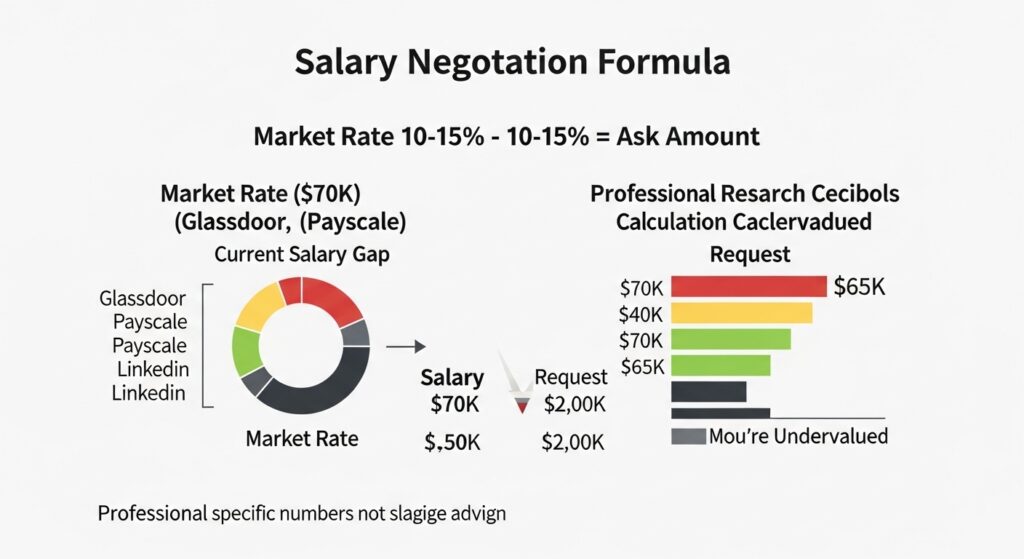
Formula: Market Rate – 10-15% = Your Ask
Why 10-15% below market?
- Shows you’re reasonable
- Gives them room to negotiate
- But still gets you raises
- Keeps goodwill intact
Example:
- Market rate: $70,000
- You ask: $65,000 (7% below)
- They counter: $62,500
- You negotiate to: $64,000
- Result: Better than current $55,000
Alternative: Ask for percentage
- “I’m requesting a 10% raise”
- From $55,000 = $60,500
- Clearer, sometimes easier
The Minimum Ask
Never ask for less than:
- Inflation rate + 2%
- Example: Inflation 3% + 2% = ask for 5% minimum
- If not, you’re getting a pay CUT in real terms
The Preparation Phase: Building Your Case
Your boss needs reasons. Provide them.
Document Your Value
Create a file with:
- Projects you led (with results)
- Problems you solved (with impact)
- Revenue/savings impact (specific numbers)
- Additional responsibilities taken
- Skills developed
- Promotions/expanded role
Example format:
- “Led Q4 marketing campaign: Generated $250K in revenue”
- “Streamlined process: Saved company 10 hours/week”
- “Trained 3 new team members”
- “Took on social media management (new responsibility)”
- “Got Google Analytics certification (new skill)”
The Presentation Deck
Create 1-page summary:
- Title: “Career Development Conversation”
- 5-7 bullet points of achievements
- Market rate research (if comfortable sharing)
- Your request (specific number)
- Timeline (when you need answer)
This isn’t confrontational. It’s professional.
Practice Your Talking Points
Say these out loud:
- “I’ve contributed significantly to X, Y, Z”
- “Market rate for this role in our area is $X-Y”
- “I’m requesting a raise to $Z to align with market”
- “I’m committed to continuing to deliver results”
- “I’d like to know your thoughts”
Practice removes nervousness.
Perfect Timing: When to Ask
Timing matters more than you think.
✅ GOOD Timing
After completing major project:
- You just shipped big initiative
- Impact is obvious
- Momentum is on your side
During performance review:
- Formal review meeting scheduled
- Explicitly for discussing performance
- Builds naturally into discussion
During company growth:
- Company just got funding
- Hired new people
- Revenue up significantly
After taking on new role/responsibilities:
- You expanded your job
- New projects assigned
- Clear value addition
When you have job offer:
- Other company wants you
- You have leverage
- Current employer wants to retain
❌ BAD Timing
❌ Right after company layoffs
- Focus is on retention, not raises
- “Why should we give raises when laying off?”
❌ Right before company earnings report
- Unknown if year was good
- Wait until results known
❌ During economic downturn
- Companies cutting costs
- Wrong market conditions
❌ In casual passing
- Deserves formal discussion
- Schedule proper meeting
❌ While you’re stressed/emotional
- You’ll negotiate poorly
- Might say wrong thing
- Appears unprofessional
❌ Right after mistake/problem
- Wait until that’s resolved
- Timing looks bad
The Perfect Window
Best scenario: 6-12 months after hire/last raise + positive project completion + during scheduled review
The Conversation: What to Say
Word for word script to follow.
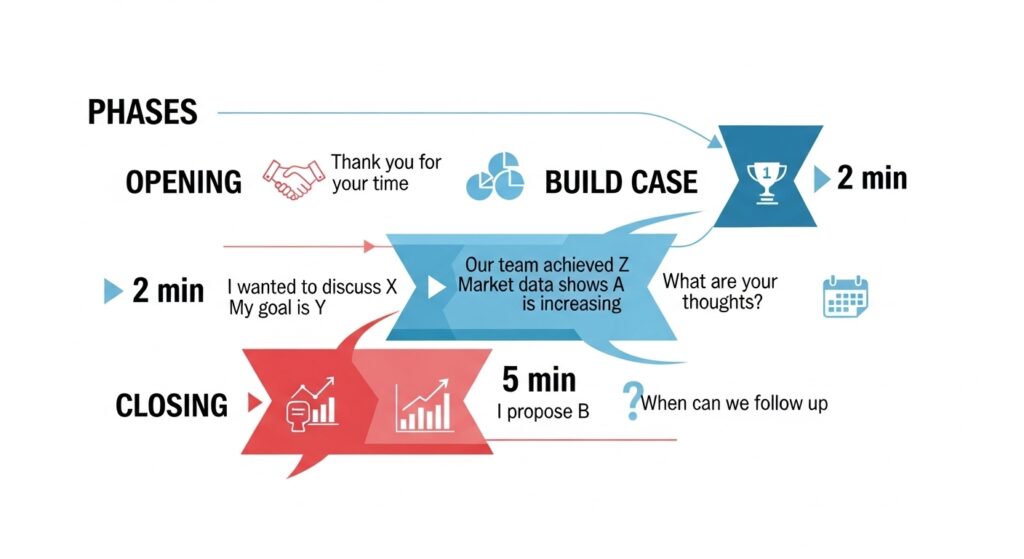
Opening (First 2 minutes)
You: “Thanks for taking the time to meet. I wanted to discuss my compensation. I’ve been here [X years/months] and have really enjoyed contributing to the team. I’d like to talk about my salary.”
This: Shows gratitude, states purpose, explains you enjoy it
The Case (Next 5 minutes)
You: “I’ve contributed significantly in several ways:
First, I led [project] which resulted in [measurable outcome].
Second, I’ve taken on [additional responsibility] beyond my original role.
Third, I’ve developed [new skill] which benefits the team.
Based on market research, the range for this role in our area is $X-Y. I’m requesting a raise to $[specific number], which is below market but reflects my current contribution level. This would bring me closer to market rate.”
This: Shows specific value, cites market data, makes reasonable ask
Closing (Final 2 minutes)
You: “I’m committed to continuing to deliver strong results. I’d like to know your thoughts on this request. Can we discuss timing and next steps?”
This: Reaffirms commitment, asks for response, moves to decision
Then STOP TALKING. Let them respond. Silence is powerful.
Handling Objections and “No”
They might not say yes immediately.
Objection 1: “We don’t have budget”
Your response: “I understand budget constraints. What would need to happen for us to revisit this in [3 months]? What metrics or milestones would justify the raise?”
Strategy: Get commitment to future discussion with clear criteria.
Objection 2: “You’re already paid well for your level”
Your response: “I appreciate that. Based on market data, comparable roles in our area are $X-Y. How would you suggest I get to market rate?”
Strategy: Acknowledge but cite data. Ask for plan.
Objection 3: “We can only offer 2%”
Your response: “I appreciate the offer. That’s below inflation. Could we discuss [X] to make this work? Is there flexibility on timing or performance metrics that would unlock the raise I’m requesting?”
Strategy: Don’t accept low offer. Negotiate or delay.
Objection 4: “Now’s not the right time”
Your response: “I understand. When would be a good time to revisit this conversation? [3 months? 6 months?] I’d like to have a timeline so we can both prepare.”
Strategy: Get specific timeline, not vague “later.”
If They Say Flat “No”
Response options:
Option 1: Accept with timeline
- “Okay, I understand. Can we revisit this in 6 months?”
- “What would need to change for this to be possible?”
Option 2: Accept with conditions
- “What if I [new project/skill]? Would that change things?”
- “What specific metrics would justify a raise?”
Option 3: Start job searching
- If they definitively won’t raise you AND you’re below market
- You vote with your feet
- Other companies will pay you more
If They Say Yes: Lock It In
Get it in writing immediately.
What You Need
In writing:
- New salary (specific number)
- Effective date (when it starts)
- Any conditions (if applicable)
- Next review date (for future raises)
Email confirmation: “Thanks for approving my raise. Just to confirm: My new salary is $[X], effective [date]. Next review is [date]. I’m excited to continue delivering results.”
This prevents: Miscommunication, confusion, memory gaps.
The Follow-Up
During next 3 months:
- Deliver exceptional work
- Prove you earned it
- Build case for next raise
If They Say No: Your Options
Option 1: Accept and Plan for Next Raise
If no is firm but company is good:
- Accept decision gracefully
- Ask when next review is
- Plan for next raise attempt
- Continue strong performance
Timeline: Try again in 6-12 months
Option 2: Negotiate Alternative Compensation
If cash raise isn’t available:
- Remote work option (saves commute cost)
- Extra vacation days (worth money)
- Flexible schedule (quality of life)
- Professional development budget (investment in you)
- Bonus structure (tied to performance)
These have real value.
Option 3: Job Search
If no is definitive and you’re below market:
- Start looking for new job
- Other companies will pay more
- You weren’t going to get raise here
- Switching jobs is how most people get big raises
Truth: Statistically, external hires get 10-20% more than internal promotions.
Using Raises to Build Wealth
This is where it matters.
The Wealth-Building Strategy
When you get raise, don’t spend it.
Example:
- Current: $55,000/year
- Get raise: $60,000/year
- Raise amount: $5,000/year ($417/month)
Wrong approach: Spend the extra $417/month
- You’re back to living paycheck-to-paycheck
- No wealth building benefit
Right approach: Invest the raise
- Automatic transfer: $417/month → Roth IRA
- You live on $55,000 (your old salary)
- Raise goes straight to wealth building
Result:
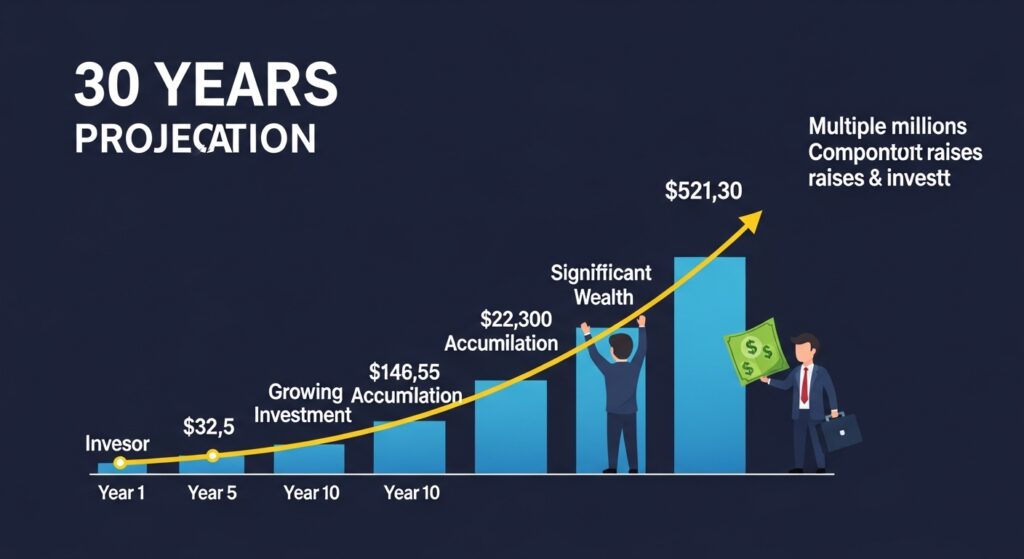
- $417/month × 12 = $5,000/year invested
- At 8% return over 30 years = $621,000+
- Raise turned into retirement wealth
The Compounding Raise Strategy
Year 1: $55,000 → $60,000 raise
- Invest $417/month (the raise)
Year 3: $60,000 → $65,000 raise
- Invest $417/month (old raise)
- Invest $208/month (new raise)
- Total: $625/month invested
Year 5: $65,000 → $70,000 raise
- Investing increases amount
- Compounding accelerates
Result after 30 years: Multiple millions from capturing every raise.
This is how serious wealth building works.
Frequently Asked Questions – FAQ 👈
Q: Will asking for a raise get me fired?
A: In legitimate companies, no. Asking for market-rate compensation is normal. If asking gets you fired, you work for bad company and should leave anyway.
Q: How often should I ask for raises?
A: Annually at minimum. Some companies do raises on anniversaries. Some during reviews. Every 12-18 months is standard to ask.
Q: Should I mention other job offers?
A: Only if you have actual offer. Then: “I’ve been approached by [company] with offer of $X. I prefer to stay here if we can discuss my compensation.”
Q: What if I’m self-employed?
A: You negotiate with clients. Raise your rates 5-10% annually. Most clients will stay. Some will leave, new ones at higher rates replace them.
Q: Is it awkward to ask?
A: Yes. Do it anyway. Awkward for 10 minutes beats underpaid for years.
Q: What if I’m newer to the role?
A: Wait 6-12 months. Prove competence. Then ask. You have more power after track record.
Q: Should I ask during group meeting or one-on-one?
A: Always one-on-one. Private, professional conversation.
🎥 BONUS
Want to see real negotiation conversations and hear actual scripts people used successfully?
This video shows real-world examples and what works:
FI NAL THOUGHTS: Your Income is Your Responsibility
Here’s what separates people who build wealth from those who don’t:
Wealthy people negotiate.
They don’t leave raises on the table. They don’t accept less than market rate. They don’t hope their boss notices their value.
They ASK.
Your boss is not responsible for your wealth. Your company is not responsible for your retirement. Your paycheck is your responsibility.
Every raise you negotiate is wealth building. Every year you don’t ask is wealth lost. It’s not about greed—it’s about self-respect and financial responsibility.
The Bureau of Labor Statistics provides wage and employment data to help you understand market rates and industry salary trends.
You’ve already done the hard part: You work hard, you deliver value, you earn your keep.
Now ask for what you deserve.
The worst they can say is no. And if they say no, you know it’s time to find a company that values you.
But most will say yes, if you ask right.
INTERESTING TOPICS
Ready to learn how to build an emergency fund to protect your increased income?
Want to discover how to invest your raises wisely for maximum wealth growth?
Need to understand how compound interest multiplies your raises into retirement wealth?
Want more financial insights delivered to you? Subscribe to our newsletter
and get weekly articles with practical strategies to grow your wealth sent straight to your inbox.
Obs: Sign up for our newsletter and receive a free Finance For Beginner eBook.
Disclaimer: This article is for educational purposes only and should not be considered financial advice. Budgeting approaches should be tailored to individual circumstances, income levels, and financial goals. The examples provided are for illustrative purposes and may not reflect your specific situation. The 50/30/20 rule is a guideline and may need adjustment based on your cost of living, debt obligations, and personal priorities. Consider consulting with a financial advisor for personalized guidance on managing your finances and creating a budget that works for your unique situation.
—— End of Article ——