How to Start Investing With $100
Last updated: December 2025
Starting your investment journey can feel intimidating — especially if you believe you need thousands of dollars to begin. But the truth is far more encouraging: you can start investing with as little as $100, and that small seed can become the foundation of long-term wealth.
In this guide, we break down a simple, realistic strategy to help beginners understand where to invest, how to reduce risks, and what steps to take today so your money begins working for you. This isn’t theory — this is practical, accessible investing anyone can start right now.
Let’s dive in.
1. Why $100 Is Enough to Get Started
Most people delay investing because they think they “don’t have enough.”
But the modern financial world has changed:
-
Many investment platforms allow fractional shares, meaning you can buy a portion of a stock like Apple or Amazon.
-
You can start with micro-investing apps that accept even small deposits.
-
ETFs (Exchange Traded Funds) let you diversify instantly with minimum amounts.
-
Compound interest works even on small amounts — as long as you start early.
The biggest advantage isn’t the $100 itself…
It’s building the habit of investing.
Once that habit forms, your wealth grows naturally over time.
2. Why Starting with $100 is Actually Smart
Many successful investors started with small amounts. The key isn’t how much you start with—it’s that you start at all.
The Power of Starting Early
Time is your greatest asset when investing. Even $100 invested today can grow significantly over the years thanks to compound interest. For example, if you invest $100 and earn an average annual return of 8%, in 30 years that $100 could grow to over $1,000—without adding another penny.
Building Good Habits
Starting small allows you to learn without risking significant money. You’ll understand how markets work, how to handle emotions during market swings, and develop discipline—all crucial skills for successful investing.
No More Excuses
With modern investment platforms and fractional shares, the barrier to entry has never been lower. You no longer need to buy whole shares of expensive stocks. Your $100 can be diversified across multiple investments.
3. The Power of Compound Growth
Investing $100 isn’t about becoming rich overnight. It’s about letting time multiply your money. Consider this:
If you invest $100 today and keep adding just $25/month with an average 8% annual return, after 20 years you’ll have:
-
Total invested: $6,100
-
Total value: over $14,000
That’s more than double your contributions — simply from staying consistent.
Time is your greatest financial ally.
Small beginnings create big outcomes.
4. Step 1: Define Your Investing Goal
Before you invest your first $100, clarify why you’re investing. Common goals include:
-
Building an emergency fund
-
Saving for retirement
-
Preparing for a big purchase
-
Creating passive income
-
Simply learning how investing works
Your goal determines your risk tolerance and investment style.
For example:
-
Long-term goals → Higher-risk assets are acceptable
-
Short-term goals → Safer and more stable investments
Knowing your purpose keeps you motivated and protects you from emotional decisions.
5. Step 2: Choose the Right Platform
With numerous investing platforms available, choose one that supports low-minimum or no-minimum investments. The ideal broker for beginners should offer:
-
Fractional shares
-
ETFs
-
Zero or low fees
-
Easy-to-use mobile app
-
Automatic investing features
-
Educational tools
Popular beginner-friendly options include platforms like Robinhood, eToro, Webull, Fidelity, or Vanguard — depending on your region.
Selecting the right platform is like choosing the right gym:
It should make it easy to show up and stay consistent.
👉 The importance of starting even with brief descriptions
6. Step 3: Decide Where to Invest Your $100
Here are the best beginner-friendly options to start with a small budget:
A) Broad Market ETFs (Recommended for Most Beginners)
ETFs are diversified baskets of investments.
With a single purchase, you gain exposure to hundreds of companies.
Great options include:
-
S&P 500 ETFs
-
Total Stock Market ETFs
-
Dividend ETFs
They offer stability, long-term growth, and instant diversification.
B) Fractional Shares of Big Companies
If there’s a company you believe in — Apple, Amazon, Tesla — you don’t need to buy full shares.
Fractional shares let you invest with just a few dollars.
C) REITs (Real Estate Investment Trusts)
Great way to invest in real estate without needing thousands of dollars.
Some pay monthly dividends.
D) Robo-Advisors
Perfect for beginners who want a fully automated portfolio.
Simple, hands-off, and efficient.
E) High-Yield Savings or Money Market Funds
Safer, but lower returns.
Good for short-term goals.
Think of your first $100 as a practice round — choose something stable and diversified.
7. Understanding Your Investment Options
When you have $100 to invest, you have several solid options. Let’s explore each one:
Index Funds and ETFs
What they are: Collections of many different stocks or bonds bundled together. When you buy an index fund, you’re buying a small piece of many companies at once.
Why they’re great for beginners:
- Instant diversification
• Low fees
• Less risky than individual stocks
• Easy to understand
Example: An S&P 500 index fund gives you ownership in 500 of America’s largest companies with one purchase.
Fractional Shares
What they are: Parts of a single stock share. If one share of a company costs $1,000, you can buy 0.1 shares for $100.
Why they’re useful:
- Access to expensive stocks
• Build a diverse portfolio with limited money
• Same proportional returns as full shares
Robo-Advisors
What they are: Automated investment services that create and manage a portfolio for you based on your goals and risk tolerance.
Why beginners love them:
- No investment knowledge required
• Automatic rebalancing
• Low minimums (often $0-$100)
• Hands-off approach
High-Yield Savings Accounts
What they are: Savings accounts that pay significantly higher interest than traditional bank accounts.
When to consider:
- You’re building an emergency fund first (smart move!)
• You want zero risk
• You need access to your money soon
Note: This is technically saving, not investing, but it’s a safe place for your first $100 if you’re not ready for market risk.
8. How Much Risk Should You Take?
With only $100 at stake, beginners often feel comfortable experimenting.
But smart investors balance opportunity and safety.
Ask yourself:
-
Am I investing for the long term?
-
Can I tolerate market ups and downs?
-
Does watching my money drop 10% stress me out?
If you want stability → ETFs
If you are curious and want to learn → Fractional shares
If you want income → REITs or dividend ETFs
There’s no wrong choice — but there is a right choice for your personality.
9. Building a Beginner Portfolio With $100

Here are two simple portfolio examples:
Option A: Stable & Diversified
-
80% → S&P 500 ETF
-
20% → High-Yield Dividend ETF
Low risk, long-term growth, perfect for beginners.
Option B: Balanced Beginner Portfolio
-
60% → Total Stock Market ETF
-
20% → Tech ETF
-
20% → Fractional shares of a favorite company
More growth potential with moderate risk.
These models will help your first $100 work efficiently — even with low contributions.
10. Should You Add Crypto With $100?
Crypto attracts many beginners, but with small amounts, you must be cautious.
Pros:
-
Easy to start
-
High upside potential
-
Available on most apps
Cons:
-
Highly volatile
-
Hard to predict
-
Not ideal for beginners seeking stability
If you choose to invest:
limit crypto to no more than 5–10% of your portfolio.
11. Automate Your Contributions
Once your first $100 is invested, set up small automatic deposits:
-
$5 per week
-
$10 per week
-
$25 per month
Automating turns effort into routine.
Routine becomes discipline.
Discipline creates wealth.
You don’t have to be perfect — you just have to be consistent.
12. Avoid These Common Beginner Mistakes
Many beginners lose money not because of bad investments, but because of bad behavior.
Avoid:
-
Checking your portfolio every day
-
Panic-selling when markets drop
-
Jumping into trending stocks
-
Investing money you can’t afford to lose
-
Expecting fast profits
Good investing is boring — and boring is profitable.
13. How to Protect Your First $100
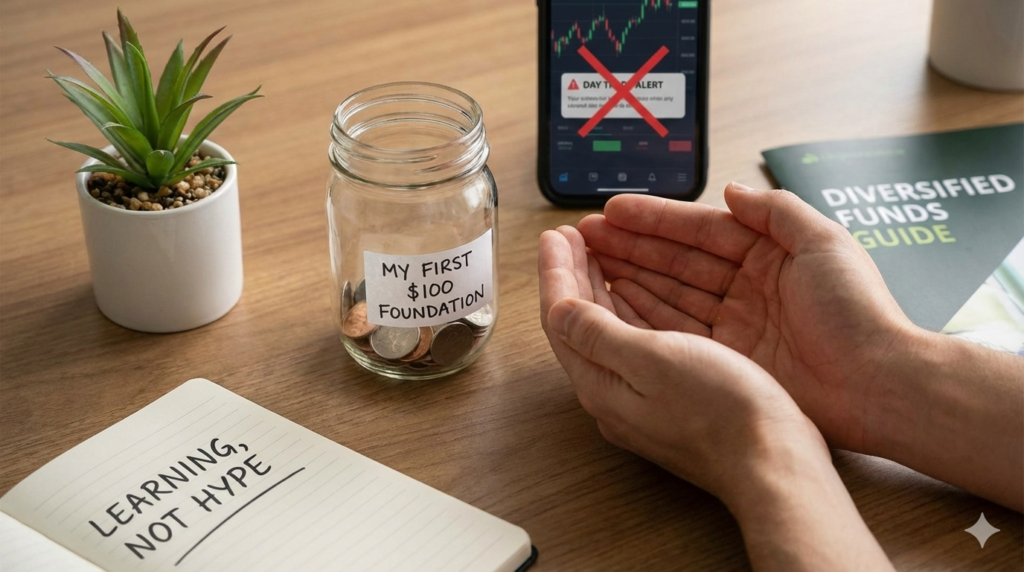
Since you’re starting small, avoid unnecessary risks:
-
Stick to diversified funds
-
Avoid day trading
-
Don’t follow hype on social media
-
Keep emotions out
-
Focus on learning, not maximizing returns
Your first investment isn’t about making money —
it’s about building the foundation for every investment that comes next.
14. Growing From $100 to Your First $1,000
Once you invest your first $100, your next goal should be reaching your first $1,000, then $5,000, and eventually $10,000.
Here’s the path many successful beginners follow:
-
Start with $100
-
Add small weekly/monthly contributions
-
Increase contributions when income grows
-
Reinvest all dividends
-
Stick to ETFs or diversified assets
Remember:
Small decisions, repeated over time, create big money.
15. When Should You Change Your Strategy?
As your portfolio grows, you may adjust for:
-
New goals
-
Higher income
-
Life changes
-
Market conditions
But don’t confuse adjusting your plan with chasing trends.
Review your strategy every 6–12 months, not every day.
16. The Mindset You Need to Succeed
Starting with $100 is an empowering step.
But mindset determines how far you’ll go.
Keep these principles:
-
Start small, think long-term.
-
Consistency beats intensity.
-
Time is more powerful than money.
-
Discipline beats emotion.
-
Investing is a marathon — not a lottery.
Your future self will thank you for every dollar you invest today.
BONUS
If you prefer to learn visually, the video below perfectly complements this guide.
In it, you will see how to invest with just $100 in practice, understanding platforms, initial strategies,
and common mistakes that every beginner should avoid.
Conclusion
You don’t need thousands of dollars to become an investor.
You only need $100, clarity, and consistency.
This small step sets you apart from millions who never begin — and it opens the door to a lifetime of financial growth.
Whether you choose ETFs, fractional shares, REITs, or robo-advisors, the most important move is the first one.
So start today.
Your journey to building wealth begins with a single decision.
Want more financial insights delivered to you? Subscribe to our newsletter
and get weekly articles with practical strategies to grow your wealth sent straight to your inbox.
Obs: Sign up for our newsletter and receive a free Finance For Beginner eBook.
Disclaimer: This article is for educational purposes only. Diversification does not guarantee profits or protect against all losses. Consider your financial situation, risk tolerance, and investment timeline before making investment decisions.
—— End of Article ——