How to Start Investing With Little Money: 10 Proven Strategies for Beginners
(Complete Guide)
Last updated: February 2026
You want to start investing.
But you look at your bank account: $500. Maybe $1,000 if you’re lucky.
You think: “Investing is for rich people. I don’t have enough money to start investing.”
That’s the biggest lie in personal finance.
The truth? You don’t need thousands of dollars to start investing. You don’t need to be wealthy. You don’t need to wait until you “have more money.”
You can start investing with little money today. Even with $100. Even with $50. Even with $10.
The wealthy understand something critical: They didn’t get rich and then start investing. They started investing and then got rich.
Small amounts invested early beat large amounts invested late. Always.
You understand compound interest? You know how to build an emergency fund?
You’ve learned how to diversify? You can read stock charts?
You know how to negotiate raises?
Don’t worry, we’ve gathered all these topics (among others) into carefully crafted and separated articles to make your learning easier.
Check out the “Categories” guide.
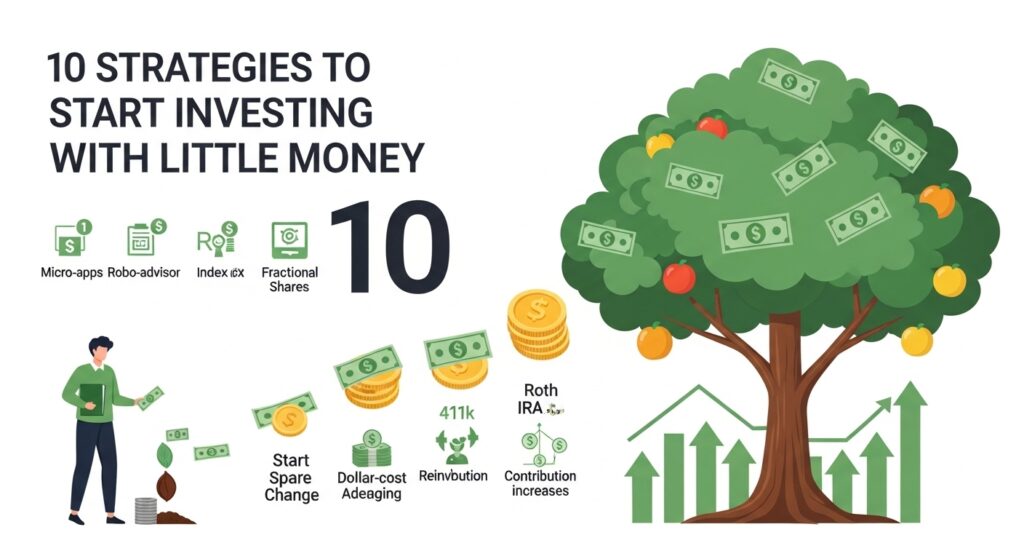
In this guide, you’ll learn exactly how to start investing with little money using 10 proven strategies, which investment accounts to open with low minimums, the best investments for beginners with small budgets, how to start investing with $100, $500, or $1,000, common mistakes beginners make (and how to avoid them), and most importantly—how to grow your small investment into life-changing wealth.
By the end, you’ll know exactly how to start investing with little money, even if you’re a complete beginner.
Let’s start investing with little money and build your wealth.
Why You Can (And Should) Start Investing With Little Money
Before we learn how to start investing with little money, let’s understand why it matters.
The Myth of “I Need More Money First”
The biggest excuse:
- “I’ll start investing when I have $5,000”
- “I’ll wait until I get a raise”
- “I need more money before I can invest”
The truth:
- Waiting costs you MORE than starting small
- Time in market beats timing the market
- Starting with little money teaches you investing without big risk
Example:
Person A: Waits to “have more money”
- Age 25: $0 invested (“waiting to save $5,000”)
- Age 30: Finally saves $5,000, starts investing
- Age 65: $387,000 (35 years of growth)
Person B: Starts investing with little money immediately
- Age 25: Invests $100/month (that’s all they have)
- Age 30: Now invests $500/month (got raise)
- Age 65: $847,000 (40 years of growth, 5 extra years!)
Difference: $460,000 just from starting 5 years earlier with little money!
Waiting to “have more money” is the most expensive mistake you can make.
The Power of Starting With Little Money
When you start investing with little money:
Benefit 1: Time multiplies money
- $100/month for 40 years at 8% = $349,000
- $400/month for 10 years at 8% = $73,000
- Time > Amount!
Benefit 2: Learn without big risk
- Lose $100 learning? Painful but survivable
- Lose $10,000 learning? Devastating
- Start with little money = cheap education
Benefit 3: Build the habit
- Investing becomes automatic
- You learn discipline
- When income grows, habit already exists
Benefit 4: Compound interest works
- Even small amounts compound
- $50/month becomes $77,000 in 30 years
- Zero becomes zero no matter how long you wait
The Math That Changes Everything
Starting to invest with little money vs. waiting:
Scenario 1: Start with $50/month at age 25
- Monthly: $50
- Years: 40 (to age 65)
- Total invested: $24,000
- Value at 65: $174,000 (at 8% return)
Scenario 2: Wait, invest $200/month at age 35
- Monthly: $200
- Years: 30 (to age 65)
- Total invested: $72,000
- Value at 65: $298,000 (at 8% return)
Scenario 1 wins per dollar invested:
- Person 1: Invested $24,000 → Got $174,000 (7.25x return)
- Person 2: Invested $72,000 → Got $298,000 (4.14x return)
Starting early with little money beats starting late with more!
How Much Money Do You Really Need to Start Investing?
The answer will surprise you.
Traditional Investing (OLD way)
What brokers used to require:
- Minimum account: $1,000-5,000
- Minimum stock purchase: $500+ (had to buy whole shares)
- Minimum mutual fund: $2,500-3,000
- Fees: $7-10 per trade
Result: Most people couldn’t afford to start investing
Modern Investing (NEW way – 2026)
What you can do now:
- Minimum account: $0 (many brokers)
- Minimum stock purchase: $1 (fractional shares!)
- Minimum ETF: $1
- Fees: $0 (commission-free trading)
Result: ANYONE can start investing with little money!
The Real Minimum to Start Investing
Realistic minimums by strategy:
- Micro-investing apps: $5
- Fractional shares: $1
- Robo-advisors: $100-500
- Index funds: $100-500
- 401(k): $25-50/paycheck
- Roth IRA: $50/month
You can start investing with little money even with $10-50!
Strategy 1: Start With a Micro-Investing App ($5-10)
Best for: Complete beginners who want to start investing with little money
What Are Micro-Investing Apps?
Apps designed for people who want to start investing with little money:
- Low minimums ($5-10)
- Automatic investing
- Simple interface
- Round-up features
- Pre-built portfolios
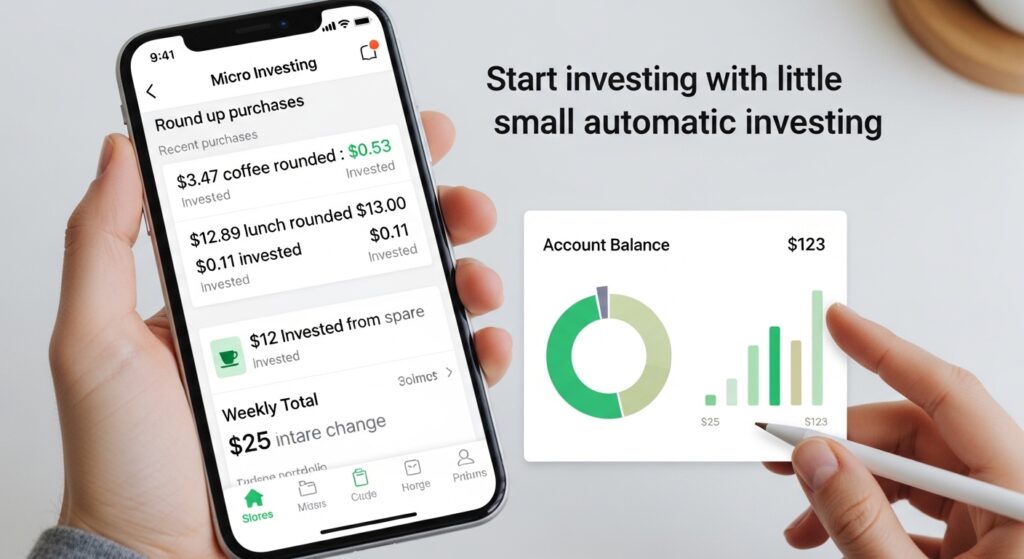
To start investing with little money automatically using spare change round-ups and small recurring contributions, Acorns makes it simple for complete beginners to build wealth with just $5 to start.
Popular micro-investing apps:
Acorns:
- Minimum: $5
- Cost: $3-9/month
- Features: Round-ups, automatic investing, IRA options
- Best for: Complete beginners
Stash:
- Minimum: $5
- Cost: $3-9/month
- Features: Fractional shares, learn as you invest, retirement accounts
- Best for: People who want to learn
Robinhood:
- Minimum: $0
- Cost: Free (or $5/month for Gold)
- Features: Stocks, ETFs, crypto, fractional shares
- Best for: Self-directed beginners
How to Start Investing With Little Money Using Micro-Apps
Week 1: Download and set up
- Choose app (Acorns for simplicity, Robinhood for control)
- Link bank account
- Deposit $10-50 to start
Week 2: Enable automatic features
- Round-ups: App rounds purchases to nearest dollar, invests difference
- Example: Buy coffee $3.50 → Rounds to $4.00 → Invests $0.50
- Recurring deposits: $5-25/week automatic
Week 3-4: Watch it grow
- Money invests in diversified portfolio
- See first gains (or losses – part of learning!)
- Build confidence
Month 2+: Increase contributions
- Raise weekly amount by $5-10
- Continue building
The Results
Example: Sarah starts investing with little money via Acorns
Month 1:
- Initial deposit: $25
- Round-ups: $18
- Recurring: $20/week × 4 = $80
- Total invested: $123
- Value: $123
Month 6:
- Contributions: $600 total
- Market gains: $32 (5.3% return)
- Account value: $632
- First $32 made while sleeping!
Year 1:
- Contributions: $1,300
- Market gains: $89
- Account value: $1,389
- Started with $25, now has $1,389!
That’s how to start investing with little money using apps.
Strategy 2: Open a Robo-Advisor Account ($100)
Best for: Hands-off investors who want professionals to manage investments
What Are Robo-Advisors?
Automated investment managers:
- Algorithm builds your portfolio
- Automatically rebalances
- Tax-loss harvesting
- Based on your risk tolerance
- Low fees (0.25-0.50%/year)
Best robo-advisors to start investing with little money:
Betterment:
- Minimum: $0 (but $10 to actually invest)
- Fee: 0.25%/year
- Features: Auto-rebalancing, tax-loss harvesting, retirement planning
- Best for: Set-it-and-forget-it investors
Wealthfront:
- Minimum: $500
- Fee: 0.25%/year
- Features: Tax-loss harvesting, financial planning, free software
- Best for: Higher earners starting out
M1 Finance:
- Minimum: $100
- Fee: $0 (free!)
- Features: Custom pies, automatic rebalancing, fractional shares
- Best for: People who want some control
How to Start Investing With Little Money Using Robo-Advisors
Step 1: Open account
- Choose robo-advisor (Betterment recommended for beginners)
- Answer risk tolerance questions
- App creates custom portfolio
Step 2: Make initial deposit
- Start with $100-500
- Money automatically invests in diversified portfolio (stocks + bonds)
Step 3: Set up automatic deposits
- $25-100/week or month
- Robo-advisor automatically buys more investments
- Rebalances portfolio as needed
Step 4: Let it run
- Check quarterly (not daily!)
- Annual returns: 6-9% average historically
- Keep contributing consistently
The Results
Example: Mike starts investing with little money via Betterment
Initial:
- Deposit: $500
- Risk tolerance: Moderate (70% stocks, 30% bonds)
- Automatic: $100/month
After 1 year:
- Contributions: $500 + ($100 × 12) = $1,700
- Returns: 7.2% = $67
- Account value: $1,767
- Fees paid: $4 (0.25% of average balance)
- Net: $63 profit
After 5 years:
- Contributions: $6,500
- Returns: 8.1% average = $1,312
- Account value: $7,812
- Started with $500, now has $7,812!
That’s how to start investing with little money hands-off.
Strategy 3: Buy Fractional Shares ($1 per stock)
Best for: People who want to own specific stocks but have little money
What Are Fractional Shares?
Old way (impossible for beginners):
- Amazon stock: $180/share
- Need $180 to buy 1 share
- Can’t afford? Can’t invest in Amazon
New way (fractional shares):
- Amazon stock: $180/share
- Want to invest $10? Buy 0.055 shares
- Own tiny piece of Amazon for $10!
Brokers offering fractional shares:
- Fidelity: $1 minimum
- Charles Schwab: $5 minimum
- Robinhood: $1 minimum
- Interactive Brokers: $1 minimum
How to Start Investing With Little Money Using Fractional Shares
Step 1: Open brokerage account
- Fidelity or Charles Schwab (most reliable)
- $0 minimum to open
- No fees
Step 2: Deposit money
- Start with $50-100
- Can add more anytime
Step 3: Buy fractional shares
- Search for stocks (Apple, Microsoft, Amazon, etc.)
- Enter dollar amount (not share amount)
- Example: “Buy $10 of Apple stock”
- App automatically calculates fractional shares
Step 4: Build portfolio
- $10 in Apple
- $10 in Microsoft
- $10 in Amazon
- $10 in Google
- $10 in index fund
- $50 total = diversified portfolio!
The Strategy
Instead of buying 1 full share of 1 company:
- Buy fractional shares of 10 companies
- Instant diversification
- Lower risk
Example portfolio with $100:
- $20 – S&P 500 ETF (VOO)
- $15 – Technology (Apple, Microsoft)
- $15 – Healthcare (Johnson & Johnson, UnitedHealth)
- $15 – Finance (JPMorgan, Visa)
- $15 – Consumer (Amazon, Walmart)
- $20 – Keep for next purchase
That’s how to start investing with little money in blue-chip stocks!
Strategy 4: Invest in Index Funds ($100-500)
Best for: Long-term investors who want simple, diversified growth
What Are Index Funds?
One fund = hundreds or thousands of companies:
- S&P 500 index fund = 500 largest US companies
- Total stock market fund = entire US stock market (3,500+ companies)
- International fund = companies worldwide
Benefits:
- Instant diversification (1 fund = 500+ companies)
- Low fees (0.03-0.20%/year)
- Historical returns: 8-10%/year
- Warren Buffett’s #1 recommendation
Best Index Funds to Start Investing With Little Money
Vanguard:
- VOO (S&P 500 ETF): $100 minimum (1 share ~$500, but fractional available)
- VTI (Total Stock Market): $100 minimum
- Fee: 0.03%/year (almost free!)
Fidelity:
- FXAIX (S&P 500): $0 minimum!
- FZROX (Total Market): $0 minimum!
- Fee: 0.00% (completely free!)
Schwab:
- SWPPX (S&P 500): $1 minimum
- SWTSX (Total Market): $1 minimum
- Fee: 0.02%/year
How to Start Investing With Little Money in Index Funds
Step 1: Open account
- Fidelity (best for zero fees)
- Or Vanguard (legendary reputation)
Step 2: Choose fund
- Beginner: S&P 500 fund (500 largest companies)
- More aggressive: Total market fund (all companies)
- Conservative: Target date fund (auto-adjusts as you age)
Step 3: Invest
- Start with $100-500
- Set up automatic $50-200/month
Step 4: Never sell
- Hold for 20-40 years
- Ignore market ups and downs
- Just keep buying more
The Power of Index Funds
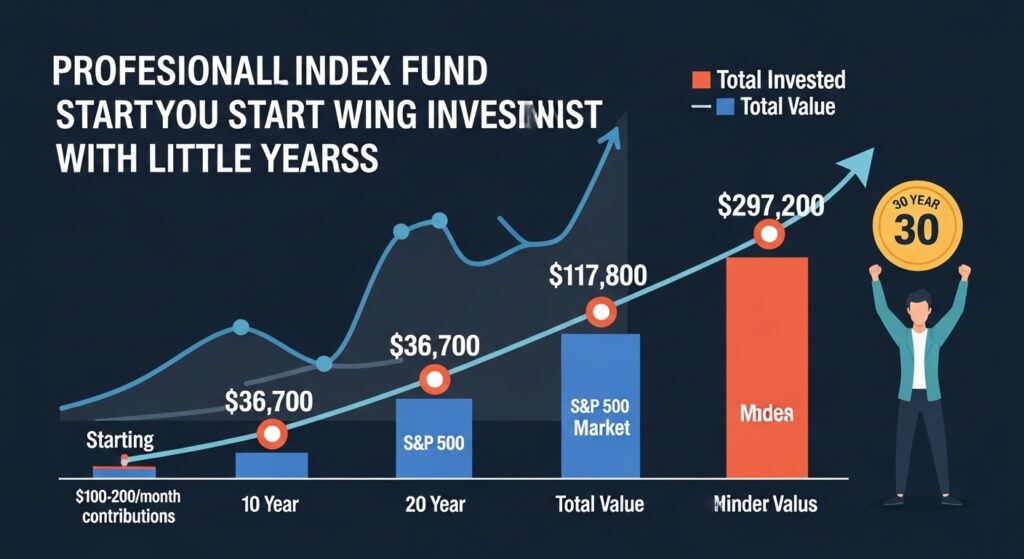
$200/month in S&P 500 index fund:
After 10 years:
- Invested: $24,000
- Value: $36,700 (at 8% return)
- Profit: $12,700
After 20 years:
- Invested: $48,000
- Value: $117,800
- Profit: $69,800
After 30 years:
- Invested: $72,000
- Value: $297,200
- Profit: $225,200
That’s how to start investing with little money and retire wealthy!
For more on why index funds are powerful, read What Are Index Funds to understand this strategy fully.
Strategy 5: Use Your Employer’s 401(k) (Even $50/month)
Best for: Anyone with access to employer retirement plan
Why 401(k) is Perfect to Start Investing With Little Money
Benefit 1: Free money (employer match)
- Employer matches 50-100% of contributions
- Example: You contribute $100 → Employer adds $50-100
- Instant 50-100% return!
Benefit 2: Automatic from paycheck
- Never see the money
- Can’t spend it
- Forced discipline
Benefit 3: Tax benefits
- Contributions reduce taxable income
- Grow tax-free
- Save on taxes now
How to Start Investing With Little Money in 401(k)
Step 1: Sign up
- Ask HR for 401(k) enrollment
- Fill out forms
- Choose contribution percentage
Step 2: Start small
- Begin with 3-5% of salary
- Minimum to get full employer match
- Example: $3,000/month salary × 5% = $150/month
Step 3: Invest in target date fund
- Choose fund with your retirement year
- Example: “Target Date 2060 Fund”
- Automatically diversified and adjusted
Step 4: Increase 1% annually
- Every year: Raise contribution 1%
- Won’t notice the difference
- Wealth grows significantly
The 401(k) Match is Free Money
Example: Emily starts investing with little money in 401(k)
Salary: $40,000/year Contribution: 5% = $2,000/year = $167/month Employer match: 50% = $1,000/year
After 1 year:
- Emily contributed: $2,000
- Employer added: $1,000
- Total: $3,000 (not $2,000!)
- 50% return before any market gains!
After 30 years:
- Emily contributed: $60,000
- Employer added: $30,000
- Market growth (8%): $266,000
- Total: $356,000!
Starting with $167/month became $356,000!
That’s how to start investing with little money using employer match.
Strategy 6: Open a Roth IRA ($50/month)
Best for: Anyone who wants tax-free growth forever
What is a Roth IRA?
Retirement account with huge benefits:
- Contribute after-tax money
- Grows completely tax-free
- Withdraw tax-free in retirement
- Maximum: $7,000/year (2026)
- Can start with $50/month
Why Roth IRA is Perfect to Start Investing With Little Money
Benefit 1: Flexibility
- Can withdraw contributions anytime (not gains)
- Emergency access if needed
- Less scary for beginners
Benefit 2: Tax-free forever
- $7,000 invested today
- Grows to $50,000 in 30 years
- Withdraw all $50,000 tax-free!
Benefit 3: Low minimums
- Fidelity: $0 minimum
- Vanguard: $1,000 (but can do $50/month to start)
- Schwab: $0 minimum
To start investing with little money in a Roth IRA with zero minimum and commission-free trading, Fidelity Investments offers one of the best platforms for beginners to open and manage a Roth IRA.
How to Start Investing With Little Money in Roth IRA
Step 1: Open Roth IRA
- Fidelity (easiest for beginners)
- Online application: 10 minutes
- $0 to open
Step 2: Set up automatic contribution
- $50-500/month (whatever you can afford)
- Automatically transfers from bank
- Invests on schedule
Step 3: Invest in index fund
- FXAIX (Fidelity S&P 500 fund)
- Or target date fund
- Set and forget
Step 4: Max it out if possible
- $7,000/year = $583/month
- If can’t max: contribute anything!
- $50/month better than $0
The Roth IRA Power
$300/month in Roth IRA:
After 10 years:
- Contributed: $36,000
- Value: $55,000 (at 8%)
- Tax owed on $55,000: $0!
After 30 years:
- Contributed: $108,000
- Value: $446,000 (at 8%)
- Tax owed on $446,000: $0!
Compare to taxable account:
- Same contributions and returns
- Tax on $338,000 gains: ~$84,500 (25% tax)
- Roth IRA saves: $84,500!
That’s how to start investing with little money tax-free!
For retirement investing strategies, read How to Invest for Retirement in Your 20s and 30s.
Strategy 7: Invest Spare Change Automatically
Best for: People who want to start investing with little money painlessly
What is Spare Change Investing?
Apps that invest your spare change:
- Link debit/credit card
- App monitors purchases
- Rounds up to nearest dollar
- Invests the difference
Example:
- Buy coffee: $3.47
- Rounds to: $4.00
- Difference: $0.53 invested
- Do this 20 times/week = $10/week invested = $520/year!
Best Spare Change Apps
Acorns:
- Round-ups: Yes
- Multipliers: 2x, 3x, 10x round-ups available
- Minimum: $5
- Cost: $3-9/month
- Best for: Set-it-and-forget-it
Chime:
- Round-ups: Yes (into savings, can move to investments)
- Cost: Free
- Minimum: $0
Bank of America “Keep the Change”:
- Rounds up purchases
- Transfers to savings
- Free feature
How to Start Investing With Little Money Using Spare Change
Week 1: Set up
- Download Acorns
- Link bank account and cards
- Enable round-ups
- Set multiplier (start with 1x)
Weeks 2-52: Automatic investing
- Spend normally
- App rounds up every purchase
- Money invests automatically
- Check monthly (not daily!)
Year 1 typical results:
- Purchases: ~500/year
- Average round-up: $0.50
- Total invested: $250/year
- With 2x multiplier: $500/year
- Without changing any habits!
The Psychological Benefit
Why spare change investing works to help start investing with little money:
- Don’t “feel” the money leaving
- Happens invisibly
- Builds investment habit
- Anyone can afford $0.50 round-ups
After 1 year:
- Invested: $500 (spare change)
- Realize you didn’t miss it
- Confidence to invest more
That’s how to start investing with little money without thinking about it!
Strategy 8: Start Dollar-Cost Averaging ($25/week)
Best for: Reducing risk and building consistency
What is Dollar-Cost Averaging?
Investing fixed amount on regular schedule:
- Same amount (e.g., $25)
- Same frequency (e.g., weekly)
- Same investment (e.g., S&P 500)
- Regardless of price
Why it works when you start investing with little money:
- Removes emotion from investing
- Buys more shares when price low
- Buys fewer shares when price high
- Averages out cost over time
- Perfect for beginners
How Dollar-Cost Averaging Protects You
Example: $100/month into stock
Without dollar-cost averaging (trying to time market):
- Month 1: Wait (market might drop)
- Month 2: Wait (market rose, wait for drop)
- Month 3: Wait (still waiting)
- Month 4: Panic buy at high price
- Result: Bad timing, poor returns
With dollar-cost averaging:
- Month 1: Buy $100 worth (price $10 = 10 shares)
- Month 2: Buy $100 worth (price $12 = 8.33 shares)
- Month 3: Buy $100 worth (price $8 = 12.5 shares)
- Month 4: Buy $100 worth (price $11 = 9.09 shares)
- Average price: $10.28
- Total shares: 39.92
- Result: Good timing without trying!
How to Start Investing With Little Money Using DCA
Step 1: Choose amount
- Start with what you can afford
- $25/week = $100/month
- $50/week = $200/month
- Even $10/week works!
Step 2: Choose investment
- Index fund (best for beginners)
- Or 2-3 ETFs
- Keep it simple
Step 3: Automate
- Set up automatic purchase
- Same day every week/month
- Set and forget
Step 4: Never stop
- Market up? Keep buying.
- Market down? Keep buying.
- Market crashing? Keep buying!
- Consistency wins
The Power of Consistency
$50/week for 20 years:
- Total invested: $52,000
- Value at 8% return: $126,000
- Profit: $74,000
$100/week for 20 years:
- Total invested: $104,000
- Value at 8% return: $252,000
- Profit: $148,000
Small weekly amounts = life-changing wealth!
That’s how to start investing with little money consistently.
For more on dollar-cost averaging, read Dollar-Cost Averaging: The Strategy That Removes Emotion from Investing.
Strategy 9: Reinvest All Dividends (Free compound growth)
Best for: Accelerating growth without adding more money
What is Dividend Reinvestment?
Dividends = cash companies pay shareholders:
- Own 100 shares
- Company pays $0.50/share dividend
- Receive $50 cash
Two options:
- Take cash (spend it)
- Reinvest (buy more shares)
Reinvesting = compound growth accelerator!
Why Dividend Reinvestment is Critical When You Start Investing With Little Money
Example: $1,000 in dividend stock (4% dividend yield)
Without reinvesting (taking cash):
- Year 1: $1,000 → Dividend $40 (take cash) → Still have $1,000
- Year 10: Still $1,000 + $400 cash taken = $1,400 total
- Year 30: Still $1,000 + $1,200 cash taken = $2,200 total
With reinvesting (DRIP):
- Year 1: $1,000 → Dividend $40 (buys more shares) → Now have $1,040
- Year 10: $1,480 (dividends bought more shares)
- Year 30: $3,243 (dividends snowballed!)
Difference: $1,043 extra just from reinvesting!
And that’s before stock price appreciation!
How to Start Investing With Little Money Using DRIP
Step 1: Enable DRIP in your account
- Every broker offers this
- Find “dividend reinvestment” setting
- Enable for all holdings
- Free automatic
Step 2: Buy dividend-paying investments
- Index funds (pay dividends)
- Dividend ETFs (SCHD, VYM, DGRO)
- Individual dividend stocks
Step 3: Never touch dividends
- Let them reinvest automatically
- Compounds silently
- Accelerates growth
The Long-Term Impact
$5,000 invested in dividend fund (3% yield, 8% total return):
Without DRIP (30 years):
- Stock appreciation: $50,317
- Dividends taken: $12,450
- Total: $62,767
With DRIP (30 years):
- Stock appreciation + reinvested dividends: $79,943
- Difference: $17,176 extra!
Reinvesting dividends adds $17,000 for free!
That’s how to start investing with little money and maximize growth.
Strategy 10: Increase Contributions by 1% Every Month
Best for: Building wealth without feeling the pain
Why 1% Monthly Increases Work
Human psychology:
- Big changes = failure (can’t sustain)
- Small changes = success (barely notice)
Example:
- Start: Invest $100/month (feels okay)
- Jump to: $300/month (feels impossible, quit)
Better approach:
- Month 1: $100
- Month 2: $101 (1% increase)
- Month 3: $102.01 (1% increase)
- Month 12: $112.68
- You barely noticed going from $100 to $113!
How to Start Investing With Little Money and Scale Up
Step 1: Start with comfortable amount
- Whatever doesn’t hurt
- $50/month? Fine.
- $100/month? Great.
Step 2: Set 1% monthly increase
- Manually or automatically
- Some apps/brokers allow this
- Calendar reminder if manual
Step 3: Let it run
- Year 1: Painless increases
- Year 2: Contributing significantly more
- Year 5: Contributing 80% more than start!
The Math
Start: $100/month, increase 1%/month
- Month 1: $100
- Month 12: $113
- Month 24: $127
- Month 36: $143
- Month 60: $181
After 5 years:
- If stayed at $100: Total invested $6,000
- With 1% increases: Total invested $7,808
- Extra: $1,808 invested (and it felt easy!)
The wealth difference:
- Flat $100/month for 30 years: $149,000
- $100 + 1%/month increases for 30 years: $298,000
- Difference: $149,000 just from 1% increases!
That’s how to start investing with little money and become wealthy effortlessly.
How to Start Investing With $100, $500, or $1,000
Specific strategies for different starting amounts.
Start Investing With $100
Best approach:
Option 1: Index fund
- $100 → Fidelity FZROX (total market, $0 minimum)
- Set up $25/month automatic
- Reinvest dividends
- Hold forever
Option 2: Fractional shares (5 stocks)
- $20 → S&P 500 ETF (VOO)
- $20 → Apple
- $20 → Microsoft
- $20 → Amazon
- $20 → Keep for next buy
Option 3: Robo-advisor
- $100 → Betterment
- Set up $50/month automatic
- Let algorithm manage
Recommendation for $100: Option 1 (index fund, simplest!)
Start Investing With $500
Best approach:
Option 1: Diversified portfolio
- $300 → S&P 500 index (FXAIX/VOO)
- $100 → International index (VXUS)
- $100 → Bond fund (BND)
- Set up $100/month contributions
Option 2: Roth IRA start
- Open Roth IRA
- $500 initial deposit
- $100/month automatic
- Invest in target date fund
Option 3: Robo-advisor premium
- $500 → Wealthfront
- Diversified portfolio
- Tax-loss harvesting included
Recommendation for $500: Option 2 (Roth IRA, tax benefits!)
Start Investing With $1,000
Best approach:
Option 1: Roth IRA + taxable account
- $583 → Roth IRA (monthly max for $7,000/year)
- $417 → Taxable brokerage
- Both in index funds
Option 2: 401(k) focused
- $1,000 → 401(k) contributions over time
- Get employer match
- Invest in target date fund
Option 3: Full portfolio
- $600 → US stocks (S&P 500 index)
- $200 → International stocks
- $150 → Bonds
- $50 → Keep for opportunities
Recommendation for $1,000: Option 1 (Roth IRA + taxable, best tax strategy!)
Common Mistakes When You Start Investing With Little Money
Avoid these errors.
❌ Mistake 1: Waiting Until You “Have More Money”
The error:
- “I’ll start when I have $5,000”
- “I’ll wait until I get a raise”
- Years pass, never start
The reality:
- Starting with $100 today beats starting with $5,000 in 5 years
- Time in market > timing market
- Waiting costs hundreds of thousands
The solution:
- Start with whatever you have
- Even $10/month
- Increase contributions as income grows
❌ Mistake 2: Trying to Pick Individual Stocks
The error:
- “I’ll buy Tesla!”
- “Crypto is the future!”
- “My friend made $10,000 on [stock]!”
- Loses money, gets discouraged
The reality:
- 90% of professional investors can’t beat index funds
- Beginners shouldn’t try to pick winners
- Index funds beat 95% of stock pickers
The solution:
- Start with index funds
- S&P 500 or total market
- Boring = wealth building
❌ Mistake 3: Checking Portfolio Daily
The error:
- Check every day
- See -2% drop, panic
- See +3% gain, get overconfident
- Emotional decisions
The reality:
- Daily volatility is normal
- Long-term growth is what matters
- Checking daily leads to bad decisions
The solution:
- Check monthly maximum
- Quarterly is better
- Focus on contributions, not balance
❌ Mistake 4: Not Automating
The error:
- “I’ll manually invest when I have extra money”
- Extra money never comes
- Month ends, forgot to invest
- Savings: $0
The solution:
- Automate everything
- Set up automatic transfers
- Set up automatic investments
- Remove willpower from equation
❌ Mistake 5: Stopping When Market Drops
The error:
- Market drops 20%
- “I’ll wait until it recovers”
- Market recovers while they wait
- Miss the gains
The reality:
- Market drops = stocks on sale
- Best time to buy
- Stopping = worst decision
The solution:
- Never stop contributing
- Market down = buy more (it’s cheaper!)
- Dollar-cost averaging protects you
Frequently Asked Questions – FAQ 👈
Q: Can I really start investing with $100 or less?
A: Yes! Modern investing allows starting with even $1.
Options with low minimums:
- Fractional shares: $1
- Micro-investing apps: $5
- Index funds (Fidelity): $0
- Robo-advisors: $0-100
You can start investing with little money today, not tomorrow.
Q: Should I pay off debt first or start investing?
A: Depends on interest rate.
Pay debt first if:
- Interest rate over 7-8%
- Credit card debt (15-25%)
- Personal loans (10%+)
Invest while paying debt if:
- Low interest (under 5%)
- Student loans (4-6%)
- Mortgage (5-7%)
Always:
- Get employer 401(k) match (free money!)
- Build $1,000 emergency fund first
For debt strategies, read How to Pay Off Debt Fast.
Q: What’s the best investment to start investing with little money?
A: Index funds (S&P 500 or total market).
Why:
- Instant diversification (500+ companies)
- Low fees (0.03-0.20%)
- Historical returns: 8-10%/year
- Warren Buffett recommends
- Perfect for beginners
Specific funds:
- Fidelity: FXAIX (S&P 500) or FZROX (total market)
- Vanguard: VOO (S&P 500) or VTI (total market)
- Schwab: SWPPX (S&P 500) or SWTSX (total market)
Q: How long until I see returns when I start investing with little money?
A: Expect 8-10% annual returns long-term, but year-to-year varies wildly.
Realistic timeline:
- Year 1: -20% to +30% (could be anything!)
- Years 1-5: -10% to +80% (volatile)
- Years 10+: 50-150% gains (more stable)
- Years 20+: 300-400% gains (wealth built)
Key: Time smooths out volatility. Stay invested 20+ years.
Q: Can I start investing with little money if I’m in my 40s or 50s?
A: Yes, but be more aggressive with contributions.
Strategy:
- Start with whatever you have
- Contribute as much as possible
- May need to save 20-30% of income
- Less time = need larger contributions
Better late than never! Starting at 45 beats never starting.
Q: Should I use a financial advisor or start investing with little money myself?
A: Start yourself with index funds or robo-advisor.
Why:
- Financial advisors charge 1-2%/year
- On small amounts, not worth the cost
- Index funds/robo-advisors: 0-0.25%
- Difference: $10,000 saved over 20 years
When to use advisor:
- Portfolio over $100,000
- Complex tax situations
- Need comprehensive planning
For most beginners: DIY with index funds!
Your Investing Action Plan
Step-by-step to start investing with little money.
Week 1: Prepare
Day 1-2: Calculate your starting amount
- How much can you invest immediately? ($50? $100? $500?)
- How much can you invest monthly? ($25? $50? $100?)
Day 3-4: Choose your strategy
- Under $100: Micro-investing app (Acorns) or fractional shares
- $100-500: Index fund (Fidelity FZROX)
- Over $500: Roth IRA (Fidelity)
Day 5-7: Open account
- Complete application (10-20 minutes)
- Link bank account
- Transfer initial deposit
Week 2: Invest
Day 1: Make first investment
- Choose index fund (S&P 500 or total market)
- OR let robo-advisor build portfolio
- Invest your initial deposit
Day 2-7: Set up automation
- Automatic transfers from bank
- Automatic purchases
- Dividend reinvestment (DRIP)
- Never manually invest again!
Month 1: Build Habit
Week 1-4:
- Let automatic contributions run
- DON’T check daily
- Check once at month-end
Month-end:
- Review: Did contributions work?
- Verify: Dividends reinvesting?
- Celebrate: You’re an investor now!
Month 2-12: Scale
Every month:
- Continue automatic contributions
- Consider increasing by $10-25/month
- Check quarterly (not more!)
Month 6:
- Review returns (probably positive!)
- Increase contribution by 10-20%
Month 12:
- Review full year
- Calculate total invested + gains
- Plan year 2 increases
Year 2+: Wealth Building
Quarterly:
- Review portfolio (15 minutes)
- Verify still on track
- Make no changes (stay the course!)
Annually:
- Increase contributions 10-20%
- Rebalance if needed
- Increase 401(k) contribution 1-2%
After 10-20 years:
- You’re wealthy
- All from starting to invest with little money!
🎥 BONUS
Want to see real examples of people who started investing with little money and built wealth?
This video shows their exact strategies:
FINAL THOUGHTS: Start Investing With Little Money Today
Here’s what most people don’t understand about how to start investing with little money:
The amount doesn’t matter. The starting matters.
Someone who starts investing with $50/month at age 25 will be wealthier at 65 than someone who starts with $500/month at age 45.
Why?
Time is more valuable than money in investing. Compound interest needs time to work its magic.
The math:
- $50/month for 40 years (8% return) = $174,000
- $500/month for 20 years (8% return) = $247,000
Person 1 invested $24,000 total → Got $174,000 Person 2 invested $120,000 total → Got $247,000
Person 1 invested 80% LESS but only got 30% less return!
That’s the power of starting to invest with little money early.
Most people think:
- “I need $5,000 to start”
- “I’ll wait until I get a raise”
- “I don’t have enough money yet”
Wealthy people know:
- “I’ll start with $50 today”
- “I’ll increase contributions when I get a raise”
- “Having little money is exactly why I need to start now”
The difference between these mindsets = hundreds of thousands of dollars.
After learning how to start investing with little money:
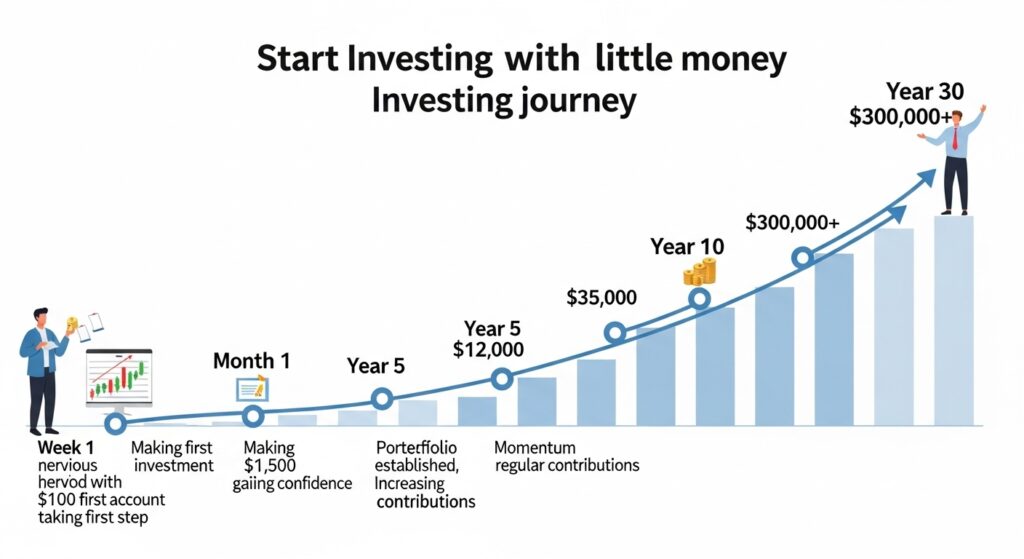
Month 1: Invested $100 (felt scary) Month 12: Invested $1,500 total (habit built) Year 5: Portfolio worth $12,000 (momentum building) Year 10: Portfolio worth $35,000 (wealth visible) Year 30: Portfolio worth $300,000+ (financially free)
All from starting with little money.
The question isn’t “Do I have enough money to invest?”
The question is: “Will I start today or wait another year?”
Every year you wait costs you tens of thousands of dollars in lost compound growth.
Start today. Start small. Start investing with little money.
Your 65-year-old self will thank you.
INTERESTING TOPICS
Want to understand what are index funds to invest your little money wisely?
Ready to learn dollar-cost averaging to reduce risk when investing?
Need to know the difference between saving and investing before starting?
Want more financial insights delivered to you? Subscribe to our newsletter
and get weekly articles with practical strategies to grow your wealth sent straight to your inbox.
Obs: Sign up for our newsletter and receive a free Finance For Beginner eBook.
Disclaimer: This article is for educational purposes only. Diversification does not guarantee profits or protect against all losses. Consider your financial situation, risk tolerance, and investment timeline before making investment decisions.
——— End of Article ———