The Difference Between Saving and Investing: And Why Both Matter
Last updated: December 2025
Imagine two people, both earning the same salary. One person saves diligently, putting money aside every month in a savings account. The other person also saves diligently, but invests that money instead. Fast forward 20 years—one has accumulated a comfortable cushion, while the other has built significant wealth. What made the difference? Understanding when to save and when to invest.
Most people use the words “saving” and “investing” interchangeably, but they’re fundamentally different strategies that serve different purposes. Confusing them can cost you thousands—even hundreds of thousands—of dollars over your lifetime.
The truth is, you need both. Saving provides security and stability for your immediate needs. Investing builds wealth for your future. Knowing when to use each strategy is one of the most important financial skills you can develop.
In this guide, you’ll learn exactly what separates saving from investing, when to use each strategy, how to balance both in your financial plan, and the costly mistakes people make by choosing the wrong approach at the wrong time. By the end, you’ll know exactly how much to save versus invest based on your specific situation.
Let’s clear up the confusion once and for all.
What is Saving? (Clear Definition)
Saving means setting money aside in safe, easily accessible accounts where the principal (your original amount) is protected and you can access it quickly without risk of loss.
In simple terms: Parking money somewhere safe for short-term needs or emergencies.
Characteristics of Saving:
Safety: Your money is protected. In the U.S., FDIC insurance protects bank deposits up to $250,000 per account.
Liquidity: You can access your money quickly—within minutes to days—without penalties (in most cases).
Stability: The value doesn’t fluctuate. $1,000 saved remains $1,000 (though inflation slowly erodes its purchasing power).
Low returns: Savings accounts typically earn 0.5% to 5% annually, depending on the type of account and economic conditions.
Common Saving Vehicles:
- Savings accounts: Traditional or high-yield
- Money market accounts: Slightly higher interest than regular savings
- Checking accounts: For everyday expenses
- Certificates of Deposit (CDs): Higher interest in exchange for locking money for a set period
- Cash: Physical money (earns nothing)
The Purpose of Saving:
Saving is designed for:
- Emergency funds (3-6 months of expenses)
- Short-term goals (under 3-5 years)
- Money you might need quickly
- Peace of mind and financial security
What is Investing? (Clear Definition)
Investing means putting money into assets like stocks, bonds, or real estate with the expectation that they will grow in value over time, accepting some risk of short-term losses in exchange for potentially higher long-term returns.
In simple terms: Using money to buy assets that can grow significantly but might lose value in the short term.
Characteristics of Investing:
Growth potential: Investments can grow substantially—historically 7-10% annually for stocks over long periods.
Risk: Your investment value fluctuates. You might lose money, especially in the short term.
Time requirement: Investments need time (typically 5+ years) to overcome short-term volatility and produce returns.
Less liquid: Selling investments takes 1-3 days, and selling at the wrong time (during a market drop) locks in losses.
Common Investment Vehicles:
- Stocks: Ownership shares in companies
- Bonds: Loans to companies or governments that pay interest
- Index funds/ETFs: Diversified collections of stocks or bonds
- Real estate: Property that generates income or appreciates
- Retirement accounts: 401(k), IRA, Roth IRA (contain investments)
The Purpose of Investing:
Investing is designed for:
- Long-term wealth building (5+ years)
- Retirement planning
- Major life goals (buying a house, children’s education)
- Outpacing inflation and growing purchasing power
The Key Differences Between Saving and Investing
Let’s break down the critical differences side by side:
| Aspect | Saving | Investing |
|---|---|---|
| Primary Goal | Preserve money safely | Grow money significantly |
| Time Horizon | Short-term (under 5 years) | Long-term (5+ years) |
| Risk Level | Extremely low | Moderate to high |
| Return Potential | Low (0.5-5% annually) | Higher (7-10% historically) |
| Liquidity | High (access in minutes/days) | Moderate (1-3 days to sell) |
| Value Stability | Very stable | Fluctuates (volatility) |
| Protection | FDIC insured up to $250k | Not insured (market risk) |
| Inflation Impact | Loses purchasing power | Usually outpaces inflation |
| Best For | Emergency fund, short goals | Retirement, long-term wealth |
| Emotional Ease | Very comfortable | Requires patience through ups/downs |
The Critical Distinction
Saving protects what you have. Investing grows what you have.
You save money you can’t afford to lose or need soon.
You invest money you won’t need for years and can tolerate fluctuating in value.
When You Should Save (Not Invest)
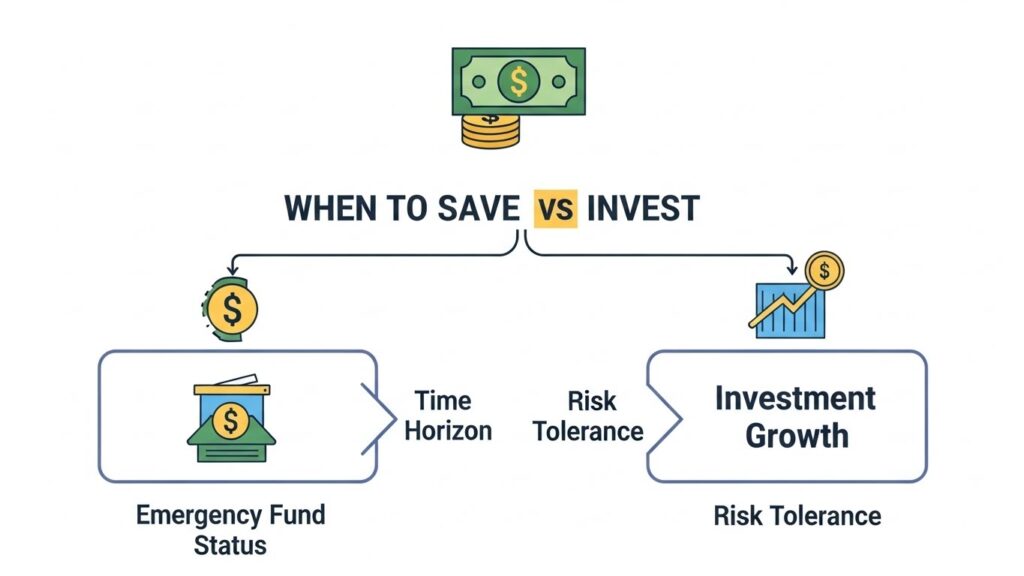
Not every dollar should be invested. Here are situations where saving is the right choice:
1. You Don’t Have an Emergency Fund Yet
Rule: Build 3-6 months of living expenses in a high-yield savings account BEFORE investing anything beyond employer 401(k) match.
Why: Emergencies happen—car repairs, medical bills, job loss. Without an emergency fund, you’ll be forced to sell investments at the worst possible time (during a crisis or market drop) or go into debt.
Example:
- Monthly expenses: $3,000
- Emergency fund needed: $9,000-$18,000
- Until you have this saved, prioritize saving over investing
2. You Need the Money Within 3-5 Years
Rule: Any goal within 3-5 years should be funded through saving, not investing.
Why: Markets are volatile short-term. If you invest money for a 2-year goal and the market drops 20% right before you need it, you’ve just lost money you needed.
Short-term goals that require saving:
- Down payment on a house (within 3 years)
- Wedding costs (within 2 years)
- Car purchase (within 1-3 years)
- Major vacation (within 1 year)
- Starting a business (within 2 years)
Where to save: High-yield savings account or CD matching your timeline.
3. You Have High-Interest Debt
Rule: Pay off any debt over 6-8% interest before investing (except employer 401(k) match—always take free money).
Why: Credit card debt at 18% interest is costing you more than investments typically earn. Paying off high-interest debt is a guaranteed “return” of that interest rate.
Priority order:
- Get employer 401(k) match (free money)
- Pay off credit cards, personal loans, high-interest student loans
- Build emergency fund
- Then start investing more aggressively
4. You’re Uncomfortable with Any Risk
Rule: If market drops of 10-20% would cause you to panic and sell, you’re not emotionally ready to invest.
Why: Investing requires weathering volatility. If you’ll sell at the first sign of trouble, you’ll lock in losses instead of benefiting from eventual recovery.
What to do: Keep money in savings while you educate yourself about how markets work, compound interest, and dollar-cost averaging. As you learn, you’ll likely become more comfortable with calculated risk.
5. You’re Building a Specific Savings Goal
Examples:
- Saving for property taxes due in 6 months
- Building a fund for holiday shopping
- Accumulating a house maintenance reserve
- Setting aside money for predictable expenses
Why save, not invest: Predictable, near-term needs require stable, accessible money.
When You Should Invest (Not Save)
Once you’ve checked the boxes above, it’s time to invest. Here’s when:
1. You Have a Solid Emergency Fund
Rule: Once you have 3-6 months of expenses saved, additional money should generally be invested, not saved.
Why: Saving beyond your emergency fund means losing to inflation. Money sitting in savings earning 3-4% loses purchasing power when inflation runs at 3-4% or higher.
Action: After your emergency fund is complete, redirect additional savings toward investments.
2. You’re Saving for Goals 5+ Years Away
Rule: Any goal more than 5 years away should be funded through investing, not saving.
Why: Time smooths out market volatility. Over 5+ years, the growth potential of investments far exceeds the safety of saving.
Long-term goals perfect for investing:
- Retirement (decades away)
- Children’s college fund (10+ years away)
- Dream home down payment (8+ years away)
- Financial independence goal (10-30+ years away)
Historical evidence: The S&P 500 has never had a negative return over any 20-year period.
The longer your timeline, the safer investing becomes, according to market data analysis.
3. You Want to Build Real Wealth
Rule: Wealth isn’t built in savings accounts—it’s built through investing.
Why: The math is simple:
Saving only ($500/month for 30 years at 3%):
- Total contributions: $180,000
- Final value: ~$291,000
- Growth: $111,000
Investing instead ($500/month for 30 years at 8%):
- Total contributions: $180,000
- Final value: ~$745,000
- Growth: $565,000
Difference: $454,000 more through investing!
That’s the power of compound interest working over time.
4. You’re Comfortable with Calculated Risk
Rule: If you understand that markets fluctuate but grow over time, and you won’t panic-sell during drops, you’re ready to invest.
Why: Accepting volatility is the price you pay for growth. Avoiding all risk means accepting minimal returns.
The right mindset:
- “My investment might drop 20% next year, but it will likely recover and grow over 10-20 years”
- “Market drops are buying opportunities through dollar-cost averaging“
- “I’m investing for the long term, not trying to get rich quick”
5. You Have a Long Time Horizon
Rule: The longer you have until you need the money, the more aggressively you should invest.
Age-based example:
- Age 25: Decades until retirement → invest 90%+ in stocks
- Age 45: 20 years until retirement → invest 70-80% in stocks
- Age 65: Near retirement → shift toward 50-60% stocks, more bonds
Why: Younger investors can weather multiple market cycles and benefit from decades of compound growth.
How to Balance Saving and Investing
The key to financial success isn’t choosing one over the other—it’s doing both strategically.
The Priority Framework
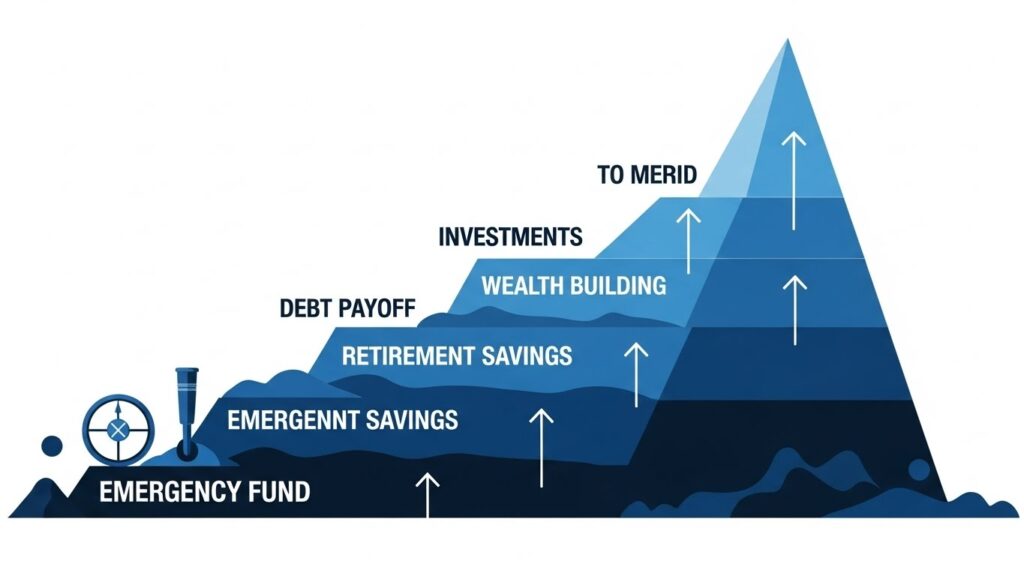
Follow this order to balance saving and investing:
Step 1: Save for immediate stability
- $1,000 mini emergency fund (if starting from zero)
- Get employer 401(k) match (free money—don’t leave it on the table!)
Step 2: Eliminate high-interest debt
- Pay off credit cards (15%+ interest)
- Pay off personal loans (10%+ interest)
- Consider aggressive payoff of student loans over 7-8%
Step 3: Build full emergency fund
- 3-6 months of living expenses
- Keep in high-yield savings account
- This is your financial foundation
Step 4: Start investing for retirement
- Contribute to 401(k) up to employer match (if not already doing)
- Open and fund Roth IRA ($7,000/year limit in 2024)
- Increase 401(k) contributions toward 15% of income
Step 5: Save for mid-term goals (1-5 years)
- House down payment
- Car purchase
- Other large expenses within 5 years
- Use high-yield savings or CDs
Step 6: Invest for long-term goals (5+ years)
- Additional retirement contributions (beyond 15%)
- Taxable brokerage account for non-retirement goals
- Children’s 529 college savings plans
- Wealth-building investments
Step 7: Invest aggressively
- Once all bases covered, maximize investment contributions
- Take full advantage of tax-advantaged accounts
- Build taxable investment accounts
- Consider real estate or other investments
The Percentage Approach
A simple framework for allocating your income:
Basic template:
- 20% to saving + investing combined
- 50% to needs (housing, food, utilities)
- 30% to wants (entertainment, dining out, hobbies)
Breaking down that 20%:
If building emergency fund (Steps 1-3):
- 15% to savings (emergency fund)
- 5% to investing (at minimum, get 401k match)
Once emergency fund complete (Steps 4-6):
- 5% to savings (specific goals, maintain emergency fund)
- 15% to investing (retirement, long-term goals)
Advanced stage (Step 7):
- 3% to savings (maintain emergency fund, short-term goals)
- 17%+ to investing (aggressive wealth building)
Real-Life Example
Sarah, age 30, income $60,000/year ($5,000/month take-home):
Current situation:
- No emergency fund
- $5,000 credit card debt at 18%
- Employer offers 401(k) with 3% match
Sarah’s plan:
Phase 1 (Months 1-3):
- Save: $800/month → mini emergency fund ($2,400)
- Invest: $150/month → 401(k) for employer match
- Debt: $300/month → credit card minimum
- Goal: Build starter emergency fund
Phase 2 (Months 4-10):
- Save: $200/month → maintain emergency fund
- Invest: $150/month → 401(k) for match
- Debt: $900/month → aggressively pay off credit card
- Goal: Eliminate high-interest debt
Phase 3 (Months 11-22):
- Save: $750/month → complete emergency fund ($9,000 total)
- Invest: $150/month → 401(k) for match
- Goal: 6 months expenses saved
Phase 4 (Month 23+):
- Save: $200/month → maintain emergency fund + short-term goals
- Invest: $750/month → 401(k) increase + Roth IRA
- Goal: Build wealth for retirement
In 2 years, Sarah goes from financially vulnerable to financially strong!
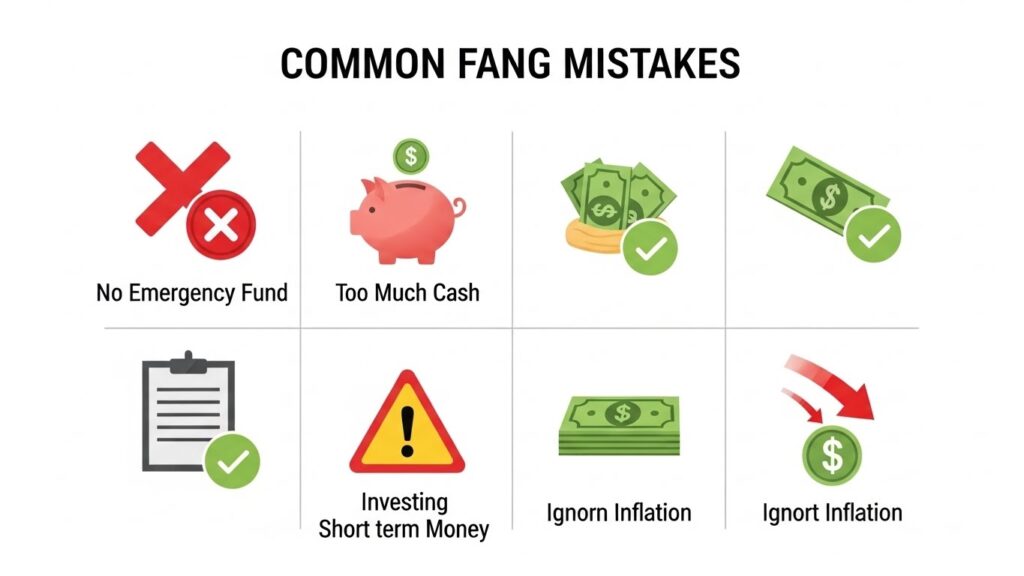
Common Mistakes People Make
Avoid these costly errors:
Mistake 1: Investing Before Building Emergency Fund
The error: Putting money in stocks while having zero savings for emergencies.
Why it’s costly: When an emergency hits (and it will), you’re forced to sell investments—possibly at a loss—and pay taxes and penalties. Or you go into debt, defeating the purpose of investing.
The fix: Emergency fund first, investing second. No exceptions.
Mistake 2: Keeping Too Much in Savings
The error: Having $50,000 in savings “just in case” while investing nothing.
Why it’s costly: Inflation destroys purchasing power. At 3% inflation, $50,000 loses $1,500 in purchasing power annually. Over 20 years, you’ve effectively lost $20,000+.
Example:
- $30,000 sitting in savings for 20 years at 3% = $54,000
- $30,000 invested for 20 years at 8% = $140,000
- Cost of over-saving: $86,000!
The fix: Keep only 3-6 months expenses in savings. Invest the rest for long-term goals.
Mistake 3: Investing Money You’ll Need Soon
The error: Investing money for a house down payment you need in 2 years.
Why it’s costly: Markets dropped 34% in March 2020. If your down payment was invested, you’d have lost 34% right when you needed it. Recovering would take months or years.
The fix: Short-term money (under 5 years) belongs in savings, not investments.
Mistake 4: Treating All Debt the Same
The error: Aggressively paying off 2.5% student loans while not investing.
Why it’s costly: Low-interest debt (under 4-5%) costs less than investment returns. By prioritizing low-interest debt over investing, you miss years of compound growth.
Better approach:
- High-interest debt (8%+): Pay off before investing heavily
- Medium-interest debt (4-8%): Split between debt payoff and investing
- Low-interest debt (under 4%): Make minimum payments, invest the rest
Mistake 5: All-or-Nothing Thinking
The error: “I can’t invest much, so why bother?” or “I’ll start investing when I have $10,000.”
Why it’s costly: Time in the market beats timing the market. Starting with $50/month now beats starting with $500/month in 5 years.
Example:
- Option A: Invest $100/month starting today for 30 years at 8% = $149,000
- Option B: Wait 5 years, then invest $200/month for 25 years at 8% = $187,000
- Option C: Start with $100/month now, increase to $200 after 5 years = $284,000
The fix: Start with what you can afford now, even if small.
Mistake 6: Ignoring Inflation
The error: Thinking “I’m being safe by keeping everything in savings.”
Why it’s costly: Safety against loss isn’t the same as safety against inflation. At 3% inflation, money doubles in purchasing power loss every 24 years.
Reality check:
- $100,000 today with 3% inflation
- Purchasing power in 10 years: $74,000
- Purchasing power in 20 years: $55,000
- Purchasing power in 30 years: $41,000
You didn’t “lose” money, but your $100,000 only buys what $41,000 bought 30 years ago.
The fix: According to historical data from Vanguard research, invest long-term money in diversified portfolios that historically outpace inflation.
Your Action Plan Based on Your Situation
Choose your scenario and follow the plan:
Scenario 1: Starting From Zero
Your situation:
- No emergency fund
- No investments
- Maybe some debt
- Want to start building wealth
Your plan:
- This month: Save $1,000 mini emergency fund
- Next 2-6 months: Contribute to get full employer 401(k) match + aggressively pay high-interest debt
- Next 6-12 months: Build 3-6 months emergency fund in high-yield savings
- After that: Start investing 15% of income (401k + Roth IRA)
- Ongoing: Maintain emergency fund, increase investments as income grows
Scenario 2: Emergency Fund Complete, Not Investing
Your situation:
- Have 6+ months expenses saved
- Little to no debt
- Not investing yet or investing minimally
Your plan:
- This week: Open Roth IRA or increase 401(k) contributions
- This month: Set up automatic investment of $200-500/month (or 10-15% of income)
- Next 3 months: Educate yourself on index funds, diversification, dollar-cost averaging
- Next 6 months: Gradually increase investment percentage to 15-20% of income
- Ongoing: Keep emergency fund, invest everything else for long-term goals
Scenario 3: Investing But No Emergency Fund
Your situation:
- Investing in 401(k) or IRA
- Little to no liquid savings
- Living paycheck to paycheck
Your plan:
- This month: Reduce investment contributions to minimum for employer match
- Next 3-6 months: Redirect extra money to build $3,000-5,000 emergency fund
- Next 6-12 months: Complete full 3-6 month emergency fund
- After that: Resume and increase investment contributions to 15%+
- Ongoing: Maintain emergency fund, maximize investments
Scenario 4: Too Much Saved, Not Enough Invested
Your situation:
- Have $20,000+ sitting in savings
- Only need $10,000 for emergency fund
- Not investing aggressively
Your plan:
- This week: Calculate actual emergency fund need (3-6 months expenses)
- This month: Open taxable brokerage account + increase retirement contributions
- Next 1-3 months: Gradually move excess savings (beyond emergency fund) into investments
- Strategy: Invest excess over 3-6 months using dollar-cost averaging to reduce timing risk
- Ongoing: Keep appropriate emergency fund, invest everything else
Scenario 5: Advanced (Optimizing)
Your situation:
- Emergency fund complete
- Investing 15%+ consistently
- Looking to optimize strategy
Your plan:
- This month: Review asset allocation – properly diversified?
- This quarter: Maximize tax-advantaged accounts (401k, IRA, HSA)
- This year: Open taxable brokerage for additional investing beyond retirement accounts
- Consider: Real estate, 529 plans for kids, backdoor Roth conversions
- Ongoing: Annual rebalancing, increase contributions with raises, stay the course
Frequently Asked Questions – FAQ
What is the difference between saving and investing?
Saving is setting money aside in safe, easily accessible accounts like savings accounts or CDs where the value is stable and protected. Investing is putting money into assets like stocks or bonds that have potential for significant growth but also risk of loss, requiring a longer time horizon of 5+ years. Saving prioritizes safety and accessibility, while investing prioritizes growth.
Should I save or invest first?
Save first to build a 3-6 month emergency fund in a high-yield savings account. This provides financial stability for unexpected expenses without forcing you to sell investments at bad times. After your emergency fund is complete, shift focus to investing for long-term goals like retirement. The exception: always get your full employer 401(k) match before finishing your emergency fund, as it’s free money.
How much should I save versus invest?
Keep 3-6 months of living expenses in savings as an emergency fund, plus any money you’ll need within 3-5 years for specific goals. Everything else should be invested for long-term growth. As a general rule, aim to invest 15-20% of your income for retirement and long-term wealth building, while maintaining a stable emergency fund. The exact split depends on your income, expenses, and goals.
Is it better to pay off debt or invest?
Pay off high-interest debt (over 6-8%) before investing heavily, with one exception: always get your full employer 401(k) match first, as it’s an immediate 100% return. For moderate-interest debt (4-8%), split between paying extra on debt and investing. For low-interest debt (under 4%), make minimum payments and invest the rest, as historical investment returns typically exceed these low rates.
Can I lose money in a savings account?
No, you cannot lose the principal in FDIC-insured savings accounts (protected up to $250,000 per account). However, you do lose purchasing power to inflation. If your savings earn 2% interest but inflation is 3%, you’re effectively losing 1% in purchasing power annually. This is why long-term money should be invested rather than saved.
How long should I invest for?
Invest money you won’t need for at least 5 years, though 10+ years is better. The longer your investment timeline, the more time you have to weather market volatility and benefit from compound growth. For retirement, you’re investing for decades, which historically has resulted in positive returns despite short-term market fluctuations. Money needed within 3-5 years should stay in savings.
BONUS
Want a visual explanation of saving versus investing?
This video breaks down the key differences and shows you exactly when to use each strategy:
Final Thoughts: The Power of Doing Both Right
Here’s the truth that many people miss: saving and investing aren’t competitors—they’re teammates.
You don’t choose one over the other. You don’t decide whether you’re a “saver” or an “investor.” You do both, strategically, based on your timeline and goals.
Saving provides security. Investing builds wealth.
Saving alone leaves you financially safe but unlikely to build significant wealth. You’ll have stability, but you’ll watch inflation slowly erode your purchasing power while others grow their net worth exponentially.
Investing alone leaves you financially vulnerable. One emergency could force you to sell investments at the worst possible time, locking in losses and derailing your long-term plan.
But doing both? That’s how you build real, lasting financial security AND wealth.
The Simple Truth
Financial success isn’t complicated:
- Build your foundation: Emergency fund in savings
- Eliminate expensive debt: Free up cash flow
- Start investing consistently: Time and compound interest do the heavy lifting
- Maintain the balance: Keep your emergency fund, invest everything else
- Stay the course: Decades of consistency beats perfect timing
That’s it. No secrets. No tricks. Just disciplined execution of a simple plan.
Your Next Steps
Don’t overthink this. Take action:
This week:
- Calculate how much you need for a full emergency fund (3-6 months expenses)
- Determine whether you should prioritize saving or investing based on your situation
- Open necessary accounts (high-yield savings or investment account)
This month:
- Set up automatic transfers to the right accounts
- Start your emergency fund or increase investments based on your priority
- Review your budget to find extra money for saving/investing
This year:
- Complete your emergency fund if needed
- Establish consistent investment habits
- Educate yourself on diversification, dollar-cost averaging, and long-term wealth building
- Rebalance as you hit milestones
Twenty years from now, you’ll look back at today as the turning point. The day you stopped confusing saving and investing. The day you started building both security and wealth.
You don’t have to choose between safety and growth.
Build your foundation through saving, then build your wealth through investing.
Start today. Do both.
Transform your financial future.
INTERESTING TOPICS
Ready to start investing?
Learn how to begin with just $100 after you’ve built your emergency fund.
Want to understand why investing works?
Discover the power of compound interest and why time is your greatest asset.
Not sure how to invest consistently?
Master dollar-cost averaging, the strategy that removes emotion and timing from investing.
Want more financial insights delivered to you? Subscribe to our newsletter
and get weekly articles with practical strategies to grow your wealth sent straight to your inbox.
Obs: Sign up for our newsletter and receive a free Finance For Beginner eBook.
Disclaimer: This article is for educational purposes only. Diversification does not guarantee profits or protect against all losses. Consider your financial situation, risk tolerance, and investment timeline before making investment decisions.
—— End of Article ——