
What Are REITs and How Do They Work? Complete Guide
Real Estate Investing Without Buying Property
Last updated: May 2026
You want to invest in real estate.
But you see property prices: $300,000, $400,000, $500,000.
You have $5,000. Maybe $10,000.
Traditional real estate is out of reach. But what are REITs?
The solution hiding in plain sight.
Most people think real estate investing requires:
- $50,000+ down payment
- Mortgage approval
- Property management skills
- Landlord responsibilities
- Hundreds of thousands in capital
What are REITs changes everything. Own real estate with $100.
No tenants. No maintenance. No mortgages.
Here’s what most people don’t understand about what are REITs:
- You own pieces of commercial properties ($100 minimum)
- Dividends paid quarterly (3-8% yields typical)
- Trade like stocks (buy/sell instantly)
- Professional management handles everything
- Diversification across 50+ properties automatically
Traditional real estate = Buy property.
What are REITs = Buy shares of property portfolios.
The wealthy understand something critical:
What are REITs answers how to invest in real estate without massive capital, landlord work, or illiquidity. Professional real estate ownership accessible to everyone.
In this guide, you’ll learn exactly what are REITs, how REITs work mechanically, types of REITs available, how to buy REITs, REIT advantages and disadvantages, tax treatment of REITs, best REITs for beginners, and most importantly—how to start investing in REITs with as little as $100 this week.
By the end, you’ll know if REITs belong in your portfolio and how to start.
Let’s understand what are REITs.
What Are REITs? (The Simple Definition)
Understanding the foundation of what are REITs.
The Core Concept
REIT = Real Estate Investment Trust
Simple explanation of what are REITs:
- Company that owns income-producing real estate
- You buy shares of the company
- Company collects rent from tenants
- Distributes 90% of profits to shareholders as dividends
- You own real estate without buying property
Traditional real estate:
- Buy $300,000 apartment building
- Be landlord
- Collect rent
- Handle maintenance
- 100% your responsibility
What are REITs:
- Buy $300 of REIT shares
- Company owns apartment buildings
- Company is landlord
- Company handles everything
- You receive dividends
- Passive real estate ownership
Real Example of What Are REITs
AvalonBay Communities (AVB):
- REIT that owns apartment buildings
- 295 communities across US
- 88,000 apartment units
- Collects $2.5 billion in rent annually
- Distributes to shareholders
You buy 10 shares:
- Cost: ~$1,800 (10 × $180/share)
- You now own 0.00001% of 88,000 apartments
- Quarterly dividends: ~$20
- Annual yield: ~4.5%
- This is what are REITs in action
Why REITs Exist
Legal structure created by Congress (1960):
- Allow small investors to own real estate
- Must distribute 90% of taxable income
- Don’t pay corporate tax (pass-through)
- Democratize real estate investing
What are REITs solved:
- Before: Only wealthy could own commercial real estate
- After: Anyone with $100 can invest
- Leveled playing field
What Are REITs NOT
Common misconceptions:
REITs are NOT:
- ❌ Real estate companies (like brokers or developers)
- ❌ REIGs (Real Estate Investment Groups)
- ❌ Direct property ownership
- ❌ House flipping companies
REITs ARE:
- ✅ Companies that OWN and OPERATE real estate
- ✅ Dividend-paying stocks
- ✅ Passive real estate ownership
- ✅ Professionally managed portfolios
Understanding what are REITs correctly is critical.
For broader real estate investing strategies, see how to start investing in real estate with little money.
How Do REITs Work? (The Mechanics)

Understanding the operational mechanics of what are REITs
The REIT Business Model
Step-by-step how REITs work:
1. REIT raises capital:
- Issues stock to public
- Investors buy shares
- REIT has money to buy properties
2. REIT buys properties:
- Apartments, offices, malls, warehouses
- Commercial real estate
- Portfolio of 20-200+ properties
3. REIT operates properties:
- Leases to tenants
- Collects monthly rent
- Handles maintenance
- Professional management
4. REIT earns income:
- Rental income from all properties
- Example: $100 million annually
5. REIT pays expenses:
- Property management: $20 million
- Maintenance: $15 million
- Debt service: $25 million
- Operating expenses: $10 million
- Total expenses: $70 million
6. REIT has profit:
- Income: $100 million
- Expenses: $70 million
- Profit: $30 million
7. REIT distributes 90%+:
- Must pay 90% to shareholders (IRS requirement)
- $27 million to shareholders
- Divided among all shares
- You receive your portion
This is how REITs work to generate shareholder income.
Example: Your Share of the Pie
Scenario:
- REIT has 10 million shares outstanding
- You own 100 shares (0.001% of company)
- REIT profit: $30 million
- Distributes: $27 million (90%)
Your dividend:
- $27 million ÷ 10 million shares = $2.70/share
- Your 100 shares × $2.70 = $270 dividend
- Paid quarterly: $67.50 every 3 months
This repeats every quarter when you understand what are REITs.
The 90% Rule
Why REITs distribute so much:
- IRS requirement: Distribute 90% of taxable income
- In exchange: REIT pays no corporate tax
- Shareholders pay tax on dividends
- Pass-through structure
Comparison:
Regular corporation:
- Profit: $100 million
- Corporate tax (21%): -$21 million
- After-tax profit: $79 million
- Dividends: Maybe 40% = $31.6 million
- Less for shareholders
REIT:
- Profit: $100 million
- Corporate tax: $0
- Distributed: $90 million
- More for shareholders
This structure is core to what are REITs.
How REITs Grow
Two ways REITs increase value:
1. Property appreciation:
- Buy building for $10 million
- 10 years later: Worth $15 million
- Share price increases
- Capital gains for shareholders
2. Acquire more properties:
- Issue more stock
- Use funds to buy more buildings
- More rental income
- Higher dividends
- Growth through expansion
Understanding what are REITs includes knowing growth mechanisms.
Types of REITs: Which to Choose?

Different categories when exploring what are REITs
The REIT Spectrum
Main types of REITs:
By property type:
- Residential (apartments)
- Commercial (offices, retail)
- Industrial (warehouses)
- Healthcare (hospitals, senior living)
- Specialty (cell towers, data centers)
By structure:
- Equity REITs (own properties)
- Mortgage REITs (lend money)
- Hybrid REITs (both)
By trading:
- Publicly traded (stock market)
- Public non-traded (can’t sell easily)
- Private REITs (accredited investors only)
Each answers “what are REITs” differently depending on focus.
Equity REITs vs. Mortgage REITs
Equity REITs (90% of market):
- Own and operate physical properties
- Earn rental income
- More stable
- What most people mean by “what are REITs”
- Recommended for beginners
Mortgage REITs (mREITs):
- Don’t own properties
- Lend money for real estate
- Earn interest income
- More volatile
- Higher yields but higher risk
- Advanced investors only
This guide focuses on Equity REITs.
Publicly Traded vs. Non-Traded
Publicly traded REITs:
- Listed on stock exchanges (NYSE, NASDAQ)
- Buy/sell like stocks
- Liquid (sell anytime)
- Transparent pricing
- Best for most investors
Public non-traded REITs:
- Not on exchanges
- Hard to sell
- Illiquid
- High fees
- Avoid unless specific reason
Private REITs:
- Accredited investors only
- ($200k+ income or $1M+ net worth)
- Very illiquid
- Not accessible to most
When asking what are REITs for beginners, answer is publicly traded equity REITs.
For more on accessible investing, see what are index funds.
Residential REITs (Apartments and Housing)
First major category of what are REITs.
What Are Residential REITs?
Focus:
- Apartment buildings
- Multi-family housing
- Student housing
- Manufactured home communities
- Single-family rentals
How they work:
- Own thousands of rental units
- Lease to residents
- Collect monthly rent
- Provide housing
Examples:
- AvalonBay Communities (AVB) – Luxury apartments
- Equity Residential (EQR) – Urban apartments
- Essex Property Trust (ESS) – West Coast apartments
- American Campus Communities – Student housing
Why Residential REITs?
Advantages:
- ✅ Steady demand (everyone needs housing)
- ✅ Inflation protection (rents rise with inflation)
- ✅ Shorter leases (can raise rent yearly)
- ✅ Recession-resistant (people always need homes)
Disadvantages:
- ❌ Turnover costs (new tenant setup)
- ❌ Maintenance intensive
- ❌ Regulatory risk (rent control)
Residential REIT Performance
Typical metrics:
- Dividend yield: 3-4%
- Occupancy rates: 94-96%
- Annual rent growth: 3-5%
- Stable, moderate returns
Who should invest:
- Conservative investors
- Seeking stable dividends
- Long-term holders
- Inflation protection
Residential REITs are foundational when learning what are REITs.
Commercial REITs (Offices and Retail)
Second major category of what are REITs.
What Are Commercial REITs?
Focus:
- Office buildings
- Shopping malls
- Strip centers
- Retail stores
- Mixed-use developments
How they work:
- Lease to businesses
- Long-term leases (5-10 years)
- Higher rents than residential
- Corporate tenants
Examples:
- Boston Properties (BXP) – Premium office
- Simon Property Group (SPG) – Shopping malls
- Realty Income (O) – Retail properties
- Ventas (VTR) – Healthcare properties
Office REITs
What they own:
- Class A office towers
- Suburban office parks
- Corporate campuses
Tenants:
- Large corporations
- Professional services
- Tech companies
- Government agencies
Challenges:
- Work-from-home trend
- Vacancy increasing
- Longer lease cycles
Opportunities:
- High-quality buildings in demand
- Flight to quality
- Urban centers recovering
Retail REITs
What they own:
- Shopping malls
- Strip centers
- Grocery-anchored centers
- Outlet malls
Performance varies:
- Malls: Struggling (Amazon effect)
- Grocery-anchored: Strong (essential)
- Outlet centers: Moderate
Example: Realty Income (O)
- “The Monthly Dividend Company”
- 12,000+ retail properties
- Pays dividends monthly
- Tenants: Walgreens, 7-Eleven, FedEx
- Popular among dividend investors
Commercial REIT Risks
What to watch:
- Economic sensitivity (recessions hit hard)
- E-commerce disruption (retail)
- Work-from-home (office)
- Longer recovery cycles
Commercial REITs require more research when exploring what are REITs.
Industrial REITs (Warehouses and Logistics)
Third major category of what are REITs.
What Are Industrial REITs?
Focus:
- Warehouses
- Distribution centers
- Fulfillment centers
- Logistics facilities
- Data centers
How they work:
- Lease to logistics companies
- E-commerce fulfillment
- Supply chain critical
- Long-term leases
Examples:
- Prologis (PLD) – Largest industrial REIT
- Duke Realty – Logistics facilities
- Americold Realty – Cold storage
- Terreno Realty – Coastal markets
Why Industrial REITs Are Hot
E-commerce growth:
- Online shopping increases
- Need more warehouses
- Amazon effect
- Last-mile delivery
Supply chain focus:
- Pandemic highlighted importance
- Reshoring manufacturing
- Increased inventory needs
Performance:
- Strongest REIT sector (2015-2025)
- High occupancy (95-98%)
- Rent growth: 5-8% annually
- Exceptional returns
Prologis Example
Profile:
- 1 billion square feet of warehouses
- 19 countries
- 5,800 properties
- Customers: Amazon, FedEx, DHL, Home Depot
Your investment:
- Buy shares at ~$130
- Dividend yield: ~2.5%
- Growth: Strong appreciation
- Growth + income combination
Industrial REIT Advantages
Why they work:
- ✅ E-commerce tailwind (structural growth)
- ✅ High barriers to entry (zoning, land scarcity)
- ✅ Long leases (5-10 years)
- ✅ Low maintenance (simple buildings)
- ✅ Strong tenant demand
Industrial REITs are exciting part of what are REITs universe.
Specialty REITs (Data Centers, Cell Towers, Healthcare)
Unique categories of what are REITs.
Data Center REITs
What they own:
- Server farms
- Cloud infrastructure
- Internet backbone
- Co-location facilities
Examples:
- Equinix (EQIX) – Global data centers
- Digital Realty (DLR) – Enterprise data centers
- CyrusOne – Multi-tenant facilities
Why they’re valuable:
- Cloud computing growth
- Streaming services
- AI and machine learning
- 5G networks
- Digital infrastructure critical
Performance:
- High growth potential
- Lower yields (2-3%)
- Capital appreciation focus
- Tech-driven REITs
Cell Tower REITs
What they own:
- Cell phone towers
- Wireless infrastructure
- Rooftop installations
- Small cell networks
Examples:
- American Tower (AMT) – 220,000 towers globally
- Crown Castle (CCI) – 40,000 towers US
- SBA Communications – 39,000 towers
Business model:
- Lease space to carriers (AT&T, Verizon, T-Mobile)
- Multiple tenants per tower
- Long-term contracts (5-15 years)
- Rent increases built in
Why they work:
- 5G buildout
- Data usage growing exponentially
- High barriers to entry
- Essential infrastructure
Healthcare REITs
What they own:
- Hospitals
- Medical office buildings
- Senior housing
- Skilled nursing facilities
- Life science buildings
Examples:
- Welltower (WELL) – Senior housing leader
- Ventas (VTR) – Diversified healthcare
- Healthpeak Properties (PEAK) – Medical offices
Demographics driving demand:
- Aging population (Baby Boomers)
- Healthcare spending increasing
- Senior housing need growing
Challenges:
- Regulatory risk (Medicare/Medicaid)
- Reimbursement rate changes
- Operating partner dependence
Healthcare REITs offer defensive characteristics when understanding what are REITs.
For more on specialized investing, see what are ETFs.
How to Buy REITs (Step-by-Step)
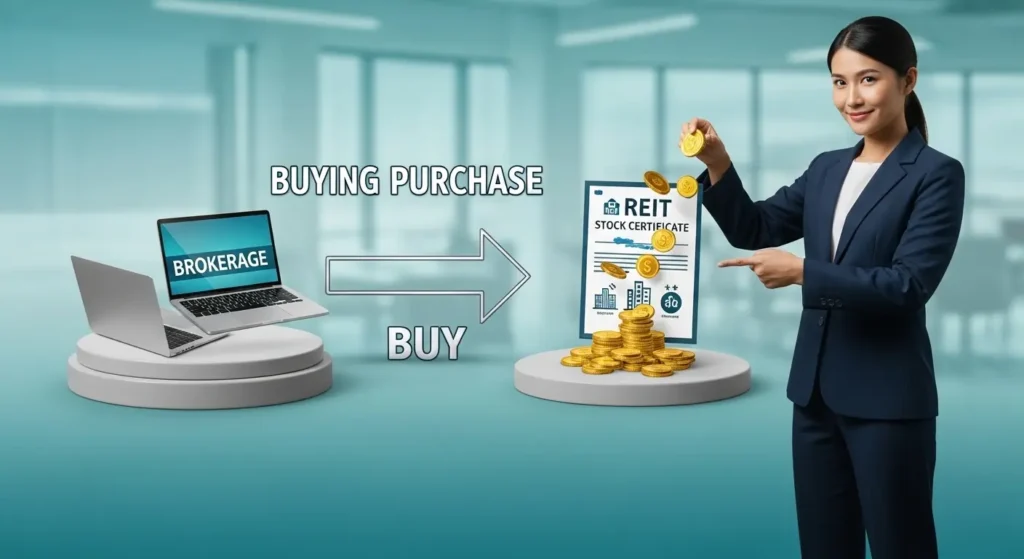
Practical guide to purchasing when you know what are REITs
Step 1: Open Brokerage Account
Choose broker:
- Fidelity
- Vanguard
- Charles Schwab
- E*TRADE
- Robinhood
All offer:
- $0 commission trading
- REIT access
- Easy platform
- Mobile apps
Setup time: 10-15 minutes
What you need:
- Social Security number
- Bank account to link
- Driver’s license (ID)
- Address
Process:
- Apply online
- Verify identity
- Link bank account
- Fund account
- Ready to buy REITs
To start investing in REITs with low fees and excellent platform, Vanguard offers commission-free trading and access to their popular VNQ REIT ETF. For comprehensive REIT research and analysis before investing, NAREIT provides industry data, REIT performance metrics, and educational resources on what are REITs.
Step 2: Research REITs
Before buying, research:
Financial metrics:
- Funds From Operations (FFO) – REIT version of earnings
- Dividend yield
- Payout ratio
- Debt levels
- Occupancy rates
Business quality:
- Property locations
- Tenant quality
- Management team
- Growth strategy
Where to research:
- REIT company websites
- Seeking Alpha
- REITwatch
- Investor presentations
- Do homework on what are REITs you’re considering
Step 3: Choose Your REITs
Beginner-friendly options:
Individual REITs:
- Realty Income (O) – Monthly dividends, retail
- Prologis (PLD) – Industrial leader
- AvalonBay (AVB) – Residential apartments
- American Tower (AMT) – Cell towers
REIT ETFs (diversified):
- Vanguard Real Estate ETF (VNQ) – Broad exposure
- Schwab US REIT ETF (SCHH) – Low cost
- iShares US Real Estate ETF (IYR) – Popular
ETFs = Instant diversification across 100+ REITs
Step 4: Buy Shares
Process:
1. Login to brokerage 2. Search for REIT ticker
- Example: “VNQ” or “O” or “PLD”
3. Click “Buy” or “Trade” 4. Enter details:
- Number of shares OR dollar amount
- Market order (buy at current price)
- OR limit order (set max price)
5. Review and confirm
- Double-check ticker
- Verify amount
- Confirm purchase
6. Order executes
- Typically instant (market hours)
- Shares appear in account
- You now own REITs
Total time: 2 minutes
Step 5: Set Up Dividend Reinvestment
DRIP = Dividend Reinvestment Plan
How it works:
- REITs pay quarterly dividends
- Instead of cash to account
- Automatically buy more shares
- Compound growth
Setup:
- Brokerage account settings
- Enable “Dividend Reinvestment”
- Select REITs to reinvest
- Automatic from then on
Benefits:
- No commissions on reinvestment
- Buy fractional shares
- Compound faster
- Passive growth when you understand what are REITs
Step 6: Monitor (But Don’t Obsess)
Quarterly review:
- Check dividend payments
- Review property news
- Read earnings reports
- Assess performance
Don’t:
- Check daily prices
- Panic on short-term drops
- Sell on volatility
- REITs are long-term holdings
Understanding what are REITs includes knowing they’re buy-and-hold investments.
REIT Advantages: Why Invest in REITs?
Benefits of investing when you understand what are REITs.
Advantage 1: Real Estate Exposure, No Landlord Work
Traditional real estate:
- Buy property: $300,000
- Down payment: $60,000
- Become landlord
- Handle repairs
- Deal with tenants
- 2 AM emergency calls
- Time and stress intensive
What are REITs:
- Buy shares: $3,000
- No down payment
- Professional management
- No repairs
- No tenants
- No calls
- Completely passive
Same real estate exposure, zero work.
Advantage 2: Low Minimum Investment
Traditional:
- $50,000-100,000 to start
- All in one property
- No diversification
- Capital intensive
REITs:
- $100 minimum (one share)
- Diversified immediately
- Accessible to all
- Democratized real estate
Advantage 3: Liquidity
Traditional:
- Sell property: 3-6 months
- Realtor fees: 6%
- Closing costs: 2-3%
- Illiquid
- Trapped capital
REITs:
- Sell shares: Instant
- No fees ($0 commissions)
- Cash in 2 days
- Liquid
- Access money anytime
Advantage 4: Diversification
Traditional:
- One property
- One location
- One tenant/market
- Concentrated risk
REITs:
- 50-200 properties
- Multiple states/countries
- Hundreds of tenants
- Diversified risk
- Instant diversification
Advantage 5: Professional Management
REITs employ:
- Experienced executives
- Property managers
- Acquisition teams
- Legal departments
- Expertise you can’t match
You benefit from:
- Better locations
- Better tenant negotiations
- Better financing terms
- Economies of scale
Advantage 6: Dividend Income
Required 90% distribution:
- Consistent cash flow
- Quarterly payments
- 3-8% yields typical
- Passive income stream
Comparison:
- Stocks: 1-2% dividend yield
- Bonds: 3-5% yield
- REITs: 3-8% yield
- Higher income than alternatives
Advantage 7: Inflation Hedge
Rents increase with inflation:
- CPI up 3%
- Rents up 3-5%
- Property values up
- REITs protect purchasing power
Leases adjust:
- Short-term (residential): Yearly increases
- Long-term (commercial): Built-in escalators
- Inflation-protected income
These advantages explain why investors explore what are REITs.
REIT Disadvantages: The Downsides
Challenges to consider when learning what are REITs.
Disadvantage 1: No Leverage Advantage
Traditional real estate:
- Buy $300k property
- $60k down (20%)
- Bank lends $240k
- 5:1 leverage
- Property appreciates on full $300k
- Leverage amplifies returns
REITs:
- Buy $10,000 of shares
- No leverage
- Returns on $10,000 only
- No amplification
Example:
- Property: 5% appreciation on $300k = $15,000 gain on $60k invested = 25% return
- REIT: 5% appreciation on $10k = $500 gain = 5% return
- Leverage advantage lost
Disadvantage 2: Tax Treatment
Dividends taxed as ordinary income:
- Not qualified dividends
- Taxed at income tax rate (up to 37%)
- No preferential rate
- Higher tax burden
Comparison:
- Qualified dividends: 15-20% tax
- REIT dividends: 22-37% tax (for most)
- Tax disadvantage
Solution:
- Hold REITs in IRA/401(k)
- Tax-deferred or tax-free growth
- Shelter from taxes
Disadvantage 3: Market Volatility
REITs trade like stocks:
- Daily price fluctuations
- Can drop 20-30% in recessions
- Correlation with stock market
- Volatility
Physical real estate:
- Doesn’t have daily price quotes
- Feels stable
- Ignorance is bliss
But:
- Property values DO fluctuate
- You just don’t see it daily
- REIT volatility is visibility, not necessarily more risk
Disadvantage 4: Interest Rate Sensitivity
Rising rates hurt REITs:
- Higher mortgage rates
- Higher borrowing costs
- Competition from bonds
- Price pressure
Example:
- Rates rise from 3% to 6%
- Bonds yield 6%
- REIT yielding 4% less attractive
- REIT price drops
- Inverse relationship
Disadvantage 5: No Direct Control
With property ownership:
- Choose renovations
- Select tenants
- Set rents
- Make decisions
- Total control
With REITs:
- Management decides
- You have no say
- Passive only
- No control
Trade-off:
- Control vs. Convenience
- Most prefer convenience
- What are REITs offer: hands-off ownership
Disadvantage 6: Fees (Some REITs)
Publicly traded: Low/no fees
- $0 commissions
- Low expense ratios (ETFs: 0.10-0.15%)
- Minimal costs
Non-traded REITs: High fees
- 7-15% upfront loads
- 1-2% annual fees
- Avoid these
Stick to publicly traded REITs = Avoid fee disadvantage.
Understanding both sides of what are REITs ensures informed decisions.
For comparison to other investments, see stocks vs bonds.
REIT Taxes: What You Need to Know
Tax considerations when investing in what are REITs.
REIT Dividend Taxation
Key point: Not qualified dividends
Regular stock dividends:
- Qualified dividend treatment
- 15-20% tax rate
- Favorable treatment
REIT dividends:
- Ordinary income treatment
- Your income tax rate (10-37%)
- Higher tax
Why:
- REITs don’t pay corporate tax
- Pass-through structure
- You pay the tax
- One level of tax, but at higher rate
Tax Example
Scenario: $10,000 REIT investment, 5% yield
- Annual dividends: $500
Your tax bracket: 24%
- Tax on dividends: $500 × 0.24 = $120
- After-tax income: $380
- After-tax yield: 3.8%
Vs. qualified dividends (15% rate):
- Tax: $500 × 0.15 = $75
- After-tax income: $425
- $45 difference
The QBI Deduction
Good news: 20% deduction (through 2025)
Qualified Business Income deduction:
- 20% of REIT dividends deductible
- Reduces taxable income
- Helps offset high rate
Example:
- REIT dividends: $500
- QBI deduction: $500 × 0.20 = $100
- Taxable income: $400
- Tax (24% bracket): $400 × 0.24 = $96
- Effective rate: 19.2%
- Much better
Note: Expires 2025 unless extended
Tax-Advantaged Accounts
Best strategy: Hold REITs in retirement accounts
IRA/401(k) benefits:
- No tax on dividends (while in account)
- No tax on capital gains
- Tax-deferred growth
- Maximizes returns
Roth IRA even better:
- Tax-free dividends
- Tax-free growth
- Tax-free withdrawals
- Perfect for REITs
Taxable account:
- Use for stocks with qualified dividends
- Use IRA for REITs
- Tax optimization when understanding what are REITs
Capital Gains on REITs
When you sell REIT shares:
- Standard capital gains treatment
- Short-term (under 1 year): Ordinary income rate
- Long-term (over 1 year): 15-20%
- Same as stocks
No different treatment here.
Return of Capital
Sometimes REITs distribute “return of capital”:
- Not taxable when received
- Reduces your cost basis
- Taxed when you sell
- Tax deferral
You’ll receive 1099-DIV showing breakdown:
- Ordinary dividends
- Capital gain distributions
- Return of capital
- Track for taxes
Tax considerations are important part of what are REITs education.
Best REITs for Beginners (Top Picks)
Recommended options when starting with what are REITs.
Option 1: REIT ETFs (Easiest)
Vanguard Real Estate ETF (VNQ)
- 170+ REITs
- Diversified across all sectors
- Expense ratio: 0.12%
- Dividend yield: ~4%
- One purchase = Full REIT exposure
Schwab US REIT ETF (SCHH)
- Similar to VNQ
- Expense ratio: 0.07% (lower)
- Good alternative
Why ETFs for beginners:
- Instant diversification
- No research needed
- Low cost
- Safe entry to what are REITs
Option 2: Blue Chip Individual REITs
If you want individual REITs, start with leaders:
Prologis (PLD) – Industrial
- Largest industrial REIT
- 1 billion sq ft globally
- Strong e-commerce tailwind
- Yield: ~2.5%, Growth: Strong
Realty Income (O) – Retail
- “The Monthly Dividend Company”
- 12,000+ properties
- 50+ year track record
- Pays monthly
- Yield: ~5%, Growth: Moderate
AvalonBay (AVB) – Residential
- Luxury apartments
- High-quality locations
- Recession-resistant
- Yield: ~3.5%, Growth: Steady
American Tower (AMT) – Cell Towers
- 220,000 towers
- 5G buildout beneficiary
- Global presence
- Yield: ~3%, Growth: Strong
Equinix (EQIX) – Data Centers
- Digital infrastructure
- Cloud computing growth
- Premium assets
- Yield: ~2%, Growth: Very strong
These five cover all major sectors when exploring what are REITs.
Recommended Allocation
Conservative beginner:
- 100% REIT ETF (VNQ)
- Maximum simplicity
Moderate beginner:
- 70% REIT ETF
- 30% Individual REITs (2-3 names from above)
- Some customization
Aggressive beginner:
- 50% REIT ETF
- 50% Individual REITs (4-5 names)
- More targeted exposure
Start with $1,000-5,000 total REIT allocation.
How Much to Allocate
Portfolio allocation guidance:
Conservative portfolio:
- 5-10% REITs
- 60% Stocks
- 30% Bonds
- Small REIT position
Moderate portfolio:
- 10-15% REITs
- 70% Stocks
- 15% Bonds
- Meaningful REIT exposure
Aggressive portfolio:
- 15-20% REITs
- 75% Stocks
- 5% Bonds
- Significant REIT allocation
Don’t over-concentrate in REITs. Diversify.
These picks simplify starting with what are REITs.
For portfolio construction, see how to diversify your investment portfolio.
REITs vs. Physical Real Estate: Which is Better?
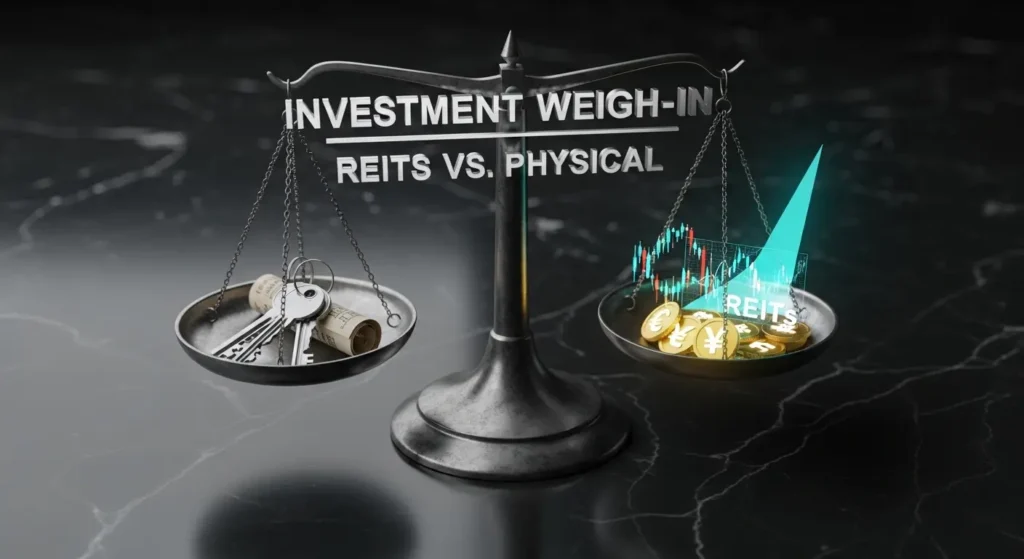
Comparing options when understanding what are REITs
Capital Required
Physical real estate:
- Down payment: $50,000-100,000
- Closing costs: $5,000-10,000
- Repairs/reserves: $10,000+
- Total: $65,000-120,000 minimum
REITs:
- Minimum: $100 (one share)
- Recommended: $1,000-5,000
- 65-120X less capital
Winner: REITs (accessibility)
Time Commitment
Physical real estate:
- Property search: 20-40 hours
- Due diligence: 10-20 hours
- Management: 5-10 hours/month
- Ongoing time sink
REITs:
- Research: 2-5 hours
- Purchase: 5 minutes
- Management: 0 hours
- Passive
Winner: REITs (time savings)
Leverage
Physical real estate:
- 5:1 leverage typical
- Amplifies returns
- $60k controls $300k
- Powerful
REITs:
- No leverage (unless margin)
- Returns on invested capital only
- No amplification
Winner: Physical real estate (leverage advantage)
Diversification
Physical real estate:
- Typically one property
- One location
- Concentrated
- All eggs one basket
REITs:
- 100+ properties (ETF)
- Multiple markets
- Diversified
- Risk spread
Winner: REITs (diversification)
Returns
Physical real estate:
- Appreciation: 3-5% annually
- Cash flow: 5-10% on equity
- Leverage amplifies
- Tax benefits
- 10-20% total returns possible
REITs:
- Appreciation: 5-7% annually
- Dividends: 3-5%
- No leverage
- Tax disadvantage
- 8-12% total returns typical
Winner: Physical real estate (if manage well), REITs (if not)
Liquidity
Physical real estate:
- Sell: 3-6 months
- Costs: 8-10%
- Illiquid
- Trapped
REITs:
- Sell: Instant
- Costs: $0
- Liquid
- Freedom
Winner: REITs (liquidity)
Summary: Which to Choose?
Choose physical real estate if:
- Have $50k+ to invest
- Want leverage benefits
- Enjoy property management
- Can handle illiquidity
- Comfortable with concentration
- Active investor mindset
Choose REITs if:
- Have $100-10,000 to invest
- Want passive income
- No time for management
- Need liquidity
- Want diversification
- Passive investor mindset
Best answer: BOTH
- REITs in retirement accounts
- Physical rental property if able
- Diversified real estate exposure
Both answer what are REITs and traditional real estate offer different benefits.
For more on real estate investing, see how to start investing in real estate with little money.
Common REIT Mistakes to Avoid
Errors when investing in what are REITs.
Mistake 1: Chasing Yield
The error:
- See REIT with 12% yield
- “Better than 4% yield!”
- Buy high-yield REIT
- Yield trap
The reality:
- High yield = High risk
- Dividend may be cut
- Share price drops
- Lose money
Example:
- REIT X: 12% yield, share price $20
- Dividend cut in half
- New yield: 6%
- Share price drops to $10
- 50% loss
The solution:
- Sustainable yields only (3-6%)
- Research payout ratio
- Check dividend history
- Quality over yield
Mistake 2: Ignoring Interest Rates
The error:
- Buy REITs
- Interest rates rise 2%
- REIT prices drop 20%
- Panic and sell
- Loss
The understanding:
- Rising rates pressure REITs
- Temporary, not permanent
- Dividends still pay
- Hold through cycle
The solution:
- Expect rate sensitivity
- Hold long-term
- Focus on dividends, not price
- Don’t panic sell
Mistake 3: Over-Concentrating
The error:
- Love REITs
- Put 50% of portfolio in REITs
- Sector-specific risk
- Too concentrated
The rule:
- REITs: 5-20% of portfolio
- Stocks: 60-80%
- Bonds: 10-30%
- Balanced allocation
Mistake 4: Buying Non-Traded REITs
The error:
- Advisor recommends non-traded REIT
- “Higher returns”
- Pay 7% upfront fee
- Can’t sell
- Trapped in expensive REIT
The solution:
- Only buy publicly-traded REITs
- On major exchanges
- $0 commissions
- Liquid
- Avoid non-traded
Mistake 5: Tax Account Placement
The error:
- Buy REITs in taxable brokerage
- Pay 24-37% tax on dividends
- Tax drag
The solution:
- Hold REITs in IRA/401(k)
- Tax-deferred or tax-free
- Maximize returns
These mistakes are common when first learning what are REITs.
Frequently Asked Questions – FAQ 👈
Q: What are REITs in simple terms?
A: Companies that own real estate, collect rent, and pay 90%+ to shareholders as dividends.
Think of it like this:
- You and 10,000 friends pool money
- Buy 100 apartment buildings together
- Hire managers to run them
- Collect rent from tenants
- Distribute 90% of rent to all investors
- That’s what are REITs
You get real estate exposure without:
- Buying property
- Being landlord
- Large capital
- Illiquidity
What are REITs = Passive real estate ownership through stocks.
Q: Are REITs a good investment?
A: Yes, for diversification and income, but not as sole investment.
Pros:
- Passive real estate exposure
- 3-8% dividend yields
- Diversification
- Liquidity
- Low minimum ($100)
Cons:
- Interest rate sensitive
- No leverage advantage
- Higher tax on dividends
- Market volatility
Best used:
- 5-15% of portfolio
- Long-term holding
- In retirement accounts
- Part of diversified portfolio
What are REITs work best as portfolio component, not primary holding.
Q: How much money do you need to invest in REITs?
A: $100 minimum for one share, $1,000-5,000 recommended to start.
Technically:
- One share of any REIT
- Many trade $50-200/share
- $100 gets you started
Practically:
- $1,000 minimum for diversification
- $5,000 for meaningful allocation
- $10,000+ for full REIT allocation
Start small:
- Month 1: Buy $500 REIT ETF
- Month 2: Add $500
- Month 3: Add $500
- Build over time
Understanding what are REITs doesn’t require wealth—just $100 to start.
Q: Do REITs pay monthly dividends?
A: Some do, most pay quarterly.
Monthly payers:
- Realty Income (O)
- STAG Industrial (STAG)
- LTC Properties (LTC)
- Minority of REITs
Quarterly payers:
- Majority of REITs
- Standard practice
- Paid every 3 months
Does it matter?
- Not really
- Total annual income same
- Just timing difference
- Monthly is nice but not necessary
Q: Can you lose money in REITs?
A: Yes. REITs can drop 20-40% in recessions, though dividend income cushions losses.
Risk examples:
2008 financial crisis:
- REITs dropped ~40%
- Dividend cuts common
- Painful losses
COVID-2020:
- REITs dropped 30% (March)
- Recovered by year-end
- Volatility
But:
- Dividends kept paying (most REITs)
- Long-term holders recovered
- Time heals
What are REITs are not risk-free, but long-term performance is strong.
Your REIT Investment Action Plan
Step-by-step plan to start with what are REITs.
Week 1: Education & Setup
Day 1-2: Learn
- Read this guide fully
- Understand what are REITs
- Research REIT types
- Build knowledge
Day 3-4: Open brokerage
- Choose broker (Fidelity, Vanguard, Schwab)
- Complete application
- Link bank account
- Ready to invest
Day 5-7: Research specific REITs
- VNQ (REIT ETF)
- 2-3 individual REITs
- Read company info
- Know what you’re buying
Week 2: First Purchase
Day 1: Decide allocation
- Total amount: $______
- REIT ETF: ____%
- Individual REITs: ____%
- Plan set
Day 2: Execute first purchase
- Buy REIT ETF (VNQ)
- Start with 50-100% here
- Simple, diversified
- Invested in what are REITs
Day 3-4: Add individual REITs (optional)
- Choose 1-2 from top picks
- Buy shares
- Customized exposure
Day 5: Set up DRIP
- Enable dividend reinvestment
- Automatic compounding
- Growth on autopilot
Month 2-6: Building Position
Monthly:
- Add $200-1,000
- Dollar-cost average
- Don’t time market
- Steady accumulation
Quarterly:
- Receive dividend payments
- Reinvested automatically
- Watch compounding
- Passive income growing
Month 7-12: Optimization
Actions:
- Rebalance if needed
- Add to winners
- Review performance
- Optimize allocation
By month 12:
- $5,000-10,000 in REITs
- Diversified across sectors
- Dividends flowing
- Solid REIT foundation
Year 2-10: Long-Term Holding
Strategy:
- Hold through cycles
- Reinvest dividends
- Add on dips
- Ignore short-term volatility
- Buy and hold what are REITs
Year 10 result:
- $50,000-100,000 REIT portfolio
- $2,500-5,000 annual dividends
- Significant wealth built
- Real estate empire, passively
🎥 BONUS
Want to see visual examples of what are REITs and how they work?
This video breaks down REIT investing:
FINAL THOUGHTS: What Are REITs = Accessible Real Estate
Here’s what most people don’t understand about what are REITs:
They think real estate investing requires massive capital.
See $400,000 house prices. Need $80,000 down payment. Give up.
“I’ll invest in real estate when I have more money.”
Never happens.
Here’s the truth:
What are REITs changes everything about real estate investing.
You don’t need:
- $80,000 down payment ($100 works)
- Mortgage approval (just buy shares)
- Property management skills (professionals handle it)
- Landlord responsibilities (zero tenant interaction)
- Illiquid capital tied up (sell instantly)
You just need to understand what are REITs and start with $100.
After following this guide:
Week 1:
- Learned what are REITs
- Opened brokerage account
- Bought VNQ (REIT ETF)
- $500 invested
- “I own real estate!”
Month 3:
- Added $500/month
- Portfolio: $2,000
- First dividend: $20
- “Passive income works”
Year 1:
- Consistent $500/month
- Portfolio: $6,500
- Annual dividends: $260
- “This is real”
Year 5:
- Portfolio: $35,000
- Annual dividends: $1,400
- Compounding visible
- “Built real wealth”
Year 10:
- Portfolio: $80,000
- Annual dividends: $3,200
- Significant income stream
- Real estate empire from $500/month
All from understanding what are REITs and taking action.
The question isn’t “What are REITs?”
You now know what are REITs are.
The question is: “Will I start this week?”
$100. One share. That’s all it takes.
Others wait for $80,000 down payment that never comes.
You start with $100 and build from there.
That’s the difference between real estate investor and real estate dreamer.
What are REITs provide the answer: Accessible, passive, profitable real estate ownership.
Open brokerage account today.
Buy VNQ this week.
Receive first dividend next quarter.
Your real estate portfolio starts now.
INTERESTING TOPICS
Want to learn about what are index funds to combine with REITs?
Ready to understand how to start investing in real estate with little money using REITs and other methods?
Need strategies for how to diversify your investment portfolio including REITs?
Want more financial insights delivered to you? Subscribe to our newsletter
and get weekly articles with practical strategies to grow your wealth sent straight to your inbox.
Obs: Sign up for our newsletter and receive a free Finance For Beginner eBook.
Disclaimer: This article is for educational purposes only. Diversification does not guarantee profits or protect against all losses. Consider your financial situation, risk tolerance, and investment timeline before making investment decisions.
—— End of Article ——