
The 50/30/20 Budget Rule: Simple Money Management That Works
Complete Guide
Last updated: March 2026
You know you should budget.
Everyone tells you: “Track your spending!” “Make a budget!” “Control your money!”
But then you try. You download a budgeting app.
You create 47 spending categories. You track every single penny for a week.
You get overwhelmed. You quit.
Budgeting feels complicated. So you give up.
But here’s what most people don’t realize: Budgeting doesn’t have to be complicated.
You don’t need 47 categories. You don’t need to track every penny.
You don’t need complex spreadsheets.
You need ONE simple rule: The 50/30/20 budget rule.
50% of your income for needs. 30% for wants. 20% for savings and debt. That’s it.
Most budgeting methods fail because they’re too complicated.
The 50/30/20 budget rule works because it’s simple enough to actually follow.
The wealthy understand something critical: Simple systems you stick with beat complex systems you abandon.
In this guide, you’ll learn exactly what the 50/30/20 budget rule is, why it works when other budgets fail, how to calculate your 50/30/20 breakdown, what counts as needs vs wants (the critical distinction), how to implement the 50/30/20 budget rule in your life, adaptations for different income levels, and most importantly—how to use the 50/30/20 budget rule to build wealth long-term.
By the end, you’ll have a simple money management system that actually works.
Let’s master the 50/30/20 budget rule.
What is the 50/30/20 Budget Rule?
The 50/30/20 budget rule is a simple money management system that divides your after-tax income into three categories.
The Basic Formula
After-Tax Income:
- 50% → Needs (essential expenses)
- 30% → Wants (lifestyle expenses)
- 20% → Savings & Debt (future security)
That’s the entire 50/30/20 budget rule. Three categories. Easy percentages. Simple math.
The Origin
The 50/30/20 budget rule was popularized by Senator Elizabeth Warren in her book “All Your Worth: The Ultimate Lifetime Money Plan.”
Why it caught on: Unlike complex budgets with dozens of categories, the 50/30/20 budget rule is simple enough for anyone to follow.
The Visual Example
Monthly income: $4,000 (after taxes)
Using the 50/30/20 budget rule:
- 50% = $2,000 → Rent, groceries, utilities, insurance, minimum debt payments
- 30% = $1,200 → Dining out, entertainment, hobbies, shopping, subscriptions
- 20% = $800 → Emergency fund, retirement, investments, extra debt payments
Total: $4,000 (100%)
That’s the 50/30/20 budget rule in action.
Why Three Categories?
Most budgets fail because:
- Too many categories (overwhelm)
- Too much tracking (tedious)
- Too complex (give up)
The 50/30/20 budget rule succeeds because:
- Three categories only (simple)
- Easy percentages (quick math)
- Flexible within categories (freedom)
Simplicity = Sustainability
Why the 50/30/20 Budget Rule Works (When Others Fail)
The 50/30/20 budget rule has a 70%+ success rate compared to traditional budgets (40% success rate).
Reason 1: Simple Enough to Remember
Traditional budget:
- 15 categories to track
- Different amount for each
- Constant mental math
- Result: Forget the plan by week 2
50/30/20 budget rule:
- 3 categories only
- Round percentages (50/30/20)
- Easy to remember forever
- Result: Actually stick with it
You can’t follow what you can’t remember.
The 50/30/20 budget rule is memorable.
Reason 2: Flexible Within Boundaries
Traditional budget:
- $200 for groceries
- $150 for gas
- $80 for utilities
- Exceed one category = budget “broken”
- Result: Give up
50/30/20 budget rule:
- $2,000 total for ALL needs
- Spend less on groceries, more on utilities? Fine.
- Stay under $2,000 total = success
- Result: Flexibility prevents quitting
Rigid budgets break. Flexible budgets bend.
Reason 3: Balances Present and Future
Many people make two mistakes:
Mistake 1: Save nothing (live only for today)
- Spend 100% of income
- No emergency fund
- No retirement
- Future crisis guaranteed
Mistake 2: Save everything (live miserably)
- Spend $0 on enjoyment
- Miserable daily life
- Eventually binge-spend and quit
The 50/30/20 budget rule balances both:
- 50% covers essentials (survival)
- 30% covers enjoyment (quality of life)
- 20% covers future (security)
Present happiness + Future security = Sustainable system
Reason 4: Automatic Priority System
The 50/30/20 budget rule tells you exactly what matters most:
Priority 1: Needs (50%)
- Must be paid first
- Essential to survive
- Non-negotiable
Priority 2: Savings (20%)
- Pay yourself second
- Build future security
- Before lifestyle spending
Priority 3: Wants (30%)
- Enjoy life last
- After needs and savings
- Guilt-free spending within limit
Most people do this backwards (wants first, savings never).
The 50/30/20 budget rule fixes this.
Reason 5: Works at Any Income Level
The 50/30/20 budget rule scales:
$2,000/month income:
- Needs: $1,000
- Wants: $600
- Savings: $400
$10,000/month income:
- Needs: $5,000
- Wants: $3,000
- Savings: $2,000
Same percentages. Different amounts. Always works.
How to Calculate Your 50/30/20 Budget
Step-by-step math for the 50/30/20 budget rule.
Step 1: Calculate After-Tax Income
Your starting number = take-home pay (after taxes)
If paid monthly:
- Look at paycheck
- Take net income (after taxes, healthcare, 401k)
- That’s your monthly income
Example: $4,500 after taxes = starting point
If paid biweekly:
- Take net income per paycheck
- Multiply by 26 (pay periods per year)
- Divide by 12 (months)
- That’s your monthly income
Example:
- $1,730 per paycheck
- $1,730 × 26 = $44,980/year
- $44,980 ÷ 12 = $3,748/month
If income varies:
- Average last 3-6 months
- Use conservative estimate
- That’s your monthly income
Example:
- Month 1: $3,200
- Month 2: $4,500
- Month 3: $3,800
- Average: $3,833/month
Step 2: Calculate Each Category
Once you have monthly after-tax income, multiply by percentages:
Example: $4,000/month after taxes
50% Needs: $4,000 × 0.50 = $2,000/month for needs
30% Wants: $4,000 × 0.30 = $1,200/month for wants
20% Savings: $4,000 × 0.20 = $800/month for savings
That’s your 50/30/20 budget breakdown.
Step 3: Verify It Equals 100%
Quick check:
- $2,000 (needs) + $1,200 (wants) + $800 (savings) = $4,000 ✓
- 50% + 30% + 20% = 100% ✓
Your 50/30/20 budget is calculated.
The 50% Category: Needs (Essential Expenses)

What counts as a “need” in the 50/30/20 budget rule?
Definition of Needs
Needs = Expenses required to survive and function
Test: “If I don’t pay this, do I lose my home, health, or job?”
- If YES = Need
- If NO = Want
What Counts as Needs (50%)
Housing (biggest need):
- ✅ Rent or mortgage payment
- ✅ Property taxes
- ✅ Home insurance
- ✅ HOA fees
- ✅ Essential repairs
Utilities:
- ✅ Electricity
- ✅ Water
- ✅ Gas/heating
- ✅ Internet (if required for work)
- ✅ Phone (basic plan)
Transportation:
- ✅ Car payment (if needed for work)
- ✅ Gas
- ✅ Car insurance
- ✅ Car maintenance
- ✅ Public transportation
Food:
- ✅ Groceries
- ✅ Basic household supplies
Healthcare:
- ✅ Health insurance premiums
- ✅ Prescriptions
- ✅ Necessary medical care
Minimum Debt Payments:
- ✅ Minimum credit card payment
- ✅ Student loan minimum
- ✅ Personal loan minimum
Childcare (if applicable):
- ✅ Daycare
- ✅ After-school care
Total needs should equal 50% of income or less.
What Does NOT Count as Needs
Common mistakes with the 50/30/20 budget rule:
Housing upgrades:
- ❌ Luxury apartment (over budget)
- ❌ House too expensive
- ✅ Affordable housing = need
- ❌ Expensive housing = want
Transportation extras:
- ❌ Car payment on luxury vehicle
- ❌ Uber/Lyft (unless no car option)
- ✅ Basic reliable car = need
- ❌ Nice car = want
Food extras:
- ❌ Dining out
- ❌ Delivery
- ❌ Premium groceries (organic everything)
- ✅ Basic nutritious food = need
- ❌ Fancy food = want
Phone/Internet:
- ❌ Latest iPhone with unlimited premium plan
- ✅ Basic phone with reasonable plan = need
- ❌ Premium plan = want
If Your Needs Exceed 50%
Problem: Needs are 70% of income
The 50/30/20 budget rule reveals you’re overspending on “needs.”
Solutions:
- Cheaper housing (roommate, smaller place, different area)
- Cheaper car (sell expensive car, buy used reliable)
- Lower insurance (shop around, raise deductibles)
- Cheaper phone plan (switch to budget carrier)
- Increase income (side gig, better job)
Goal: Get needs under 60% minimum, ideally 50%
The 30% Category: Wants (Lifestyle Expenses)
What counts as a “want” in the 50/30/20 budget rule?
Definition of Wants
Wants = Expenses that improve quality of life but aren’t essential
Test: “Could I survive without this?”
- If YES = Want
- If NO = Need
What Counts as Wants (30%)
Entertainment:
- ✅ Streaming services (Netflix, Spotify, etc)
- ✅ Movies, concerts, events
- ✅ Hobbies
- ✅ Gym membership
- ✅ Books, games
Dining:
- ✅ Restaurants
- ✅ Coffee shops
- ✅ Bars
- ✅ Food delivery
- ✅ Takeout
Shopping:
- ✅ Clothes (beyond basics)
- ✅ Shoes
- ✅ Accessories
- ✅ Electronics (upgrades)
- ✅ Home decor
Travel:
- ✅ Vacations
- ✅ Weekend trips
- ✅ Travel experiences
Personal Care:
- ✅ Hair salon (beyond basic cuts)
- ✅ Nails, spa treatments
- ✅ Premium skincare
- ✅ Non-essential grooming
Subscriptions:
- ✅ Monthly box subscriptions
- ✅ Premium apps
- ✅ Magazine subscriptions
Gifts:
- ✅ Birthday gifts
- ✅ Holiday gifts
- ✅ Special occasions
Total wants should equal 30% of income or less.
The Freedom Within 30%
This is the beauty of the 50/30/20 budget rule:
You have $1,200/month for wants (example).
How you spend it = your choice:
- Spend $800 on restaurants, $400 on clothes? Fine.
- Spend $600 on travel savings, $600 on entertainment? Fine.
- Spend $1,200 on one big purchase? Fine (once in a while).
The 50/30/20 budget rule gives freedom within boundaries.
Rule: Stay under 30% total. How you allocate it = flexible.
If Your Wants Exceed 30%
Problem: Wants are 50% of income
The 50/30/20 budget rule reveals lifestyle inflation.
Solutions:
- Cut subscriptions (cancel what you don’t use)
- Reduce dining out (cook more at home)
- Find free entertainment (parks, free events, library)
- Set spending limits (max $X on coffee per month)
- Delay gratification (save up for big wants)
Goal: Get wants under 40% minimum, ideally 30%
The 20% Category: Savings & Debt (Future You)
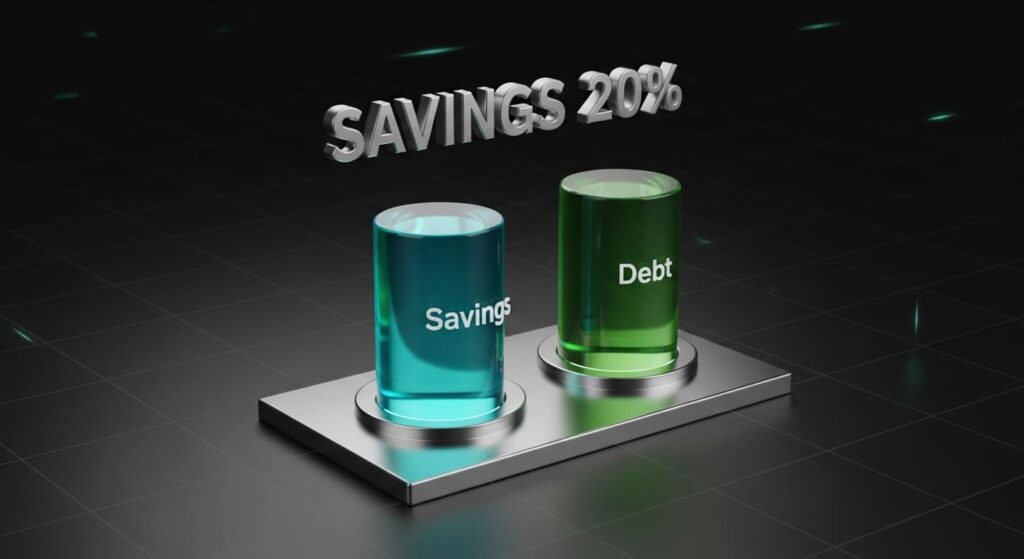
What counts in the 20% savings category of the 50/30/20 budget rule?
Definition of Savings & Debt
20% = Money that builds future security and eliminates financial stress
This category includes:
- Emergency fund
- Retirement savings
- Investments
- Extra debt payments (above minimums)
- Short-term savings goals
What Counts in the 20% Category
Emergency Fund:
- ✅ First priority
- ✅ Save $1,000 fast (starter fund)
- ✅ Then save 3-6 months expenses
- ✅ Keep in high-yield savings account
For more on how to build an emergency fund, this is your financial safety net that prevents debt.
Retirement Savings:
- ✅ 401(k) contributions (beyond employer match)
- ✅ IRA contributions
- ✅ Roth IRA
- ✅ Other retirement accounts
Investments:
- ✅ Brokerage account
- ✅ Index funds
- ✅ Stocks
- ✅ Real estate investment
Extra Debt Payments:
- ✅ Credit card payments (above minimum)
- ✅ Student loan payments (above minimum)
- ✅ Car loan extra payments
- ✅ Any debt payoff
If you need strategies for how to pay off debt fast, using your 20% category aggressively is key.
Short-Term Savings:
- ✅ House down payment
- ✅ Car replacement fund
- ✅ Wedding savings
- ✅ Major purchase savings
Total savings should equal 20% of income minimum.
Priority Order for the 20%
If you can’t do everything, prioritize this way:
Priority 1: $1,000 Emergency Fund
- First $800/month goes here (if saving 20%)
- Get to $1,000 fast
- Prevents new debt
Priority 2: Employer 401(k) Match
- Contribute enough to get full match
- This is FREE MONEY
- Don’t leave it on table
Priority 3: High-Interest Debt
- Credit cards (over 15% interest)
- Pay these aggressively
- Saves more than investing returns
Priority 4: 3-6 Month Emergency Fund
- After $1,000 and debt, build this
- Full financial security
- Sleep better at night
Priority 5: Retirement Beyond Match
- Max out 401(k) or IRA
- Build long-term wealth
- Future security
Priority 6: Low-Interest Debt
- Student loans (under 7%)
- Mortgage
- Pay these normally or invest instead
The Power of 20%
Saving 20% of income transforms your financial life:
Example: $4,000/month income, saving 20% ($800)
After 1 year:
- Emergency fund: $9,600 saved
- Credit card debt: $5,000 paid off
- Total progress: $14,600
After 5 years:
- Emergency fund: $12,000 (fully funded)
- Retirement: $35,000 (with returns)
- Debt: $0
- Total wealth: $47,000+
After 10 years:
- Emergency fund: $15,000
- Retirement: $120,000+ (with returns)
- Investments: $30,000
- Total wealth: $165,000+
20% savings rate = financial security
How to Implement the 50/30/20 Budget Rule

Step-by-step implementation of the 50/30/20 budget rule
Step 1: Calculate Your Numbers (Week 1)
Action:
- Calculate after-tax income
- Calculate 50/30/20 breakdown
- Write down the numbers
Example:
- Income: $3,500/month
- Needs (50%): $1,750
- Wants (30%): $1,050
- Savings (20%): $700
Step 2: Track Current Spending (Week 2)
Action:
- Track all expenses for one month
- Categorize as Need, Want, or Savings
- See where you actually stand
Tools:
- Bank app (review transactions)
- Budgeting app (Mint, YNAB, EveryDollar)
- Simple spreadsheet
What you’ll discover:
- “I thought I spent $400 on food… it’s actually $800”
- “My wants are 50%, not 30%”
- “I’m not saving anything”
Awareness = first step to using the 50/30/20 budget rule successfully
Step 3: Adjust Spending (Weeks 3-4)
If needs exceed 50%:
- Identify biggest expense (usually housing or car)
- Make plan to reduce (roommate, cheaper car, move)
- Short-term: Reduce wants to compensate
- Long-term: Actually reduce need expenses
If wants exceed 30%:
- Identify unnecessary spending
- Cut low-value expenses first
- Keep high-value enjoyment
- Redirect savings to 20% category
If savings under 20%:
- Automate savings first (pay yourself first)
- Treat 20% as mandatory bill
- Reduce wants to hit 20% target
Step 4: Automate the System (Month 2)
Make the 50/30/20 budget rule automatic:
On payday:
- 20% automatically transfers to savings account
- Bills (needs) on autopay
- Remaining 30% stays in checking for wants
Example: $4,000 monthly income
Automatic transfers:
- $800 → Savings account (20%)
- $2,000 → Bills account or autopay (50%)
- $1,200 → Spending account (30%)
Result: 50/30/20 budget rule happens automatically
Step 5: Monitor Monthly (Ongoing)
Monthly check-in (30 minutes):
- Review spending in all categories
- Check if stayed within 50/30/20
- Adjust if needed
- Plan next month
Quarterly review (1 hour):
- Review 3-month trends
- Adjust percentages if needed
- Celebrate progress
- Refine system
Annual review (2 hours):
- Full financial review
- Recalculate with new income
- Set new goals
- Update automation
Adapting the 50/30/20 Budget Rule for Your Income

The 50/30/20 budget rule isn’t one-size-fits-all – Here’s how to adapt it
If You’re Low Income (Under $30,000/year)
Reality: Needs often exceed 50%
Modified ratio: 60/20/20 or 70/20/10
- 60-70% Needs (higher housing cost burden)
- 20% Wants (still need quality of life)
- 10-20% Savings (whatever possible)
Strategy:
- Focus on increasing income (side gig, better job)
- Reduce needs over time (roommate, cheaper area)
- Start with even 5-10% savings (better than zero)
- Work toward standard 50/30/20 as income grows
Even 10% savings on low income = progress
If You’re High Income ($100,000+/year)
Reality: Needs are under 50%
Modified ratio: 30/30/40 or 40/20/40
- 30-40% Needs (lower percentage, still plenty)
- 20-30% Wants (enjoy wealth)
- 40-50% Savings (accelerate wealth building)
Strategy:
- Avoid lifestyle inflation (keep needs low)
- Increase savings rate aggressively
- Build wealth faster
- Retire earlier (FIRE movement)
High income = opportunity to save 40%+ and build wealth fast
If You Have High Debt
Reality: Need aggressive debt payoff
Modified ratio: 50/10/40
- 50% Needs
- 10% Wants (temporarily reduced)
- 40% Debt & Savings (attack debt)
Strategy:
- Use 30% for debt payoff
- Keep minimum 10% wants (prevents burnout)
- Keep 10% for emergency fund
- Once debt-free, return to standard 50/30/20
Temporary sacrifice = permanent freedom
If You’re Building Emergency Fund
Reality: Need security fast
Modified ratio: 50/20/30
- 50% Needs
- 20% Wants (slightly reduced)
- 30% Emergency Fund (until fully funded)
Strategy:
- Build $1,000 fast (30% dedicated)
- Then build 3-6 months expenses
- Once funded, return to 50/30/20
- Maintain emergency fund forever
Security first = financial peace
Common Mistakes with the 50/30/20 Budget Rule
Learn from these errors.
❌ Mistake 1: Miscategorizing Wants as Needs
The error:
- “My $200 phone bill is a need” (Basic plan = $40)
- “My $1,800 apartment is a need” (Roommate option = $900)
- “Eating out is a need” (Groceries = cheaper)
Result: “Needs” are 70%, can’t save, budget “doesn’t work”
Solution:
- Be honest: Need = survival, Want = preference
- Downgrade expensive “needs” to basic versions
- Reclassify wants appropriately
❌ Mistake 2: Not Including Irregular Expenses
The error:
- Budget for monthly bills only
- Forget car insurance (every 6 months)
- Forget annual subscriptions
- Forget holiday gifts
- Get “surprise” bills that break budget
Solution:
- List all irregular expenses
- Calculate monthly average
- Include in needs or wants category
- No surprises
Example:
- Car insurance: $600 every 6 months = $100/month
- Include $100 in needs category monthly
❌ Mistake 3: Not Automating Savings
The error:
- Plan to manually save 20% each month
- Spend first, save later
- “Later” never comes
- Save $0
Solution:
- Automate savings on payday
- 20% transfers before you see it
- Can’t spend what’s already saved
- Guaranteed 20% savings
Automation = success with 50/30/20 budget rule
❌ Mistake 4: Being Too Rigid
The error:
- Spend $1,199 on wants (under $1,200 limit)
- Emergency car repair: $300
- “Budget broken! Can’t touch savings!”
- Put on credit card instead
Solution:
- 50/30/20 budget rule is guideline, not prison
- Real emergencies use emergency fund
- Occasional month over 30% wants = okay
- Long-term average matters more
Flexibility prevents quitting
❌ Mistake 5: Not Adjusting for Life Changes
The error:
- Created 50/30/20 budget in January
- Got raise in July
- Never updated budget
- Spend entire raise on wants
Solution:
- Update budget with income changes
- Recalculate 50/30/20 with new income
- Allocate raises properly (some to wants, most to savings)
- Review quarterly
50/30/20 budget rule adapts with you
Tools to Track Your 50/30/20 Budget
Best tools for implementing the 50/30/20 budget rule.
Option 1: Simple Spreadsheet (Free)
How it works:
- Create spreadsheet with 3 categories
- List income and percentages
- Track spending weekly
- Verify staying within limits
Pros:
- ✅ Free
- ✅ Simple
- ✅ Complete control
- ✅ Works for anyone
Cons:
- ❌ Manual entry required
- ❌ No automation
- ❌ Basic features only
Best for: People who like control and simplicity
Option 2: Mint (Free App)
How it works:
- Connect bank accounts
- Automatically categorizes expenses
- Set up 3 budget categories (50/30/20)
- Tracks automatically
To get started with free automated budgeting that works with the 50/30/20 budget rule, download Mint by Intuit, which automatically categorizes your expenses and tracks your spending across all accounts.
Pros:
- ✅ Free
- ✅ Automatic tracking
- ✅ All accounts in one place
- ✅ Mobile app
Cons:
- ❌ Categorization sometimes wrong
- ❌ Ads and credit card offers
- ❌ Privacy concerns (connected to accounts)
Best for: People who want automation
Option 3: YNAB (You Need a Budget) – Paid
Cost: $14.99/month or $99/year
For serious budgeters willing to invest in their financial future, You Need A Budget (YNAB) offers a comprehensive budgeting system that can be customized to work perfectly with the 50/30/20 budget rule.
How it works:
- Zero-based budgeting system
- Adaptable to 50/30/20 budget rule
- Every dollar assigned purpose
- Manual but intentional
Pros:
- ✅ Forces intentional spending
- ✅ Excellent app and support
- ✅ Detailed reporting
- ✅ Very effective
Cons:
- ❌ Costs money
- ❌ Steeper learning curve
- ❌ Manual transaction entry
Best for: People serious about budgeting and willing to pay
Option 4: Simple Bank Accounts Method (Free)
How it works:
- 3 bank accounts
- Needs account (50%)
- Wants account (30%)
- Savings account (20%)
- Split paycheck automatically
Pros:
- ✅ Physical separation
- ✅ Can’t overspend categories
- ✅ Visual and automatic
- ✅ No app needed
Cons:
- ❌ Multiple accounts to manage
- ❌ Some banks charge fees
- ❌ Takes setup time
Best for: People who like physical separation
Frequently Asked Questions – FAQ 👈
Q: Is the 50/30/20 budget rule realistic for low income?
A: May need modification (60/20/20 or 70/20/10), but concept still applies.
Why:
- Lower income = higher percentage on needs (housing burden)
- Can still budget with modified percentages
- Goal: Work toward standard 50/30/20 as income grows
- Even 10% savings better than zero
Strategy: Start where you are, improve over time.
Q: Should I include retirement contributions in the 20% or take them out before calculating?
A: Two approaches work:
Approach 1: Include after 401(k)
- Calculate after-tax income AFTER 401(k) taken out
- Use that for 50/30/20 budget rule
- 20% goes to additional savings (IRA, emergency fund, debt)
Approach 2: Include in 20%
- Calculate before 401(k) contributions
- Count 401(k) as part of the 20%
- Remaining 20% goes to other savings
Both work. Choose whichever makes sense for you.
Most common: Approach 1 (after 401(k), then 50/30/20)
Q: What if my needs are 60-70% of income?
A: You have three options:
Option 1: Reduce needs
- Get roommate (reduce rent)
- Sell expensive car (reduce payment)
- Cheaper phone plan
- Lower insurance
Option 2: Increase income
- Side gig
- Better job
- Freelance work
- Part-time work
Option 3: Temporarily modify ratio
- Use 60/25/15 or 70/20/10 temporarily
- Work toward standard 50/30/20
- Focus on reducing needs long-term
Don’t give up on the 50/30/20 budget rule if needs are high. Adapt it.
Q: Can I use the 50/30/20 budget rule if I have irregular income?
A: Yes, with modification:
Strategy:
- Calculate average income (last 3-6 months)
- Use conservative estimate
- Apply 50/30/20 budget rule to that amount
- Extra income in good months → savings
- Lean months covered by emergency fund
The 50/30/20 budget rule works especially well for irregular income because it’s percentage-based.
Q: Should I pay off debt first or save first?
A: Both, using the 20% category strategically:
Priority order:
- Save $1,000 emergency fund (from 20%)
- Pay minimums on all debt (from needs 50%)
- Attack high-interest debt (from remaining 20%)
- Build 3-6 month emergency fund (from 20%)
- Pay off remaining debt (from 20%)
- Save and invest (from 20%)
The 50/30/20 budget rule’s 20% category handles all of this in order.
For detailed strategies, check out how to pay off debt fast while building savings.
Q: Is 20% savings enough?
A: Depends on age and goals:
20% is good for:
- ✅ Most people
- ✅ Starting out
- ✅ Average retirement goals
- ✅ Sustainable long-term
20% may not be enough if:
- ❌ Starting late (over 40)
- ❌ Want early retirement
- ❌ Have big goals (house down payment)
- ❌ Behind on savings
Solution: If you can save more than 20%, do it. Consider 30/30/40 ratio instead.
But 20% minimum beats what 70% of Americans save (less than 10%).
Your 50/30/20 Budget Action Plan
Step-by-step plan to implement the 50/30/20 budget rule.
Week 1: Calculate & Assess
Day 1-2: Calculate your numbers
- After-tax monthly income
- 50% = Needs budget
- 30% = Wants budget
- 20% = Savings budget
Day 3-7: Track current spending
- Review last month’s expenses
- Categorize as Need/Want/Savings
- Calculate actual percentages
- Identify gaps
Week 2: Plan Adjustments
If needs over 50%:
- List all need expenses
- Identify biggest (usually housing, car)
- Research cheaper alternatives
- Create reduction plan
If wants over 30%:
- List all want expenses
- Identify low-value spending
- Cancel unused subscriptions
- Plan cuts to hit 30%
If savings under 20%:
- Calculate gap
- Decide where to cut (wants first)
- Plan automatic transfers
- Set up savings system
Week 3: Set Up Automation
Actions:
- Open savings account (if needed)
- Set up automatic transfer (20% on payday)
- Set up bill autopay (needs)
- Create spending alerts (wants approaching limit)
Result: 50/30/20 budget rule runs automatically
Week 4: Execute
Actions:
- Let automation work
- Track wants spending manually
- Stay under 30% limit
- Adjust as needed
Monitor:
- Check savings transferred
- Verify bills paid
- Track wants category
- Ensure staying within limits
Month 2-3: Refine
Monthly review:
- Did you stay within 50/30/20?
- What worked?
- What needs adjustment?
- How can you improve?
Adjustments:
- Fine-tune categories
- Move money between wants
- Celebrate progress
- Keep going
Month 6+: Optimize
You’ve successfully used the 50/30/20 budget rule for 6 months.
Now optimize:
- Reduce needs further (if possible)
- Increase savings rate (if possible)
- Use wants intentionally
- Continue forever
The 50/30/20 budget rule becomes automatic lifestyle.
🎥 BONUS
Want to see real examples of people using the 50/30/20 budget rule successfully?
This video shows how different people implement it:
FINAL THOUGHTS: Simple Systems Win
Here’s what most people get wrong about budgeting:
They think budgeting is about restriction. It’s not.
Budgeting is about intentional living.
Most budgets fail because they’re complicated. 47 categories. Every penny tracked.
Constant mental math. Overwhelming spreadsheets.
People quit complicated systems.
The 50/30/20 budget rule succeeds because it’s simple:
- 50% needs
- 30% wants
- 20% savings
Three categories. Easy percentages. Anyone can remember it.
But here’s the deeper truth: The 50/30/20 budget rule is more than numbers.
It’s a philosophy:
- 50% = Take care of today (needs covered)
- 30% = Enjoy life (wants fulfilled)
- 20% = Build tomorrow (future secured)
Present + Enjoyment + Future = Balance
Most people live in one extreme:
- Spend everything (no future security)
- Save everything (no current enjoyment)
The 50/30/20 budget rule balances both.
You live comfortably today. You enjoy life through wants. You build wealth through savings.
That’s sustainable.
After implementing the 50/30/20 budget rule for 6-12 months:
- ✅ Needs under control
- ✅ Wants guilt-free
- ✅ Savings automatic
- ✅ Debt decreasing
- ✅ Wealth growing
- ✅ Stress reducing
Money stops controlling you. You control money.
The question isn’t “Is the 50/30/20 budget rule perfect?”
No budget is perfect.
But the 50/30/20 budget rule is simple enough to actually follow.
And a simple budget you stick with beats a perfect budget you abandon.
The question is: “Will you start today?”
If yes, 6 months from now you’ll have:
- Clear budget system
- Growing savings
- Controlled spending
- Financial confidence
For more advanced money management, learn about the difference between saving and investing to optimize that 20% category.
Start today. Use the 50/30/20 budget rule.
Transform your money.
INTERESTING TOPICS
Ready to learn how to build an emergency fund using your 20% savings category?
Want to discover how to pay off debt fast by dedicating your 20% to debt elimination?
Need to understand the difference between saving and investing to maximize your savings?
Want more financial insights delivered to you? Subscribe to our newsletter
and get weekly articles with practical strategies to grow your wealth sent straight to your inbox.
Obs: Sign up for our newsletter and receive a free Finance For Beginner eBook.
Disclaimer: This article is for educational purposes only and should not be considered financial advice. Budgeting approaches should be tailored to individual circumstances, income levels, and financial goals. The examples provided are for illustrative purposes and may not reflect your specific situation. The 50/30/20 rule is a guideline and may need adjustment based on your cost of living, debt obligations, and personal priorities. Consider consulting with a financial advisor for personalized guidance on managing your finances and creating a budget that works for your unique situation.
—— End of Article ——