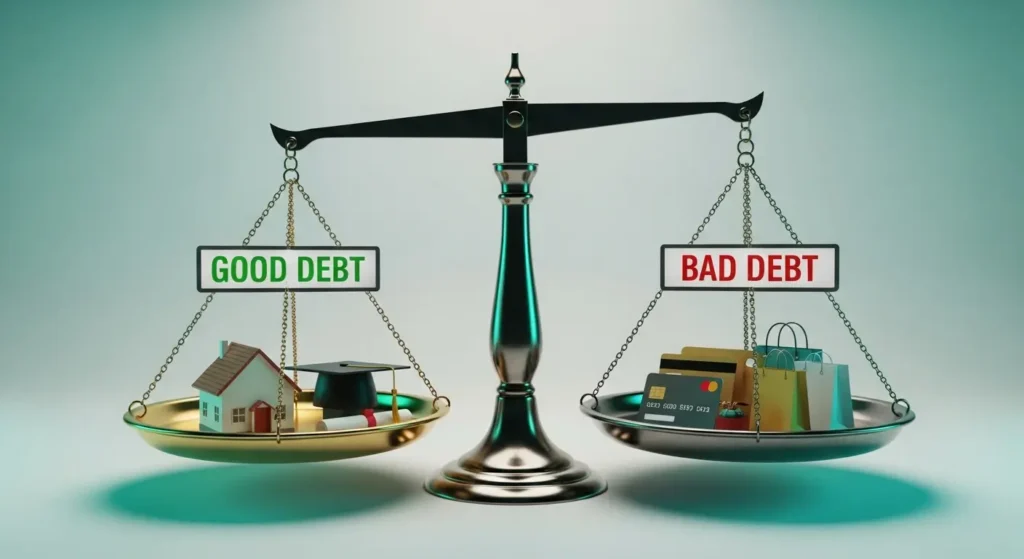
Good Debt vs Bad Debt: The Difference That Changes Everything
Complete Guide
Last updated: March 2026
You’re $50,000 in debt.
Your friend is $200,000 in debt.
You’re stressed. Your friend is calm.
Why?
Because not all debt is the same.
Your $50,000? Credit cards at 22% interest. You bought clothes, vacations, electronics.
Nothing increased your wealth. Just monthly payments draining your income.
Your friend’s $200,000? A mortgage on a $350,000 house that’s appreciating. Low 6% interest rate.
The house is building equity every month. In 10 years, it’ll be worth $500,000.
Same word—”debt”—but completely different outcomes.
This article was prepared especially for Finance For Beginner subscribers who requested this type of content due to the challenges they face in their personal and professional finances, for a better understanding
One destroys wealth. The other builds it.
Most people don’t understand this distinction. They hear “debt is bad” and avoid all borrowing. Or they think “debt is debt” and accumulate everything equally.
Both are wrong.
You understand compound interest? You know how to build an emergency fund?
You’ve learned how to diversify? You can read stock charts? You know how to negotiate raises?
Don’t worry, we’ve gathered all these topics (among others) into carefully crafted and separated articles to make your learning easier. Check out the “Categories” guide.
But ultimately, the wealthy understand something critical:
There’s good debt and bad debt. Knowing the difference changes everything.
Good debt makes you money. Bad debt costs you money. It’s that simple.
In this guide, you’ll learn exactly what makes debt “good” or “bad”, real examples of each type, when good debt becomes bad debt, how to evaluate if borrowing makes sense, which debts to pay off first, how to use leverage strategically, and most importantly—how to avoid bad debt while using good debt to build wealth.
By the end, you’ll know how to make debt work for you instead of against you.
Let’s decode debt.
What is Good Debt? (The Wealth Builder)
Good debt is borrowing that increases your net worth or generates income.
The Definition
Good debt:
- Buys assets that appreciate (go up in value)
- Generates income or future income
- Has low interest rates (under 7-8%)
- Improves your financial position
- Builds wealth over time
The Test
Ask yourself: “Will this debt make me money or save me money?”
If YES → Potentially good debt If NO → Probably bad debt
The Math
Example: Good Debt
Borrow $200,000 for house at 6% interest:
- House value: $250,000 (today)
- House value in 10 years: $350,000 (4% appreciation)
- Total interest paid: $230,000 (over 30 years)
- Equity built: $200,000 (principal paid down)
- Home appreciation: $100,000
- Net gain: $70,000+ (appreciation + equity – interest over 30 years)
Plus: You lived somewhere.
Alternative was rent ($300,000+ paid over 30 years with nothing to show).
Result: Good debt. Built wealth.
The Key Characteristics
Good debt usually has:
✅ Low interest rate (under 7-8%)
✅ Long repayment term (spreading cost)
✅ Asset backing it (house, business, education)
✅ Tax benefits (mortgage interest deduction, student loan interest)
✅ Predictable payments
✅ Clear payoff date
What is Bad Debt? (The Wealth Destroyer)
Bad debt is borrowing that decreases your net worth without building assets.
The Definition
Bad debt:
- Buys things that depreciate (lose value)
- Doesn’t generate income
- Has high interest rates (over 10%)
- Worsens your financial position
- Destroys wealth over time
The Test
Ask yourself: “Will I regret this purchase in 6 months?”
If YES → Bad debt If “I won’t even remember it” → Very bad debt
The Math
Example: Bad Debt
Borrow $5,000 on credit card at 22% for vacation:
- Minimum payment: $150/month
- Time to pay off: 4.5 years (paying minimums)
- Total interest paid: $3,100
- Value of vacation after 6 months: $0 (memories, but no financial value)
- Net loss: $3,100 (pure interest)
You paid $8,100 for a $5,000 vacation. And you have nothing to show for it financially.
Result: Bad debt. Destroyed wealth.
The Key Characteristics
Bad debt usually has:
❌ High interest rate (15-30%+)
❌ Short repayment term (but gets extended)
❌ No asset backing (or depreciating asset)
❌ No tax benefits
❌ Unpredictable payments (minimum payments that barely touch principal)
❌ No clear payoff date (revolving credit)
The Trap
Bad debt has a compounding effect:
Month 1: Owe $5,000
Month 6: Owe $5,500 (added interest + late fees)
Month 12: Owe $6,200 (keep using card, interest compounds)
Month 24: Owe $8,000 (debt grew while you “paid”)
You’re running on a treadmill. Making payments but going nowhere.
Real Examples of Good Debt
Let’s break down specific examples of good debt
Good Debt #1: Mortgage (Home Loan)
Why it’s good:
- Home typically appreciates 3-4% annually
- Builds equity as you pay down principal
- Low interest rate (5-7% typically)
- Tax deductible interest (in many countries)
- Alternative is rent (which builds zero equity)
The numbers:
$300,000 mortgage at 6.5% (30 years):
- Monthly payment: $1,896
- Total interest: $382,560
- Home value after 30 years (3% appreciation): $728,000
- Equity at payoff: $300,000
- Home appreciation: $428,000
- Net gain: $345,440 (appreciation + equity – interest)
Plus you lived there for 30 years.
Alternative: $1,800/month rent = $648,000 paid with $0 equity.
Conditions that keep it good:
✅ Buy home you can afford (payment under 28% of income)
✅ Put down 10-20% (avoids PMI, builds equity faster)
✅ Fixed-rate mortgage (predictable)
✅ Plan to stay 5+ years (covers transaction costs)
Good Debt #2: Student Loans (Strategic Education)
Why it’s good (when done right):
- Increases earning potential
- Opens career opportunities
- Relatively low interest (4-7% federal loans)
- Builds human capital (you’re the asset)
- Interest may be tax deductible
The numbers:
$30,000 student loans for nursing degree:
- Interest rate: 5%
- Monthly payment: $318
- Total interest: $8,184
- Career without degree: $35,000/year average
- Career with degree: $75,000/year average
- Difference: $40,000/year MORE income
- Return on investment over career: $1,200,000+ (30-year career earnings difference)
Conditions that keep it good:
✅ Degree leads to higher income (engineering, nursing, business, trades)
✅ Field has job demand (not oversaturated)
✅ Borrow only what’s necessary (not maximum offered)
✅ Federal loans over private (better terms, forgiveness options)
✅ Income increase > loan payment
When it becomes bad:
❌ $100,000+ for degree with $35,000/year salary
❌ Degree in oversaturated field with no jobs
❌ Private loans at 10%+ interest
❌ Borrowing for living expenses beyond tuition
Good Debt #3: Business Loans (Revenue-Generating)
Why it’s good:
- Funds income-generating asset (business)
- Allows faster growth than saving up
- Business revenue pays the loan
- Tax deductible interest
- Leverages credit to build wealth
The numbers:
$50,000 business loan at 7% for equipment:
- Equipment allows 5 new clients
- Revenue increase: $80,000/year
- Loan payment: $990/month ($11,880/year)
- Net profit after loan: $30,000/year
- Return on investment: 60% annually
After 5 years:
- Loan paid off
- Equipment still generating $80,000/year
- Total profit: $150,000+ (minus loan costs)
Conditions that keep it good:
✅ Business already profitable (proven model)
✅ Loan funds revenue-generating asset (not operating expenses)
✅ Revenue increase > loan payment
✅ Conservative projections (don’t overestimate)
✅ Business can survive if loan needs to be paid without new revenue
Good Debt #4: Real Estate Investment Loans
Why it’s good:
- Property generates rental income
- Property appreciates
- Tenants pay the mortgage
- Tax benefits (depreciation, deductions)
- Builds equity passively
The numbers:
$200,000 investment property loan at 7%:
- Monthly mortgage: $1,330
- Rental income: $1,800/month
- Expenses (taxes, insurance, maintenance): $300/month
- Cash flow: $170/month positive
- Property appreciation: 3%/year = $6,000/year
- Equity build: $400/month (principal paydown)
- Total return: ~$11,000/year (cash flow + appreciation + equity)
After 15 years:
- Mortgage paid down significantly
- Property worth $310,000 (appreciation)
- Tenants paid most of mortgage
- Net worth increase: $110,000+
Conditions that keep it good:
✅ Rental income covers mortgage + expenses
✅ Located in stable/growing market
✅ Positive cash flow (income > all costs)
✅ Emergency fund for repairs/vacancy
✅ Understand landlord responsibilities
Real Examples of Bad Debt

Now let’s look at bad debt that destroys wealth
Bad Debt #1: Credit Card Debt (Lifestyle Purchases)
Why it’s bad:
- High interest (18-28%)
- Buys depreciating items (clothes, food, entertainment)
- Items have $0 value shortly after purchase
- Interest compounds monthly
- Easy to overspend
The numbers:
$8,000 credit card debt at 22%:
- Minimum payment: $200/month
- Time to pay off: 6 years (paying minimums)
- Total interest: $6,400
- Items purchased: Now worth $0-500 (massive depreciation)
- Net loss: $6,400 (pure interest on worthless items)
You paid $14,400 for $8,000 of stuff that’s now worth almost nothing.
Common credit card traps:
❌ “I’ll pay it off next month” (then don’t)
❌ Buying wants instead of needs
❌ Only paying minimum
❌ Using credit card for emergencies (need emergency fund instead)
❌ Rewards chasing (spending $5,000 to get $50 back)
Bad Debt #2: Auto Loans (New Cars)
Why it’s often bad:
- New cars depreciate 20-30% first year
- High interest on depreciating asset
- Underwater immediately (owe more than car worth)
- Long terms (6-8 years) mean paying interest on worthless asset
- Alternative exists (used cars, saving up)
The numbers:
$35,000 new car loan at 7% (6 years):
- Monthly payment: $595
- Total paid: $42,840
- Car value after 6 years: $12,000
- Net loss: $30,840 (depreciation + interest)
vs. Buying $15,000 used car (cash or short loan):
- Depreciation over 6 years: $5,000
- Interest (if financed): $2,000
- Net loss: $7,000
Difference: $23,840 saved by avoiding new car debt
When auto loans are less bad:
✅ Buying reliable used car (3-5 years old)
✅ Short term (3-4 years max)
✅ Low interest (under 5%)
✅ Payment under 10% of income
✅ Need car for work/income
Bad Debt #3: Payday Loans
Why it’s terrible:
- Extremely high interest (400-500%+ APR!)
- Short repayment (2 weeks)
- Designed to trap you (rollover fees)
- Preys on desperate people
- Costs multiples of borrowed amount
The numbers:
$500 payday loan:
- Fee: $75 (2-week term)
- Can’t pay back in 2 weeks
- Rollover with new $75 fee
- After 6 rollovers: Paid $450 in fees on $500 loan
- Still owe the $500 principal
APR: 391% (comparison: credit cards are 18-28%)
Many people get trapped paying fees forever while principal never decreases.
NEVER use payday loans. Ever.
Better alternatives:
- Borrow from family/friends
- Side gig for quick cash
- Payment plan with creditor
- Credit union personal loan
- Even credit card is better (barely)
Bad Debt #4: Retail Store Credit Cards
Why it’s bad:
- Very high interest (25-30%)
- Encourages overspending (“Save 15% today!”)
- Tempting credit limits
- Deferred interest traps (“0% for 12 months… then 28% on full original balance if not paid off”)
- Hard inquiry for small benefit
The numbers:
$1,200 furniture on store card at 27%:
- “0% for 12 months” promotion
- Minimum payment: $50/month
- After 12 months: Paid $600
- Balance: $600 remaining
- Retroactive interest applied: $324 (27% on original $1,200 for full 12 months)
- Now owe: $924
- Many people didn’t realize this would happen
The trap: Deferred interest (not waived) applies retroactively if not paid in full by promotional end.
Bad Debt #5: Personal Loans for Luxuries
Why it’s bad:
- High interest (10-20%+)
- Paying interest on depreciating items
- Long payoff for short-term pleasure
- Nothing to show after loan is paid
- Opportunity cost (can’t save/invest)
The numbers:
$8,000 personal loan at 15% for vacation:
- Monthly payment: $238
- Total paid: $10,234
- Vacation value after: $0
- Net loss: $2,234 (interest on memories)
Compare to: Saving $666/month for 12 months = $8,000 cash = same vacation, $0 interest.
The Gray Area (When Good Debt Becomes Bad)
Some debt starts good but turns bad under certain conditions.
Student Loans Turn Bad When:
Scenario 1: Overborrowing
- Borrow: $100,000 for liberal arts degree
- Starting salary: $35,000/year
- Loan payment: $1,100/month
- Income after taxes: $2,300/month
- Loan takes 47% of income
- Can’t afford to live
- Good degree, bad debt amount
Scenario 2: Wrong Field
- Borrow: $60,000 for degree
- Field oversaturated/no jobs
- End up in unrelated job for $40,000/year
- Degree not helping income
- Still paying $600/month
- Debt with no return
The rule: Borrow no more than 1x your expected first-year salary.
Mortgages Turn Bad When:
Scenario 1: Too Much House
- Buy $400,000 house on $60,000 income
- Payment: $2,600/month (52% of income)
- “House poor” (no money for anything else)
- One emergency = can’t pay mortgage
- Good debt concept, bad execution
Scenario 2: Refinancing to Pull Cash
- Original mortgage: $200,000
- Home value: $300,000
- Refinance: $280,000 (pull out $80,000 cash)
- Spend $80,000 on cars, vacations, stuff
- Converted home equity to bad debt
- Now owe more, items depreciated
The rule: Keep housing payment under 28% of gross income.
Business Loans Turn Bad When:
Scenario 1: Borrowing for Operating Expenses
- Borrow $50,000 to cover payroll/rent
- Not investing in growth
- Just keeping lights on
- No revenue increase
- Debt doesn’t generate return
- Business still struggling + loan payment
Scenario 2: Overestimating Revenue
- Project: Loan will generate $100,000/year new revenue
- Reality: Only $30,000/year
- Loan payment: $1,000/month
- Revenue not covering payment
- Good plan, bad execution
The rule: Only borrow for revenue-generating assets, not operating costs.
How to Evaluate If Debt Makes Sense
Before borrowing, run it through this framework.
The 5-Question Test
Question 1: Will this increase my income or net worth?
YES = Potentially good debt
- Buying rental property (increases income)
- Business equipment (increases revenue)
- Education (increases salary)
NO = Probably bad debt
- Vacation
- New car
- Clothes
- Entertainment
Question 2: What’s the interest rate?
Under 5% = Cheap money (good debt potential)
5-8% = Moderate (evaluate carefully)
8-12% = Expensive (needs strong return to justify)
Over 12% = Very expensive (likely bad debt)
Over 20% = Avoid at all costs
Question 3: Can I afford the payment comfortably?
The comfort test:
- Payment < 10% of gross income = Comfortable
- Payment 10-20% of gross income = Manageable
- Payment 20-30% of gross income = Tight
- Payment > 30% of gross income = Dangerous
Example: Income: $5,000/month
- $300/month payment = 6% (comfortable)
- $800/month payment = 16% (manageable)
- $1,200/month payment = 24% (tight)
- $1,800/month payment = 36% (dangerous)
Question 4: What’s my alternative?
Compare borrowing to alternatives:
- Saving up: Takes longer but no interest
- Renting instead of buying: No equity but flexibility
- Buying used instead of new: Lower cost
- Going without: Sometimes best option
The opportunity cost test: If I pay $500/month debt payment, I can’t invest $500/month.
- $500/month invested at 8% for 30 years = $745,000
- Debt better be worth that opportunity cost
Question 5: What if things go wrong?
The disaster test:
- What if I lose my job? Can I still pay?
- What if business revenue drops 50%?
- What if interest rates rise (variable loan)?
- What if property doesn’t rent?
- What if I can’t sell the asset?
If “disaster” = “I’m ruined,” the debt is too risky.
The Decision Framework
GREEN LIGHT (Take the debt):
✅ Increases income or net worth
✅ Interest rate under 7%
✅ Payment under 15% of income
✅ Strong alternative comparison
✅ Can survive worst-case scenario
✅ Asset appreciates or generates income
YELLOW LIGHT (Evaluate carefully):
⚠️ Borderline return on investment
⚠️ Interest rate 7-10%
⚠️ Payment 15-25% of income
⚠️ Some risk involved
⚠️ Asset may or may not appreciate
RED LIGHT (Avoid the debt):
❌ Doesn’t increase wealth
❌ Interest rate over 10%
❌ Payment over 25% of income
❌ No good alternative comparison
❌ Can’t survive problems
❌ Asset depreciates
The Interest Rate Rule (The Decision Framework)
Here’s a simple way to think about interest rates and debt decisions.
The Interest Rate Hierarchy
0-4% Interest: “Free Money” Zone
- Borrow as much as you can (if it makes financial sense)
- Interest so low it’s beaten by inflation
- Money today worth more than money tomorrow
- Example: 3% mortgage while inflation is 3-4%
Strategy: Take the debt, invest extra money instead of paying early
5-7% Interest: “Strategic Debt” Zone
- Borrow if it increases income or builds equity
- Evaluate each situation
- Math works out if asset appreciates or generates income
- Example: 6% mortgage on appreciating home
Strategy: Take debt if strong financial reason, pay normally
8-10% Interest: “Expensive Debt” Zone
- Only borrow if strong ROI guaranteed
- Better to save up if possible
- Needs to generate significant income/appreciation to justify
- Example: 9% business loan that will double revenue
Strategy: Avoid unless clear financial gain, pay off aggressively if taken
11-15% Interest: “High-Cost Debt” Zone
- Avoid unless emergency
- Hard to justify mathematically
- Needs exceptional return to beat interest cost
- Example: 12% personal loan (only for true emergency)
Strategy: Avoid. If unavoidable, pay off ASAP as top priority
16%+ Interest: “Wealth Destroyer” Zone
- Never take this debt willingly
- Mathematically impossible to come out ahead
- Only in true survival emergency
- Example: Credit cards, payday loans
Strategy: Emergency fund prevents this. Pay off immediately if stuck with it
The Comparison to Investment Returns
Average stock market return: 8-10% annually
The rule:
- Debt under 8% = Could invest extra money instead of paying debt early
- Debt 8-10% = Roughly equal (slight edge to paying debt for guaranteed return)
- Debt over 10% = Pay off immediately (guaranteed return beats risky investments)
Example:
You have $10,000 extra. Two options:
- Pay extra on 4% mortgage
- Invest in stock market (8% expected return)
Option 1: Save 4% interest = $400/year return (guaranteed)
Option 2: Earn 8% return = $800/year (not guaranteed)
Math says: Invest (but some people prefer guaranteed debt payoff for peace of mind)
You have $10,000 extra. Two options:
- Pay off 18% credit card
- Invest in stock market (8% expected return)
Option 1: Save 18% interest = $1,800/year return (guaranteed)
Option 2: Earn 8% return = $800/year (not guaranteed)
Math says: Pay off credit card (guaranteed 18% return is incredible)
Which Debts to Pay Off First

If you have multiple debts, here’s the priority order.
The Debt Payoff Priority Pyramid
🔴 Priority 1: Payday Loans & Title Loans (Pay IMMEDIATELY)
- Interest: 300-500%+
- Trap you in cycle
- Pay these first even if means paying minimums on everything else
🟠 Priority 2: Credit Cards (High Interest)
- Interest: 18-28%
- No asset backing them
- Pure wealth destruction
- Pay aggressively after payday loans gone
Strategy: Use debt avalanche (highest interest first) or snowball (smallest balance first)
🟡 Priority 3: Personal Loans
- Interest: 10-15%
- Expensive but not catastrophic
- Pay after credit cards cleared
🟢 Priority 4: Auto Loans (Depreciating Asset)
- Interest: 5-10%
- Car losing value while you pay interest
- Mildly bad debt
- Pay normal schedule but consider paying extra to finish early
🔵 Priority 5: Student Loans (Federal)
- Interest: 4-7%
- Some tax benefits
- Income-based repayment options
- Forgiveness programs exist
- Pay normal schedule
Strategy: Pay minimums, focus on higher-interest debt first
🟦 Priority 6: Mortgage
- Interest: 5-7%
- Tax deductible
- Home appreciating
- Lowest priority for extra payments
Strategy: Pay normal schedule. Extra money better invested elsewhere (unless mortgage almost paid off or you hate debt psychologically)
The Exception: Psychological Debt Snowball
Math says: Pay highest interest first (avalanche)
Psychology says: Pay smallest balance first (snowball) for motivation
If you’ve failed at debt payoff before, use snowball even if it costs slightly more in interest. Success is better than perfect plan you quit.
How to Use Leverage to Build Wealth
The wealthy use “good debt” strategically. Here’s how.
Concept: Leverage
Leverage = Using borrowed money to increase returns
Example without leverage:
- Save $50,000 cash
- Buy $50,000 rental property (cash)
- Property appreciates 5%/year = $2,500/year
- Return on your money: 5%
Example with leverage:
- Save $50,000 cash
- Buy $250,000 rental property (20% down)
- Borrow $200,000 at 6% mortgage
- Property appreciates 5%/year = $12,500/year
- Rental income covers mortgage
- Return on your money: 25% ($12,500 return on $50,000 invested)
Same $50,000. Five times the return. That’s leverage.
The Wealth-Building Strategy
Step 1: Build excellent credit (670+ score)
Step 2: Save for down payment (10-20%)
Step 3: Buy appreciating asset (real estate, business)
Step 4: Use good debt (low interest, long term)
Step 5: Income from asset pays debt
Step 6: You gain equity + appreciation
Step 7: Repeat
The Rental Property Example
Year 1:
- Buy $200,000 rental property
- Put down $40,000 (20%)
- Borrow $160,000 at 6%
- Rent for $1,600/month
- Mortgage: $960/month
- Expenses: $400/month
- Cash flow: $240/month positive
After 10 years:
- Mortgage paid down to $120,000
- Equity built: $40,000 (principal paydown)
- Property appreciation: $60,000 (3%/year)
- Total cash flow: $28,800 ($240/month for 10 years)
- Your $40,000 investment is now worth $128,800
- Return: 322% over 10 years
That’s the power of leverage with good debt.
The Risk Warning
Leverage amplifies gains AND losses.
If property value drops 20%:
- Without leverage: You lose $10,000 (20% of $50,000)
- With leverage: You lose $50,000 (20% of $250,000 property value)
Use leverage carefully:
✅ Only on appreciating assets
✅ With positive cash flow
✅ With emergency fund
✅ When you understand the market
✅ When income is stable
Common Debt Mistakes People Make
Learn from these errors
❌ Mistake 1: “All Debt is Bad”
The error:
- Refuse to take any debt ever
- Miss wealth-building opportunities
- Save for 15 years for house (miss appreciation)
- Never leverage good opportunities
The solution:
- Understand good debt vs bad debt
- Use strategic debt for wealth building
- Avoid only bad debt
❌ Mistake 2: “Debt is Debt” (Treating All Equal)
The error:
- Pay extra on 4% mortgage while carrying 22% credit card balance
- Focus on student loans while high-interest cards destroy finances
- Don’t prioritize by interest rate
The solution:
- Pay off high-interest debt first
- Keep low-interest debt longer
- Understand the difference
❌ Mistake 3: Going Into Debt for Depreciating Assets
The error:
- Finance $40,000 new car
- Finance furniture, electronics, clothes
- Borrow for vacations
- Pay interest on items worth $0 soon
The solution:
- Only borrow for appreciating assets or income generation
- Save cash for depreciating items
- Wait until you can afford it
❌ Mistake 4: Not Reading the Fine Print
The error:
- “0% interest for 12 months!” (but 28% retroactive if not paid off)
- Variable rate loans (rate jumps from 4% to 12%)
- Balloon payments (small payments then huge final payment)
- Prepayment penalties (can’t pay off early without fee)
The solution:
- Read entire loan agreement
- Understand all terms
- Ask questions before signing
- Avoid “deals” that seem too good
❌ Mistake 5: Borrowing Without Plan to Repay
The error:
- “I’ll figure it out later”
- No budget
- No payment plan
- Hope income increases
The solution:
- Create repayment plan BEFORE borrowing
- Know exactly how you’ll pay it back
- Budget for payment
- Have buffer for emergencies
Frequently Asked Questions – FAQ 👈
Q: Is a mortgage good debt or bad debt?
A: Generally good debt because:
✅ Home typically appreciates
✅ Builds equity as you pay
✅ Tax deductible interest
✅ Alternative (rent) builds zero equity
BUT becomes bad debt if:
❌ Buy too much house (payment over 28% of income)
❌ Adjustable rate mortgage you can’t afford when rate rises
❌ Use home as ATM (cash-out refinances for spending)
Context matters.
Q: Should I pay off my mortgage early or invest?
A: Math says invest if mortgage rate is low.
Example: 4% mortgage:
- Paying extra = 4% guaranteed return
- Investing in stock market = 8-10% expected return (not guaranteed)
- Math favors investing
BUT: Many people prefer guaranteed return of debt payoff for peace of mind. Both are valid if mortgage is under 6%.
If mortgage over 8%: Pay off early (high guaranteed return).
Q: Are car loans ever good debt?
A: Rarely, but can be “acceptable debt” if:
✅ Buying reliable used car (not new)
✅ Interest rate under 5%
✅ Term 3-4 years maximum
✅ Payment under 10% of income
✅ Need car for work/income generation
Still not “good” debt (car depreciates), but sometimes necessary.
Best option: Save cash and buy used car outright.
Q: Should I take out student loans for college?
A: Depends on degree and amount.
GOOD decision:
✅ Federal loans (not private)
✅ Degree with strong job market (engineering, nursing, trades, business)
✅ Borrow less than expected first-year salary
✅ Affordable school (state school over expensive private)
BAD decision:
❌ Private loans at 10%+ interest
❌ Borrowing $100,000+ for low-income degree
❌ Degree in oversaturated field
❌ Expensive school when cheaper option exists
For more information on managing student loans, check out The National Foundation for Credit Counseling (NFCC), which provides free counseling services to help you create a plan for student debt.
The rule: Student loans are investment in yourself. Make sure ROI is positive.
Q: When should I use my emergency fund vs. taking on debt?
A:
Use emergency fund for:
✅ Job loss
✅ Medical emergency
✅ Urgent home/car repair
✅ True survival needs
Don’t use emergency fund for:
❌ Vacation
❌ New TV
❌ Holiday gifts
❌ Non-emergencies
Rebuild emergency fund immediately after use.
If you need guidance on building your emergency fund, that’s the foundation that prevents bad debt.
Emergency fund prevents bad debt. That’s its purpose.
Q: Can good debt become bad debt?
A: Yes. Context changes everything.
Examples:
Mortgage:
- Good: Buy $250,000 house on $80,000 income (affordable)
- Bad: Buy $500,000 house on $80,000 income (house poor)
Student loans:
- Good: $30,000 for nursing degree (job pays $75,000)
- Bad: $100,000 for art history degree (job pays $35,000)
Business loan:
- Good: Borrow to buy revenue-generating equipment
- Bad: Borrow to cover payroll/rent (not generating new revenue)
Good debt with poor execution becomes bad debt.
Your Debt Strategy Action Plan
Here’s your step-by-step framework.
Phase 1: Assess Current Debt (Week 1)
Day 1-2: List all debts
- Type of debt
- Balance owed
- Interest rate
- Monthly payment
- Category (good/bad)
Day 3-4: Classify each debt
- Good debt (mortgage, strategic student loans, appreciating assets)
- Bad debt (credit cards, payday loans, depreciating assets)
- Gray area (depends on specifics)
Day 5-7: Calculate total cost
- Total owed
- Total interest you’ll pay
- Time to payoff at current pace
Phase 2: Create Payoff Strategy (Week 2)
If you have bad debt:
- List bad debts by interest rate (highest to lowest)
- Pay minimums on all
- Attack highest interest first with extra money
- When paid off, attack next highest
- Continue until all bad debt gone
Target timeline: 2-4 years for most people
If you have only good debt:
- Make normal payments
- Don’t aggressively pay off (low interest)
- Use extra money to invest or build wealth
- Keep good credit utilization low
Phase 3: Prevent Future Bad Debt
Create system to avoid bad debt:
Rule 1: Emergency Fund First
- Build $1,000 minimum (prevents payday loans)
- Build to 3-6 months expenses (prevents credit card debt)
Rule 2: Cash-Only for Wants
- Need = survival (food, shelter, transportation)
- Want = everything else (vacation, new clothes, entertainment)
- Pay cash for wants or don’t buy
Rule 3: 24-Hour Rule
- Want to buy something over $100?
- Wait 24 hours
- If still want it, buy with cash
- Prevents impulse debt
Rule 4: Debit Over Credit
- Use debit card for daily spending
- Credit card only if paying full balance monthly
- Prevents overspending
Phase 4: Strategic Use of Good Debt
Once bad debt is eliminated:
Evaluate good debt opportunities:
- Mortgage (when ready to buy)
- Investment property (if positive cash flow)
- Business investment (if proven revenue)
- Strategic education (if clear ROI)
Run each through the 5-question test:
- Increases income/net worth?
- Interest rate acceptable?
- Can afford payment?
- Better than alternatives?
- Can survive problems?
If 5/5 YES: Consider taking good debt If 4/5 or less: Probably pass
Timeline
Months 1-3: Pay off highest-interest bad debt
- Aggressive payment on worst debt
- Minimums on rest
- Build $1,000 emergency fund
Months 4-12: Continue debt elimination
- Second-highest interest debt
- Then third
- Build emergency fund to 1 month expenses
Year 2: Finish bad debt payoff
- Last bad debts eliminated
- Emergency fund to 3-6 months
- Start considering good debt opportunities
Year 3+: Strategic wealth building
- Use good debt strategically
- Build wealth through leverage
- Maintain zero bad debt
🎥 BONUS
Want to see real examples of how people use good debt to build wealth while avoiding bad debt?
This video breaks down the concepts visually:
FINAL THOUGHTS: Debt is a Tool, Not a Trap
Here’s what the wealthy understand that most people don’t:
Debt is a tool. Like any tool, it can build or destroy.
A hammer can build a house or break a window.
Debt can build wealth or destroy it. The difference is how you use it.
Poor people avoid all debt.
They miss opportunities to build wealth through strategic leverage.
Middle class takes all debt.
They finance vacations, cars, furniture. Debt controls them.
Wealthy use good debt strategically.
They leverage low-interest borrowing to buy appreciating assets. Debt works for them.
The key is knowing the difference:
Good debt:
- Low interest (under 7%)
- Buys appreciating assets
- Generates income
- Builds wealth
Bad debt:
- High interest (over 10%)
- Buys depreciating items
- Generates nothing
- Destroys wealth
The rule is simple: Avoid bad debt. Use good debt strategically.
But here’s the truth: Most people do the opposite.
They avoid the 6% mortgage because “debt is scary” while carrying $15,000 on credit cards at 22%.
They refuse to leverage a rental property while financing a new car at 8%.
That’s backwards.
If you understand this distinction, you understand something most people never learn:
Debt doesn’t make you poor. Bad debt makes you poor.
A person with $300,000 in good debt (mortgage on appreciating property generating rental income) is in better financial position than someone with $8,000 in bad debt (credit cards for lifestyle purchases).
Net worth matters. Not total debt.
So here’s your mission:
Step 1: If you’re reading this article about how to pay off debt fast, start by eliminating all bad debt aggressively.
Credit cards first. Payday loans immediately. Get to zero bad debt.
Step 2: Build your emergency fund. 3-6 months expenses. This prevents future bad debt.
Step 3: Understand the difference between saving and investing.
Once debt-free, your money needs to work for you.
Step 4: When ready, use good debt strategically. Mortgage for home.
Investment property. Business growth. But only after bad debt is gone.
The question isn’t “Should I avoid all debt?”
The question is: “Am I using debt to build wealth or destroy it?”
Answer honestly. Then act accordingly.
Your financial future depends on knowing the difference.
INTERESTING TOPICS
Ready to learn how to pay off debt fast and eliminate bad debt?
Want to discover what is a credit score and how debt affects it?
Need to understand how to build an emergency fund to avoid bad debt?
Want more financial insights delivered to you? Subscribe to our newsletter
and get weekly articles with practical strategies to grow your wealth sent straight to your inbox.
Obs: Sign up for our newsletter and receive a free Finance For Beginner eBook.
Disclaimer: This article is for educational purposes only. Diversification does not guarantee profits or protect against all losses. Consider your financial situation, risk tolerance, and investment timeline before making investment decisions.
—— End of Article ——