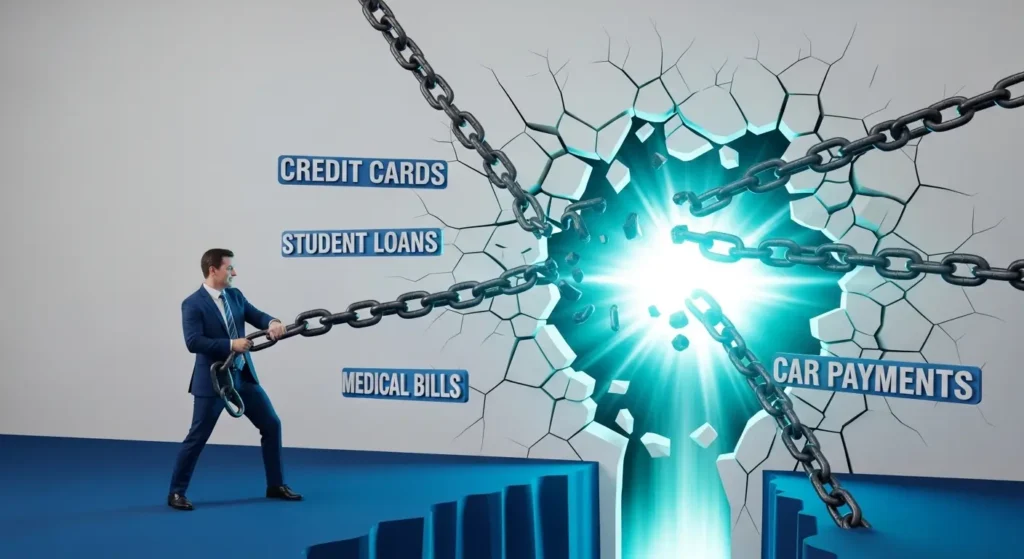
How to Pay Off Debt Fast: The Complete Strategy Guide
Last updated: March 2026
You’re drowning in debt.
Credit cards. Student loans. Car payments. Personal loans. Medical bills.
Every month, you make minimum payments.
Every month, the balance barely moves. Every month, interest piles up.
You feel trapped. Stuck. Powerless.
But here’s the truth: Debt is NOT permanent. It’s solvable.
The difference between people who escape debt and people who stay trapped isn’t luck. It’s strategy.
Some people pay off $50,000 in debt in 3 years. Others take 20 years to pay off $10,000.
Same debt. Different approach.
The wealthy understand something critical:
HOW you pay off debt matters more than HOW MUCH debt you have.
A person with $80,000 in debt using the right strategy will be debt-free faster than someone with $20,000 using the wrong approach.
In this guide, you’ll learn exactly what debt really costs you, the proven strategies to eliminate debt fast, how to choose the right method for your situation, the psychological tricks that keep you motivated, how to avoid common mistakes that keep people in debt forever, and most importantly—how to stay debt-free once you’ve escaped.
By the end, you’ll have a clear, actionable plan to destroy your debt and reclaim your financial freedom.
Let’s break free.
The True Cost of Debt (Why You Must Act Now)
Debt doesn’t just cost you money. It costs you everything.
The Money Cost
Example: $10,000 credit card debt at 18% APR
Scenario 1: Minimum payments only ($200/month)
- Total interest paid: $8,200
- Time to pay off: 9 years
- Total cost: $18,200
Scenario 2: Aggressive payments ($500/month)
- Total interest paid: $1,900
- Time to pay off: 2 years
- Total cost: $11,900
Difference: $6,300 saved + 7 years of freedom
Same debt. Different strategy. Massive difference.
The Opportunity Cost
While you’re paying debt:
- ❌ Can’t invest (missing compound growth)
- ❌ Can’t save for emergencies
- ❌ Can’t build wealth
- ❌ Can’t take opportunities
Example:
- $500/month to debt for 5 years = $30,000 paid
- $500/month invested at 8% for 5 years = $36,700 (gained $6,700)
Debt doesn’t just cost you money. It costs you wealth.
The Stress Cost
Debt creates:
- Constant anxiety
- Relationship stress
- Sleep problems
- Health issues
- Limited life choices
The bottom line: Every month you stay in debt, you’re losing money, opportunities, and freedom.
The Debt Inventory: Know Your Enemy
Before you fight, you must know exactly what you’re fighting.
Step 1: List Every Debt
Create a complete inventory:
| Debt Type | Balance | Interest Rate | Minimum Payment | Priority |
|---|---|---|---|---|
| Credit Card A | $5,000 | 22% | $150 | ? |
| Credit Card B | $3,000 | 18% | $90 | ? |
| Student Loan | $25,000 | 6% | $280 | ? |
| Car Loan | $12,000 | 5% | $350 | ? |
| Personal Loan | $8,000 | 12% | $200 | ? |
| TOTAL | $53,000 | – | $1,070 | – |
Step 2: Calculate Your Debt Metrics
Total Debt: Add all balances ($53,000 in example)
Monthly Obligations: Add all minimum payments ($1,070 in example)
Debt-to-Income Ratio:
- Monthly debt payments ÷ Monthly gross income
- Example: $1,070 ÷ $4,000 = 26.75%
- Under 36% = Manageable
- Over 43% = Critical (need aggressive action)
Weighted Average Interest Rate:
- Calculate total interest paid annually
- Divide by total debt
- Example: ~13% weighted average
Step 3: Face the Truth
If you only pay minimums on $53,000:
- Time to pay off: 15-25 years
- Total interest: $35,000-$60,000
- Total paid: $88,000-$113,000
If you pay aggressively ($1,500/month instead of $1,070):
- Time to pay off: 4-5 years
- Total interest: $8,000-$12,000
- Total paid: $61,000-$65,000
Difference: $27,000-$48,000 saved + 10-20 years of freedom
This is why strategy matters.
The Debt Avalanche Method (Mathematical Best)
The Strategy: Pay minimums on everything. Attack the highest interest rate first.
How It Works
Using our example:
Order of attack (highest interest first):
- Credit Card A (22%) – $5,000
- Credit Card B (18%) – $3,000
- Personal Loan (12%) – $8,000
- Student Loan (6%) – $25,000
- Car Loan (5%) – $12,000
Execution:
- Pay minimums on all debts: $1,070
- Find extra $430/month = $1,500 total budget
- Extra $430 goes to Credit Card A
- When Credit Card A is paid off, take that $150 minimum + $430 extra = $580
- Apply $580 to Credit Card B
- Keep cascading down
The Math
Debt Avalanche Results:
- Total interest paid: ~$9,500
- Time to debt freedom: 42 months (3.5 years)
- Total paid: ~$62,500
Compared to minimum payments:
- Saves: $25,500-$50,500
- Faster by: 12-22 years
Pros:
✅ Mathematically optimal (saves most money)
✅ Fastest (gets out of debt soonest)
✅ Logical (targets expensive debt first)
Cons:
❌ Doesn’t provide quick wins
❌ Can feel slow if highest-rate debt is large
❌ Requires discipline (no immediate gratification)
Best for: People motivated by math and maximum savings
The Debt Snowball Method (Psychological Best)

The Strategy: Pay minimums on everything.
Attack the smallest balance first.
How It Works
Using our example:
Order of attack (smallest balance first):
- Credit Card B (18%) – $3,000
- Credit Card A (22%) – $5,000
- Personal Loan (12%) – $8,000
- Car Loan (5%) – $12,000
- Student Loan (6%) – $25,000
Execution:
- Pay minimums on all debts: $1,070
- Find extra $430/month = $1,500 total budget
- Extra $430 goes to Credit Card B
- When Credit Card B is paid off (7 months), celebrate!
- Take that $90 minimum + $430 extra = $520
- Apply $520 to Credit Card A
- Keep rolling the snowball
The Math
Debt Snowball Results:
- Total interest paid: ~$11,000
- Time to debt freedom: 44 months (3.7 years)
- Total paid: ~$64,000
Compared to Avalanche:
- Costs: ~$1,500 more in interest
- Takes: ~2 months longer
But here’s the key: You get WINS faster
- Debt eliminated in 7 months (Credit Card B)
- Second debt gone in 16 months (Credit Card A)
- Three debts gone in 26 months
Pros:
✅ Quick psychological wins (motivation boost)
✅ Simplifies (fewer debts to track)
✅ Builds momentum (snowball effect)
✅ Higher success rate (people stick with it)
Cons:
❌ Costs slightly more in interest (~$1,500 in example)
❌ Takes slightly longer (~2 months in example)
❌ Not mathematically optimal
Best for: People who need motivation and quick wins to stay on track
The Debt Consolidation Strategy
The Strategy: Combine multiple debts into one loan with lower interest.
How It Works
Before consolidation:
- Credit Card A: $5,000 at 22%
- Credit Card B: $3,000 at 18%
- Personal Loan: $8,000 at 12%
- Total: $16,000 at weighted avg 16.5% interest
After consolidation:
- Consolidation Loan: $16,000 at 8-10%
- One payment instead of three
- Lower interest = more goes to principal
Consolidation Options
Option 1: Personal Consolidation Loan
- Get loan from bank/credit union
- Interest: 6-12% (if good credit)
- Fixed term: 3-5 years
- One monthly payment
Option 2: Balance Transfer Credit Card
- 0% APR for 12-18 months
- Transfer fee: 3-5%
- Must pay off during 0% period
- Good for short-term payoff
Option 3: Home Equity Loan (RISKY)
- Use home equity to pay debts
- Interest: 5-8%
- Tax deductible interest
- DANGER: Your home is collateral (can lose it!)
The Math
Example: $16,000 debt consolidated at 9%
Before (16.5% average):
- Monthly payment: $500
- Interest over 4 years: $7,900
- Total paid: $23,900
After (9% consolidated):
- Monthly payment: $400
- Interest over 4 years: $3,200
- Total paid: $19,200
Savings: $4,700 + lower monthly payment
Pros:
✅ Lower interest rate
✅ Simplified (one payment vs many)
✅ Lower monthly payment
✅ Easier to track
Cons:
❌ Requires good credit to qualify
❌ Doesn’t address spending habits
❌ Risk of running up cards again
❌ May have origination fees
Best for: People with good credit and multiple high-interest debts
WARNING: Only works if you stop using credit cards after consolidation!
How to Choose Your Debt Payoff Method
The right method depends on your personality and situation.
Choose Debt Avalanche If:
✅ You’re motivated by math and logic
✅ You can delay gratification
✅ Saving maximum money matters most
✅ Your highest-interest debt isn’t huge
✅ You have strong discipline
Choose Debt Snowball If:
✅ You need quick wins to stay motivated
✅ You’ve failed at debt payoff before
✅ You have several small debts
✅ Psychological momentum matters
✅ You need to see progress quickly
Choose Debt Consolidation If:
✅ You have good credit (650+)
✅ You have multiple high-interest debts
✅ You can get significantly lower rate (3%+ reduction)
✅ You’ve stopped using credit cards
✅ You want simplified payments
Hybrid Approach (My Recommendation)
Step 1: Consolidate high-interest debt if possible (lower rates)
Step 2: Use Snowball on remaining debts (quick wins)
Step 3: Once momentum builds, switch to Avalanche (maximum savings)
Example:
- Consolidate 3 credit cards into one 9% loan
- Pay off smallest remaining debt (car loan $2,000) – quick win
- Switch to Avalanche for remaining larger debts
Best of all worlds:
- ✅ Lower interest (consolidation)
- ✅ Quick win (snowball)
- ✅ Maximum savings (avalanche)
Finding Extra Money to Pay Debt Faster

The faster you pay, the less you pay total.
Here’s how to find extra money.
Strategy 1: Cut Unnecessary Expenses
Audit your spending. Find waste.
Common cuts:
- Unused subscriptions: $50-150/month
- Eating out less: $100-300/month
- Downgrade phone plan: $20-50/month
- Cancel gym (workout at home): $30-60/month
- Shop generic brands: $50-100/month
- Cut cable (use streaming): $50-100/month
Potential extra: $300-760/month
Strategy 2: Increase Income
Earn more. Pay debt faster.
Side income ideas:
- Freelance work: $200-1,000/month
- Rideshare driving: $300-800/month
- Online tutoring: $200-600/month
- Sell unused items: $100-500 (one-time)
- Part-time job: $500-1,200/month
For finding freelance opportunities to earn extra income for debt payoff, platforms like Upwork Freelance Platform connect you with clients worldwide looking for your skills.
Potential extra: $500-2,000/month
Strategy 3: Use Windfalls Strategically
Every unexpected money = debt payment
Windfalls:
- Tax refund: $1,000-3,000
- Work bonus: $500-5,000
- Gift money: $100-500
- Side gig payment: varies
Rule: 100% of windfalls to debt (during payoff phase)
The Impact
Example: $53,000 debt
Paying $1,070/month (minimums only):
- Time: 20+ years
- Total paid: ~$100,000
Paying $1,500/month (+$430 extra):
- Time: 3.5 years
- Total paid: ~$62,500
- Savings: $37,500 + 16.5 years
Paying $2,000/month (+$930 extra):
- Time: 2.5 years
- Total paid: ~$58,000
- Savings: $42,000 + 17.5 years
Every extra dollar = massive return.
The Negotiation Strategy (Lower Your Interest Rates)
You can often negotiate lower rates. Here’s how.
Credit Card Rate Negotiation
The Script:
“Hi, I’ve been a customer for [X years] and have always paid on time.
I’m currently paying 22% interest on my balance, but I see competitor cards offering 15-18%.
Can you lower my rate to match?”
Success rate: 50-70% if you have:
- ✅ Good payment history
- ✅ Been customer 1+ years
- ✅ Decent credit score
Average reduction: 3-5%
Impact on $5,000 balance:
- Before: 22% = $1,100/year in interest
- After: 17% = $850/year in interest
- Savings: $250/year (just from one call!)
Student Loan Refinancing
If you have private student loans:
- Shop refinancing companies
- Get 1-3% lower rate
- Fixed vs variable decision
Example: $25,000 at 6%
- Refinance to 4.5%
- Monthly payment drops $30-50
- Total savings: $2,000-4,000 over life of loan
Medical Debt Negotiation
Medical bills are HIGHLY negotiable.
Tactics:
- Ask for itemized bill (often find errors)
- Request financial hardship discount (30-60% off)
- Offer lump sum payment (20-40% discount for cash)
- Set up payment plan (often 0% interest)
Success rate: 70-90% (medical providers want something vs nothing)
Staying Motivated Through the Journey
Debt payoff is a marathon, not a sprint. Here’s how to stay motivated.
Tactic 1: Visual Trackers
Make progress visible.
Options:
- Debt thermometer (color in as you pay)
- Debt-free chart (cross off debts)
- Spreadsheet with graphs
- Debt payoff app (visual progress)
Psychology: Seeing progress = motivation to continue
Tactic 2: Celebrate Milestones
Reward yourself (smartly) at milestones.
Milestones:
- First $1,000 paid off → Nice dinner ($50)
- First debt eliminated → Fun experience ($100)
- 50% paid off → Weekend trip ($200-300)
- Debt freedom → Big celebration ($500-1,000)
Rule: Reward must be cash (never debt!) and planned
Tactic 3: Accountability Partner
Tell someone your goal. Report progress monthly.
Options:
- Spouse/partner
- Close friend
- Family member
- Online community
Accountability increases success rate by 65%
Tactic 4: Visualize Debt-Free Life
What will you do when debt-free?
List your dreams:
- Invest $500/month
- Save for house down payment
- Take dream vacation
- Start business
- Help family
Keep this list visible. Read it when tempted to quit.
Tactic 5: Track Non-Financial Wins
Debt payoff improves:
- ✅ Sleep quality
- ✅ Relationship harmony
- ✅ Stress levels
- ✅ Confidence
- ✅ Focus at work
Journal these improvements. Motivation isn’t just about numbers.
Common Debt Payoff Mistakes to Avoid
Learn from others’ failures.
❌ Mistake 1: Not Building Small Emergency Fund First
The error:
- Pay all extra money to debt
- Car breaks down ($800 repair)
- No savings
- Put repair on credit card
- Back in debt
The solution:
- Save $500-1,000 before aggressive debt payoff
- This prevents new debt during payoff
- Once debt-free, build full 3-6 month emergency fund
❌ Mistake 2: Trying to Pay All Debts Equally
The error:
- Split extra money across all debts
- No debt gets paid off quickly
- No wins
- Lose motivation
- Quit
The solution:
- Pick ONE method (Avalanche or Snowball)
- Attack ONE debt at a time
- Celebrate each payoff
- Build momentum
❌ Mistake 3: Not Addressing Spending Habits
The error:
- Pay off credit cards
- Keep overspending
- Run cards back up
- Back to square one
The solution:
- Create budget WHILE paying debt
- Track spending
- Identify triggers (stress shopping, keeping up with friends)
- Change habits permanently
❌ Mistake 4: Quitting When You Slip Up
The error:
- Make great progress
- One month overspend $200
- Feel like failure
- Quit entire plan
The solution:
- Expect imperfection
- One bad month ≠ failure
- Adjust and continue
- Progress > Perfection
❌ Mistake 5: Not Increasing Payments as Income Grows
The error:
- Get raise ($200/month extra)
- Lifestyle inflation (spend it)
- Debt payoff stays same speed
The solution:
- Every raise = increase debt payment
- Every bonus = lump sum to debt
- Aggressively attack debt while income grows
How to Stay Debt-Free Forever

Paying off debt is half the battle.
Staying debt-free is the other half.
Rule 1: Never Carry Credit Card Balance
The habit:
- Use credit cards for rewards
- Pay full balance every month
- Never pay interest again
If you can’t do this → Don’t use credit cards
Rule 2: Live Below Your Means
The formula:
- Earn $4,000/month
- Spend $3,500/month
- Save/invest $500/month
This creates:
- ✅ No new debt
- ✅ Emergency fund grows
- ✅ Wealth building begins
Rule 3: Build Full Emergency Fund
Once debt-free:
- Save 3-6 months expenses
- Keep in high-yield savings
- Only for TRUE emergencies
This prevents going back into debt
Rule 4: Use Cash for Big Purchases
New rule:
- Want new car? Save cash.
- Want furniture? Save cash.
- Want vacation? Save cash.
Exception: Mortgage (good debt with asset backing)
Rule 5: Annual Money Check-In
Every year:
- Review spending
- Check for lifestyle inflation
- Adjust budget
- Ensure staying on track
Prevention is easier than correction
Frequently Asked Questions – FAQ 👈
Q: Should I pay off debt or invest?
A: Depends on interest rate.
- Debt over 7% interest → Pay off first
- Debt under 4% interest → Can invest while paying minimums
- Debt 4-7% → Hybrid (pay extra on debt + invest 401k match)
High-interest debt costs more than investments earn. Eliminate it first.
Q: Should I stop contributing to retirement while paying debt?
A:
- Always contribute enough to get employer match (free money)
- Beyond that, pause if debt is over 10% interest
- Resume full contributions once debt-free
Q: How long will it take to pay off my debt?
A: Use this formula:
- Total debt ÷ (monthly payment – monthly interest) = months
Example: $10,000 debt at 18% ($150 interest/month), paying $500/month
- $10,000 ÷ ($500 – $150) = 28.5 months
Q: What if I can’t afford minimum payments?
A:
- Contact lenders (explain situation, request hardship plan)
- Consider credit counseling (nonprofit agencies help)
The National Foundation for Credit Counseling provides free credit counseling services to help you create a debt management plan and negotiate with creditors.
- Explore debt management plan (consolidated payment)
- Last resort: Bankruptcy (damages credit 7-10 years)
Q: Should I use my savings to pay off debt?
A:
- Keep $500-1,000 emergency fund
- Use rest to pay off high-interest debt (15%+)
- Rebuild savings once debt is gone
Q: Can I negotiate settled debts?
A: Yes, especially for:
- Collections accounts
- Medical bills
- Old credit card debt
Offer 30-50% lump sum. Get agreement in writing before paying.
Your Debt Freedom Action Plan
Here’s your step-by-step roadmap.
Week 1: Assess
Day 1-2: Create complete debt inventory
- List all debts
- Record balances, rates, minimums
- Calculate total debt
Day 3-4: Analyze current spending
- Track where money goes
- Find waste
- Identify cuts
Day 5-7: Calculate debt payoff scenarios
- Current pace (minimums only)
- With extra $200/month
- With extra $500/month
Week 2: Plan
Day 1-2: Choose your method
- Avalanche (math)
- Snowball (psychology)
- Consolidation (simplify)
- Hybrid (best of all)
Day 3-4: Create budget
- Income
- Necessary expenses
- Debt payments
- Extra payment amount
Day 5-7: Set up systems
- Automatic payments
- Tracking spreadsheet
- Visual motivators
Week 3-4: Execute
Day 1: Make first aggressive payment
Day 7: Review first week progress
Day 14: Adjust if needed
Day 21: Celebrate first month milestone
Day 28: Plan next month
Ongoing: Monthly Routine
Each month:
- Make all debt payments
- Track progress
- Find extra money (cuts or income)
- Apply extra to target debt
- Celebrate milestones
- Review and adjust
The Timeline
Months 1-3: Building momentum, seeing small wins
Months 4-6: First debt paid off (if using Snowball)
Months 7-12: Momentum strong, second debt gone
Year 2: Major progress, 50%+ debt eliminated
Year 3: Final debts falling, freedom in sight
Debt Freedom Day: Celebrate! Then build wealth.
🎥 BONUS
Want to see real examples of people who paid off massive debt?
This video shows different debt payoff journeys and strategies:
FINAL THOUGHTS: Your Debt-Free Future
Here’s what most people don’t realize:
Debt payoff isn’t just about money. It’s about FREEDOM.
The person with $0 debt and $10,000 saved has more freedom than the person with $100,000 income and $80,000 debt.
Why? Because debt is financial slavery.
Every dollar you owe is a dollar you can’t use for your dreams.
But here’s the truth: Getting out of debt is HARD.
There’s no shortcut. No hack. No “pay off debt fast” secret.
It takes:
- Discipline (saying no to wants)
- Sacrifice (working extra hours)
- Patience (2-5 years is normal)
- Consistency (showing up every month)
But here’s the payoff:
After 2-5 years of focused effort, you have:
- ✅ Zero debt
- ✅ Full paychecks (no payments!)
- ✅ Peace of mind
- ✅ Wealth building begins
- ✅ Life on YOUR terms
You don’t escape debt overnight. But you DO escape.
Start with one extra payment. Then another. Then another.
In 3 years, you’re in a completely different financial position.
The question isn’t “Can I get out of debt?”
The question is: “When do I start?”
The answer is NOW.
INTERESTING TOPICS
Ready to learn how to build an emergency fund once you’re debt-free?
Want to discover the difference between saving and investing after eliminating debt?
Need to understand how to build wealth once debt is no longer holding you back?
Want more financial insights delivered to you? Subscribe to our newsletter Register Now
and get weekly articles with practical strategies to grow your wealth sent straight to your inbox.
Obs: Sign up for our newsletter and receive a free Finance For Beginner eBook.
Disclaimer: This article is for educational purposes only. Diversification does not guarantee profits or protect against all losses. Consider your financial situation, risk tolerance, and investment timeline before making investment decisions.
—— End of Article ——