What is a Credit Score and Why Does It Matter?
Complete Guide
Last updated: March 2026
You applied for a car loan.
The lender checks your credit score. It’s 580.
“We can’t approve you,” they say. “Your credit score is too low.”
Or worse: “We can approve you… but your interest rate will be 18% instead of 5%.”
That low credit score just cost you $15,000 extra in interest over five years.
Same car. Same loan. Different credit score.
But here’s what most people don’t understand: Your credit score is your financial reputation number.
It’s not just about getting loans. It affects:
- Whether you can rent an apartment
- How much you pay for car insurance
- If you get approved for a credit card
- Whether an employer hires you
- How much your mortgage costs
A good credit score can save you $100,000+ over your lifetime.
A bad one can cost you that much—or more.
Yet most people don’t know their score. They don’t understand how it’s calculated.
They don’t realize the simple actions that destroy it or the easy habits that build it.
In this guide, you’ll learn exactly what a credit score is, how it’s calculated (the 5 factors that matter), what each score range means, why it affects every major financial decision, how to check your score for free, how to improve a bad score (or build one from scratch), the common myths that hurt people, and most importantly—how to build and maintain excellent credit for life.
By the end, you’ll understand your financial reputation number and know exactly how to control it.
Let’s decode your credit score.
What is a Credit Score? (The Basics)
A credit score is a three-digit number (300-850) that represents how likely you are to repay borrowed money.
Think of it as your financial reputation score.
How It Works
When you borrow money:
- Lender gives you $10,000
- You promise to pay it back
- Lender wonders: “Will they actually repay?”
- They check your credit score
- Score tells them: “This person repays 95% of the time” or “This person defaults 40% of the time”
Your credit score is calculated by:
- Your payment history (do you pay on time?)
- How much you owe (are you maxed out?)
- Length of credit history (how long have you borrowed?)
- Types of credit (credit cards, loans, mortgage)
- Recent credit applications (are you desperate for money?)
The Credit Bureaus
Three companies track your credit:
- Equifax
- Experian
- TransUnion
They collect data from:
- Credit card companies
- Banks and lenders
- Mortgage companies
- Collection agencies
- Public records (bankruptcies, judgments)
Each bureau creates a credit report. Your credit score comes from that report.
FICO vs VantageScore
Two scoring models exist:
FICO Score (most common):
- Range: 300-850
- Used by 90% of lenders
- Industry standard since 1989
VantageScore:
- Range: 300-850
- Newer model (2006)
- Used by some lenders and credit monitoring services
Most lenders use FICO. That’s the score that matters most.
What Credit Scores DON’T Include
Your score is NOT affected by:
- ❌ Your income
- ❌ Your savings
- ❌ Your age
- ❌ Your job
- ❌ Where you live
- ❌ Your race or gender
It only measures: Will you repay borrowed money based on past behavior?
The 5 Factors That Determine Your Score

Understanding these factors is critical.
They control your entire score.
Factor 1: Payment History (35% of Score)
The biggest factor.
What it measures:
- Do you pay bills on time?
- Have you missed payments?
- How late were they? (30, 60, 90+ days)
- Do you have collections, judgments, bankruptcies?
Impact:
Good payment history:
- Pay all bills on time
- No late payments
- No collections
- Score: 750-850
Bad payment history:
- Multiple late payments
- Accounts in collections
- Bankruptcy
- Score: 300-550
The rule: ONE late payment can drop your score 50-100 points.
Factor 2: Credit Utilization (30% of Score)
How much credit you’re using vs. how much you have available.
Formula: Credit Utilization = (Total Balances ÷ Total Credit Limits) × 100
Example:
- Credit Card A: $2,000 balance / $5,000 limit
- Credit Card B: $500 balance / $3,000 limit
- Total: $2,500 owed / $8,000 available
- Utilization: 31%
Impact on score:
| Utilization | Impact | Score Range |
|---|---|---|
| 0-10% | Excellent | 800-850 |
| 10-30% | Good | 740-799 |
| 30-50% | Fair | 670-739 |
| 50-75% | Poor | 580-669 |
| 75-100% | Very Poor | 300-579 |
Golden rule: Keep utilization under 30% (ideally under 10%)
How to lower utilization:
- Pay down balances
- Request credit limit increases
- Open new credit card (increases total available credit)
- Pay credit card twice per month (lowers reported balance)
Factor 3: Length of Credit History (15% of Score)
How long you’ve had credit.
What it measures:
- Age of oldest account
- Average age of all accounts
- How long since you used accounts
Impact:
Longer history = better score
- 10+ years: Excellent
- 5-9 years: Good
- 2-4 years: Fair
- 0-1 year: Limited
Why it matters:
- Longer history shows consistent behavior
- Lenders trust established credit users
- New credit users are unknown/risky
Important: This is why you should NEVER close your oldest credit card (even if you don’t use it).
Closing it shortens your credit history and can drop your score 20-50 points.
Factor 4: Credit Mix (10% of Score)
Types of credit you have.
Credit types:
- Revolving credit: Credit cards, lines of credit
- Installment loans: Car loans, mortgages, personal loans
- Open credit: Utility bills (sometimes)
Impact:
Good credit mix:
- 2-3 credit cards
- 1 auto loan
- 1 mortgage
- Shows you can manage different types
Limited credit mix:
- 1 credit card only
- No other credit
- Less diverse experience
Note: This is a small factor (10%). Don’t open accounts just for credit mix. But having variety helps slightly.
Factor 5: New Credit / Hard Inquiries (10% of Score)
Recent applications for credit.
What it measures:
- How many times you applied for credit recently
- How many new accounts you opened
Hard inquiry = lender checks your credit for lending decision
Impact:
- Each hard inquiry: -5 to 10 points
- Multiple inquiries in short time: bigger drop
- Inquiries stay on report 2 years (but only affect score for 1 year)
Rate shopping exception:
- Multiple inquiries for same loan type (mortgage, auto) within 14-45 days = counted as ONE inquiry
- This allows you to shop for best rates
Soft inquiry = no impact:
- Checking your own score
- Pre-approved offers
- Employer checks
- Background checks
Red flag to lenders:
- Opening 5+ accounts in 6 months = “desperate for credit” = risky borrower
Credit Score Ranges (What Each Number Means)
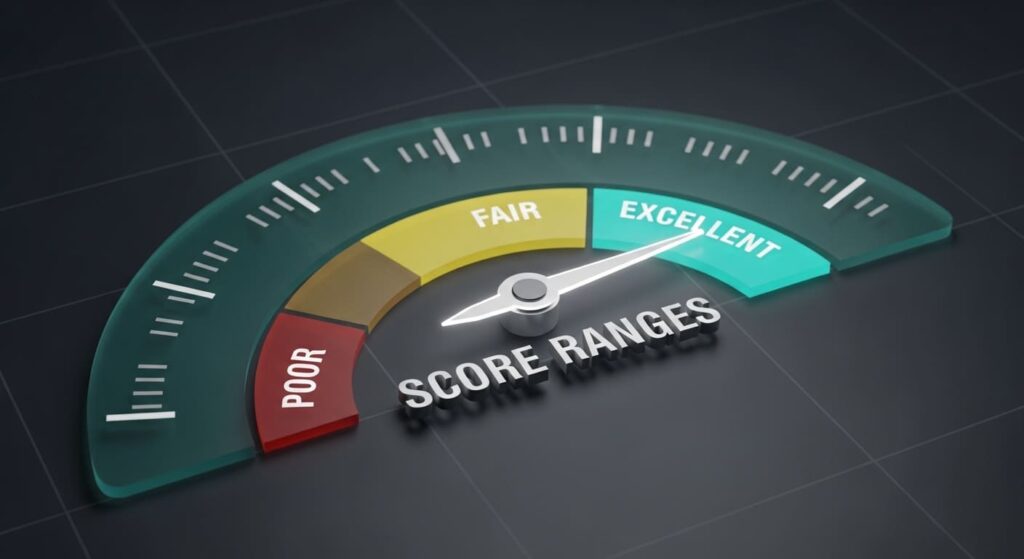
Your score determines what lenders offer you
The FICO Score Breakdown
| Score Range | Rating | What It Means | % of Population |
|---|---|---|---|
| 800-850 | Exceptional | Almost perfect credit. Best rates on everything. | 21% |
| 740-799 | Very Good | Excellent credit. Great rates, easy approvals. | 25% |
| 670-739 | Good | Above average. Good rates, most approvals. | 21% |
| 580-669 | Fair | Below average. Higher rates, some denials. | 18% |
| 300-579 | Poor | Bad credit. Very high rates or denials. | 15% |
What Each Range Gets You
800-850: Exceptional Credit
- ✅ Lowest interest rates on everything
- ✅ Approved for any credit card
- ✅ Best mortgage rates (save $50,000-100,000)
- ✅ Easy approvals
- ✅ Negotiate better terms
- ✅ Premium rewards cards
740-799: Very Good Credit
- ✅ Excellent interest rates
- ✅ Approved for most credit cards
- ✅ Great mortgage rates
- ✅ Easy approvals
- ✅ Access to good rewards cards
670-739: Good Credit
- ✅ Good interest rates (slightly higher)
- ✅ Approved for many cards
- ✅ Decent mortgage rates
- ⚠️ May need higher down payment
- ⚠️ Some premium cards may deny
580-669: Fair Credit
- ⚠️ Higher interest rates (5-10% more)
- ⚠️ Limited credit card options
- ⚠️ Higher mortgage rates
- ⚠️ May need co-signer
- ⚠️ Some landlords may deny rental
300-579: Poor Credit
- ❌ Very high interest rates (15-25%+)
- ❌ Most credit cards deny
- ❌ Difficult to get mortgage
- ❌ May need secured credit card
- ❌ Many landlords deny
- ❌ Employers may not hire (some industries)
Why Your Credit Score Matters So Much
Your credit score affects almost every major financial decision.
Impact 1: Borrowing Money (Interest Rates)
Same loan. Different rates based on credit score.
Example: $300,000 mortgage (30-year fixed)
| Credit Score | Interest Rate | Monthly Payment | Total Interest Paid |
|---|---|---|---|
| 760-850 | 6.5% | $1,896 | $382,560 |
| 700-759 | 6.8% | $1,953 | $403,080 |
| 660-699 | 7.2% | $2,036 | $433,000 |
| 620-659 | 7.8% | $2,147 | $473,000 |
| 580-619 | 8.5% | $2,307 | $530,520 |
Difference between 760 and 580 credit score: $147,960 MORE paid in interest
Same house. Same loan. Different credit score. Massive difference.
Impact 2: Credit Cards
Credit score determines:
- Whether you’re approved
- Your credit limit
- Your interest rate
- Which rewards cards you can get
Good credit (740+):
- Approved for premium rewards cards
- 0% intro APR offers
- High credit limits ($10,000-50,000+)
- Low ongoing APR (15-20%)
Bad credit (580-669):
- Only secured cards (require deposit)
- No rewards
- Low credit limits ($500-2,000)
- High APR (25-30%)
Impact 3: Renting an Apartment
Landlords check credit scores.
Good credit (670+):
- ✅ Easy approval
- ✅ Lower security deposit
- ✅ Better rental terms
Bad credit (580-669):
- ⚠️ May require co-signer
- ⚠️ Higher security deposit (2-3 months rent)
- ⚠️ Some landlords auto-deny under 620
Impact 4: Car Insurance
Many states allow insurers to use credit scores for pricing.
Good credit:
- Average insurance: $1,200/year
Bad credit:
- Average insurance: $2,000-2,500/year
Difference: $800-1,300 MORE per year just for insurance
Impact 5: Employment
Some employers check credit (especially finance, government, security).
Bad credit can:
- ❌ Disqualify you from job
- ❌ Prevent security clearance
- ❌ Suggest “financial irresponsibility”
Note: Employers see a modified credit report (no score, but see payment history, debts, bankruptcies).
Impact 6: Utility Deposits
Electric, water, gas, internet companies may check credit.
Good credit:
- No deposit required
Bad credit:
- Deposit required ($200-500)
- Refunded after 12 months good payment
The Real Cost of a Bad Credit Score
Let’s calculate the lifetime cost.
Person A: Excellent Credit (780) Person B: Poor Credit (580)
Mortgage ($300,000):
- Person A: 6.5% = $382,560 interest
- Person B: 8.5% = $530,520 interest
- Difference: $147,960
Auto Loans (3 cars over lifetime, $30,000 each):
- Person A: 4% = $14,000 total interest
- Person B: 12% = $42,000 total interest
- Difference: $28,000
Credit Cards (average $5,000 balance):
- Person A: 16% APR = $800/year interest
- Person B: 28% APR = $1,400/year interest
- Over 30 years: Difference: $18,000
Car Insurance (30 years):
- Person A: $1,200/year = $36,000
- Person B: $2,000/year = $60,000
- Difference: $24,000
Security Deposits (rentals, utilities):
- Person A: $0
- Person B: $2,000 tied up
- Difference: $2,000 + opportunity cost
Total lifetime cost of bad credit: $220,000+
That’s $220,000 more paid just for having a low credit score.
How to Check Your Credit Score (Free)
You have the right to check your credit for free.
Option 1: AnnualCreditReport.com (Official Site)
The official government-authorized website for free credit reports, AnnualCreditReport.com, allows you to request your full credit report from all three bureaus once per year at no cost.
What it provides:
- Free credit report from all 3 bureaus
- Once per year from each bureau
- Shows all accounts, payment history, inquiries
What it DOESN’T provide:
- Your credit score (just the report)
How to use:
- Visit AnnualCreditReport.com
- Request report from one bureau every 4 months (spreads out access)
- Review for errors
Option 2: Credit Card Companies (Free Score)
Many credit cards provide free FICO scores:
- Discover cards
- Capital One
- Chase
- Citi
- American Express
Updated monthly. Check your statement or app.
Option 3: Credit Monitoring Services
Free options:
- Credit Karma (VantageScore, not FICO)
- Credit Sesame
- Experian (free account)
Paid options:
- MyFICO ($19.95-39.95/month) – official FICO scores from all 3 bureaus
- IdentityGuard, PrivacyGuard – monitoring + protection
Option 4: Your Bank
Many banks offer free credit scores:
- Bank of America
- Wells Fargo
- US Bank
Check your online banking.
What to Look For
When checking your credit report:
- Errors (accounts that aren’t yours)
- Late payments (check if accurate)
- High balances (reduce them)
- Collections (old debts)
- Hard inquiries (should recognize all)
- Identity theft (unknown accounts)
If you find errors: Dispute them immediately.
How to Build Credit From Scratch
Starting with no credit? Here’s how to build it.
The Problem
No credit = no credit score = can’t get credit
It’s a catch-22. You need credit to build credit.
Solution 1: Secured Credit Card (Best for Beginners)
How it works:
- You deposit $200-500
- Bank gives you credit card with that limit
- You use it and pay it off
- Bank reports to credit bureaus
- After 6-12 months, you get deposit back and regular credit card
Best secured cards:
- Discover it® Secured
- Capital One Platinum Secured
- Citi® Secured Mastercard®
One of the best secured credit cards for building credit is the Discover it® Secured Card, which offers cash back rewards and reports to all three credit bureaus to help you build credit.
Strategy:
- Use card for small purchases ($20-50/month)
- Pay full balance every month
- Keep utilization under 30%
- After 6 months, you’ll have a credit score
Solution 2: Become Authorized User
How it works:
- Parent/family member adds you to their credit card
- You get card in your name
- Their payment history transfers to your credit report
- You build credit without being responsible for payments
Requirements:
- They must have good credit (700+)
- They must pay on time always
- Their card must report authorized users to bureaus
Result: You can build 650+ credit score in 6 months without using the card.
Solution 3: Credit Builder Loan
How it works:
- Credit union/bank “lends” you $500-1,000
- Money goes into locked savings account
- You make monthly payments for 12 months
- After 12 months, you get the money back
- Payments reported to credit bureaus
Benefits:
- Builds credit
- Forces savings
- Small monthly payment ($50-100)
Where to get:
- Local credit unions
- Self (online credit builder)
- Digital Federal Credit Union
Solution 4: Rent/Utility Reporting
Normally rent doesn’t build credit. But some services report it:
- Rental Kharma
- Rent Reporters
- Experian RentBureau
How it works:
- Pay small fee ($50-100/year)
- They report rent payments to credit bureaus
- On-time rent = credit building
Also available:
- Experian Boost (reports utilities, streaming, phone bills)
The Timeline
Month 1: Get secured card or become authorized user
Month 3: First credit score appears (usually 600-650)
Month 6: Score improves to 670-700
Month 12: Score improves to 700-740
Month 24: Can qualify for regular credit cards, loans
Key: Perfect payment history during this time.
How to Improve a Bad Credit Score

Already have bad credit? Here’s how to fix it.
Step 1: Get Your Credit Report
Check all 3 bureaus:
- Equifax
- Experian
- TransUnion
Look for:
- Errors (dispute them)
- Late payments
- Collections
- High balances
- Maxed out cards
Step 2: Dispute Errors
If you find mistakes:
Process:
- File dispute online with credit bureau
- Provide documentation
- Bureau investigates (30 days)
- Error removed if verified as mistake
Common errors:
- Accounts that aren’t yours
- Incorrect late payments
- Duplicate accounts
- Wrong balances
- Old accounts not removed (7-10 year rule)
Disputing can increase score 20-100 points if errors exist.
Step 3: Pay Down High Balances
Target: Get utilization under 30% (ideally under 10%)
Strategy:
If you owe $5,000 across cards with $10,000 limit (50% utilization):
- Pay down to $3,000 = 30% utilization
- Score increases 30-60 points
If you owe $10,000 with $10,000 limit (100% utilization):
- Pay down to $3,000 = 30% utilization
- Score increases 80-120 points
Quick win: Pay down credit cards BEFORE statement date. This reports lower balance to bureaus.
Step 4: Make All Payments On Time (From Now On)
The most important step.
Timeline:
- Month 1: First on-time payment (small impact)
- Month 3: Three on-time payments (20-30 point increase)
- Month 6: Six on-time payments (40-60 point increase)
- Month 12: Twelve on-time payments (60-80 point increase)
- Year 2: Perfect payment history (score improves significantly)
Even one late payment in the future will hurt progress.
Step 5: Deal With Collections
Collections hurt your score significantly.
Options:
Option 1: Pay for Delete
- Negotiate with collector
- “I’ll pay $X if you remove from credit report”
- Get agreement IN WRITING
- Pay only after written agreement
Success rate: 30-50%
Option 2: Pay in Full
- Pay the debt
- Status changes to “paid collection”
- Still on report but less damaging
- Newer scores (FICO 9, VantageScore 3.0) ignore paid collections
Option 3: Wait It Out
- Collections fall off after 7 years
- If debt is 6 years old, might not be worth paying
- Each state has statute of limitations
Step 6: Become Authorized User
Get added to someone’s good credit card:
- Their history transfers to you
- Immediate boost (30-60 points possible)
- You don’t need to use the card
Requirements:
- They have 700+ credit
- Always pay on time
- Low utilization
Step 7: Request Credit Limit Increases
Higher limits = lower utilization = better score
Example:
- Card A: $2,000 balance / $3,000 limit = 67% utilization
- Request increase to $6,000 limit
- Now: $2,000 / $6,000 = 33% utilization
- Score improves 20-40 points
How to request:
- Call credit card company
- Request online
- Usually instant decision
- May be hard inquiry (worth it if approved)
Step 8: Keep Old Accounts Open
Don’t close old credit cards (even if unused).
Closing cards:
- Shortens credit history
- Reduces available credit
- Increases utilization
Result: Score drops 20-50 points
Instead: Keep cards open, use occasionally (once every 6 months), pay off immediately.
The Improvement Timeline
Starting score: 550
Month 3: (pay down balances, on-time payments)
- New score: 590-610
Month 6: (continued good behavior, dispute errors)
- New score: 620-650
Month 12: (12 months perfect payments, low utilization)
- New score: 660-690
Year 2: (24 months good history)
- New score: 700-730
Year 3: (36 months good history, old negatives falling off)
- New score: 730-760
Realistic improvement: 50-100 points in first year, 150-200 points in 3 years
How to Maintain Excellent Credit
You’ve built good credit. Here’s how to keep it.
Rule 1: Pay Every Bill On Time, Every Time
Set up autopay on:
- Credit cards (at least minimum, ideally full balance)
- Loans
- Utilities
- Phone/internet
One late payment = 50-100 point drop
Even if you dispute and win later, the temporary damage hurts.
Rule 2: Keep Utilization Under 30% (Ideally Under 10%)
Monitor your credit card balances.
Strategy:
- Pay cards twice per month
- Pay before statement date (reports lower balance)
- Request credit limit increases annually
High utilization temporarily drops score 30-60 points
Rule 3: Don’t Close Old Credit Cards
Even if you don’t use them:
- Keep them open
- Use once every 6 months (buy coffee, pay off immediately)
- This maintains credit history length
Exception: If card has annual fee and you don’t use it, call and request downgrade to no-fee version.
Rule 4: Limit Hard Inquiries
Only apply for credit when necessary.
Too many applications:
- Signals “desperate for credit”
- Drops score 5-10 points each
- Multiple in short time = bigger drop
Safe application rate: 1-2 per year maximum
Rule 5: Maintain Credit Mix
As you add credit, maintain variety:
- 2-3 credit cards
- 1 installment loan (auto, personal)
- 1 mortgage (when you buy)
Don’t open accounts just for mix. But when borrowing, mix helps slightly.
Rule 6: Check Credit Report Annually
Look for:
- Errors
- Identity theft
- Unknown accounts
- Incorrect information
Dispute immediately if found.
Rule 7: Never Max Out Cards
Even if you pay off monthly.
Why:
- Balance reports before payment
- High utilization hurts score temporarily
- Lenders see maxed out cards as risk
Keep utilization low always.
Common Credit Score Myths (Don’t Believe These)

Let’s bust the myths that hurt people
❌ Myth 1: “Checking My Credit Hurts My Score”
FALSE.
Soft inquiry (checking your own credit) = NO IMPACT
You can check your credit score 100 times. It won’t hurt.
Hard inquiry (lender checking for loan decision) = small impact (-5 to 10 points)
❌ Myth 2: “Closing Credit Cards Improves My Score”
FALSE.
Closing cards:
- Reduces available credit
- Increases utilization
- Shortens credit history
- Score drops 20-50 points
Keep cards open (unless annual fee you won’t use).
❌ Myth 3: “Carrying a Balance Improves My Score”
FALSE.
You do NOT need to carry a balance or pay interest to build credit.
Best practice:
- Use card monthly
- Pay FULL balance before due date
- Pay $0 in interest
- Build excellent credit
Carrying balance just costs you money. Zero benefit to score.
❌ Myth 4: “I Only Have One Credit Score”
FALSE.
You have dozens of credit scores:
- 3 bureaus (Equifax, Experian, TransUnion)
- Multiple FICO versions (FICO 8, FICO 9, FICO 10, industry-specific)
- VantageScore versions
Lenders choose which to use. Usually FICO 8.
Your scores can vary 20-40 points between bureaus.
❌ Myth 5: “Income Affects My Credit Score”
FALSE.
Credit score does NOT include:
- Your income
- Your savings
- Your assets
- Your job
It ONLY measures: Do you repay borrowed money?
However: Lenders consider income separately when approving loans.
❌ Myth 6: “Paying Off Collections Removes Them”
FALSE (mostly).
Paying a collection:
- Changes status to “paid collection”
- Still shows on report for 7 years
- Still impacts score (less with newer FICO versions)
To remove: Negotiate “pay for delete” in writing BEFORE paying.
❌ Myth 7: “I Don’t Need Credit If I Pay Cash”
FALSE (for modern life).
Without credit:
- Can’t rent apartment easily
- Can’t get mortgage
- Higher car insurance
- Some employers won’t hire
- Hotels require credit card hold
- Rental car companies won’t rent
Modern life requires credit. Build it even if you prefer cash.
❌ Myth 8: “Credit Repair Companies Can Remove Accurate Negatives”
FALSE.
Credit repair companies can:
- Dispute errors (you can do this free yourself)
- Organize process
They CANNOT:
- Remove accurate late payments
- Remove legitimate collections
- Remove bankruptcies
- Perform “magic”
Save your money. Do it yourself.
Frequently Asked Questions – FAQ 👈
Q: How long does it take to build good credit from scratch?
A: With perfect payment history:
- 6 months: 650-680 credit score
- 12 months: 680-710
- 24 months: 710-750
- 36+ months: 750-800+
Starting point matters, but expect 12-24 months to reach “good credit” (670+).
Q: How long do negative items stay on my credit report?
A:
- Late payments: 7 years
- Collections: 7 years
- Chapter 7 bankruptcy: 10 years
- Chapter 13 bankruptcy: 7 years
- Foreclosure: 7 years
- Hard inquiries: 2 years (impact score for 1 year)
After the time period, they automatically fall off.
Q: Will paying off my car loan hurt my credit?
A: Temporarily, yes (10-30 points for 1-3 months).
Why: Reduces credit mix, closes account.
But: This is temporary. Score recovers. Paying off debt is worth the temporary dip.
Don’t keep debt just to maintain credit score.
Q: Can I have an 850 credit score?
A: Yes, but it’s extremely rare (less than 1% of population).
Requirements:
- 30+ years perfect credit history
- Multiple accounts in perfect standing
- Zero utilization
- No inquiries
- No negative items ever
More realistic goal: 760-800 (gets you best rates on everything)
Q: Does getting married affect my credit score?
A: No. Credit scores don’t combine.
However:
- Joint accounts affect both scores
- If spouse has bad credit, can hurt your ability to get joint loans
- Each person maintains individual score
Q: Can my employer see my credit score?
A: No. Employers see a modified credit report (no score).
They see:
- Payment history
- Debts
- Bankruptcies
- Collections
But NOT:
- Your actual score
- Account numbers
Used mainly in finance, government, security clearance jobs.
Your Credit Score Action Plan
Step-by-step plan to build or improve credit.
If You Have No Credit (Building from Scratch)
Week 1:
- Get secured credit card OR become authorized user
- Set up autopay for full balance
Month 1-6:
- Use card for small purchases ($20-50/month)
- Pay full balance every month
- Keep utilization under 30%
Month 6:
- Check credit score (should be 650-680)
- Request credit limit increase or graduate to regular card
Month 12:
- Apply for second credit card (rewards card)
- Keep both cards active
- Maintain perfect payment history
Month 24:
- Credit score should be 700-740
- Can qualify for auto loans, mortgages at good rates
If You Have Bad Credit (Improving Score)
Week 1:
- Get credit reports from all 3 bureaus
- Check for errors
- List all debts and balances
Week 2:
- Dispute any errors found
- Create plan to pay down high balances
- Set up autopay on all accounts
Month 1-3:
- Pay down credit cards (target under 30% utilization)
- Make all payments on time
- Negotiate with collections (pay for delete)
Month 3:
- Check score (should see 30-50 point increase)
- Request credit limit increases
Month 6:
- Score should be 40-80 points higher
- Continue perfect payment history
Month 12:
- Score should be 80-120 points higher
- Apply for credit builder accounts if needed
- Consider becoming authorized user
Year 2-3:
- Maintain perfect payment history
- Watch as old negative items fall off
- Score continues improving
If You Have Good Credit (Maintaining Excellence)
Monthly:
- Check balances (keep under 30% utilization)
- Verify all payments processed
- Monitor for fraud
Quarterly:
- Review credit card statements
- Ensure autopay working correctly
Annually:
- Check credit report from all 3 bureaus
- Request credit limit increases
- Review credit mix and accounts
Ongoing:
- Never miss payments
- Keep utilization low
- Don’t close old accounts
- Limit hard inquiries to 1-2 per year
🎥 BONUS
Want to see real examples of how credit scores work and how people improved theirs?
This video breaks down credit scores visually:
FINAL THOUGHTS: Your Financial Reputation
Here’s what most people don’t realize:
Your credit score is your financial identity in the modern world.
It’s not just about borrowing money. It affects:
- Where you can live
- How much you pay for insurance
- Whether you get hired
- The opportunities available to you
A person with 800 credit has financial freedom.
They get approved easily, pay lowest rates, and save $100,000+ over their lifetime.
A person with 550 credit has financial handcuffs.
They get denied, pay highest rates, and lose $200,000+ to bad credit over their lifetime.
But here’s the truth: Credit scores are controllable.
Unlike income (which takes years to increase significantly), you can improve your credit score in months with the right actions:
- Pay on time, every time
- Keep utilization under 30%
- Don’t close old accounts
- Dispute errors
- Build positive history
The difference between 550 and 750 credit?
- Not luck
- Not income
- Not where you’re from
It’s habits.
Good credit = good financial habits over time.
You don’t build excellent credit overnight. But you build it with consistent action.
Pay bills on time. Keep balances low. Don’t overextend. Check your report.
Do this for 12 months, and your score improves dramatically.
Do this for 36 months, and you have excellent credit. Do this for life, and you save hundreds of thousands of dollars.
Your credit score is your financial reputation.
The question isn’t “Can I build good credit?”
The question is: “Do I have the discipline?”
If yes, your financial reputation—and your financial future—are in your control.
Start today.
INTERESTING TOPICS
Ready to learn how to pay off debt fast to improve your credit score?
Want to discover the difference between saving and investing once you have good credit?
Need to understand how to build an emergency fund before taking on debt?
Want more financial insights delivered to you? Subscribe to our newsletter
and get weekly articles with practical strategies to grow your wealth sent straight to your inbox.
Obs: Sign up for our newsletter and receive a free Finance For Beginner eBook.
Disclaimer: This article is for educational purposes only and should not be considered financial advice. Budgeting approaches should be tailored to individual circumstances, income levels, and financial goals. The examples provided are for illustrative purposes and may not reflect your specific situation. The 50/30/20 rule is a guideline and may need adjustment based on your cost of living, debt obligations, and personal priorities. Consider consulting with a financial advisor for personalized guidance on managing your finances and creating a budget that works for your unique situation.
—— End of Article ——