
Financial Independence Explained: The Path to Early Retirement (FIRE)
Freedom Through Strategic Wealth Building
Last updated: May 2026
You work until 65. That’s the plan.
40+ years of employment. Retire at traditional age. Hope money lasts.
But what if you could retire at 40? Or 50?
Or work because you want to, not because you must?
Most people accept traditional retirement:
- Work 40 years minimum
- Retire at 65-70
- Hope savings sufficient
- No choice in timing
- Financial dependence on job
Financial independence changes everything. Retire when you choose.
Work if you want. Freedom from financial necessity.
Here’s what most people don’t understand about financial independence:
- It’s achievable without six-figure income (discipline beats salary)
- Requires 25X annual expenses saved (not random millions)
- Can retire decades early (40s and 50s common)
- Multiple FIRE types exist (Lean, Fat, Barista, Coast)
- Lifestyle design matters more than deprivation
Traditional retirement = Work until old. Financial independence = Work until free.
The wealthy understand something critical:
Financial independence isn’t about being rich.
It’s about having enough that work becomes optional. Freedom, not luxury.
This article was prepared especially for Finance For Beginner subscribers who requested this type of content due to the challenges they face in their personal and professional finances, for a better understanding.
In this way, we hope that the topic will also be relevant to more users who regularly visit our site.
In this guide, you’ll learn what financial independence really means, how to calculate your FIRE number, the 4% withdrawal rule explained, different FIRE movement types, step-by-step path to financial independence, realistic timelines by income, common mistakes, and most importantly—how to achieve financial independence and retire early regardless of current age or income.
By the end, you’ll have a complete roadmap to financial independence and early retirement.
Let’s build your path to freedom.
What Is Financial Independence? (FIRE Explained)
Understanding the foundation of financial independence.
The Core Definition
Financial independence means:
- Investment income covers living expenses
- Work becomes optional (not required)
- Choose how to spend time
- Freedom from financial necessity
- Money works for you, you don’t work for money
Traditional life:
- Must work to pay bills
- Stop working = Stop income = Can’t pay bills
- Job required until 65+
- Financial dependence
Financial independence:
- Investments generate income
- Covers all expenses
- Work optional
- Can retire at any age
- Financial freedom
FIRE = Financial Independence, Retire Early
Two components:
FI (Financial Independence):
- Core goal
- Investment income ≥ Expenses
- Work optional
- Can achieve without retiring
RE (Retire Early):
- Optional add-on
- Choose to stop working
- Before traditional retirement age
- Enabled by FI
You can be FI without RE:
- Have financial independence
- Choose to keep working
- Work on own terms
- Freedom to choose
Why People Pursue Financial Independence
Freedom motivations:
- Escape toxic job
- Spend time with family
- Pursue passion projects
- Travel while healthy
- Start business without financial pressure
- Control over life
Security motivations:
- Job market uncertainty
- Recession-proof finances
- Health issues
- Age discrimination
- Safety net
Lifestyle motivations:
- Different pace of life
- Avoid commute
- Live anywhere
- Flexibility
- Intentional living
Financial independence provides choices traditional employment doesn’t.
For foundational investing knowledge, see what are index funds.
The Math Behind Financial Independence (Your FIRE Number)
Calculating the amount needed for financial independence.
The FIRE Number Formula
Simple version:
FIRE Number = Annual Expenses × 25Why 25?
- Based on 4% withdrawal rate
- 1 ÷ 0.04 = 25
- Historical safe withdrawal rate
- Math proven over decades
Example Calculations
Example 1: Modest expenses
- Annual expenses: $40,000
- FIRE number: $40,000 × 25 = $1,000,000
- Need $1M for financial independence
Example 2: Moderate expenses
- Annual expenses: $60,000
- FIRE number: $60,000 × 25 = $1,500,000
- Need $1.5M for financial independence
Example 3: Higher expenses
- Annual expenses: $80,000
- FIRE number: $80,000 × 25 = $2,000,000
- Need $2M for financial independence
Example 4: Lean living
- Annual expenses: $30,000
- FIRE number: $30,000 × 25 = $750,000
- Need $750K for financial independence
The lower your expenses, the faster you achieve financial independence.
Why Annual Expenses, Not Income?
Common mistake:
- “I make $100,000, so I need $2.5M”
- Wrong
- Base on spending, not earning
Correct approach:
- Make $100,000
- Spend $50,000
- FIRE number: $50,000 × 25 = $1,250,000
- Half what you thought
Key insight: Cut expenses, reduce FIRE number, achieve financial independence faster.
Components of Annual Expenses
Include everything:
- Housing (rent or property tax/insurance if paid off)
- Utilities
- Food
- Transportation
- Insurance (health, car, home)
- Entertainment
- Travel
- Miscellaneous
- All regular spending
Don’t include:
- Savings (you’re already financially independent)
- Debt payments (pay off before FIRE)
- Work expenses (commuting, work clothes)
- Only retirement lifestyle costs
Calculating Your FIRE Number
Step 1: Track current annual spending
- Review last 12 months
- Add all expenses
- Example: $65,000/year
Step 2: Adjust for retirement
- Remove: Commuting, work lunches, work clothes
- Maybe add: Healthcare, travel
- Adjusted: $60,000/year
Step 3: Calculate FIRE number
- $60,000 × 25 = $1,500,000
- Your financial independence number
Step 4: Track progress
- Current net worth: $______
- FIRE number: $1,500,000
- Gap: $______
- Know the distance
This number is your target for financial independence.
The 4% Rule: How Much You Need for Financial Independence

Understanding the withdrawal rate for financial independence
What Is the 4% Rule?
Simple explanation:
- Withdraw 4% of portfolio yearly
- Historically sustainable forever
- Portfolio survives market ups/downs
- Foundation of financial independence math
Example:
- Portfolio: $1,000,000
- 4% withdrawal: $40,000/year
- Live on $40,000 indefinitely
- Money lasts lifetime
The Trinity Study
Academic research:
- Study by three professors
- Analyzed 1926-1995 market data
- 4% withdrawal rate
- 95% success rate over 30 years
- Scientific backing for financial independence
What “success” means:
- Portfolio doesn’t run out
- Survives market crashes
- Maintains through inflation
- Safe for retirement
How the 4% Rule Works
Year 1:
- Portfolio: $1,000,000
- Withdraw: $40,000 (4%)
- Remaining: $960,000
Year 2 (market up 10%):
- Portfolio grows to $1,056,000
- Withdraw: $40,800 (inflation-adjusted)
- Remaining: $1,015,200
- Recovered and grew
Year 3 (market down 20%):
- Portfolio drops to $812,160
- Withdraw: $41,616 (inflation-adjusted)
- Remaining: $770,544
- Lower, but not out
Year 4-30:
- Markets fluctuate
- Portfolio grows on average
- Withdrawals continue
- After 30 years: Usually still has money
- Historically sustainable
Adjustments to the 4% Rule
More conservative (3-3.5%):
- Retire very early (30s-40s)
- Need money for 50+ years
- Extra safety margin
- Ultra-safe financial independence
More aggressive (4.5-5%):
- Retire later (50s)
- Shorter timeline (20-30 years)
- Willing to adjust spending
- Side income possible
- Higher risk financial independence
Most financial independence seekers use 3.5-4%.
Why the 4% Rule Enables FIRE
Traditional thinking:
- “Need $3 million to retire”
- Arbitrary number
- Fear-based
- Never feels enough
4% rule thinking:
- Calculate actual needs
- $40,000/year expenses
- Need $1,000,000
- Clear target
- Achievable financial independence
Removes guesswork from financial independence planning.
For more on retirement planning, see how to invest for retirement in your 20s and 30s.
Types of FIRE: Which Path to Financial Independence?

Different approaches to financial independence
The FIRE Spectrum
Four main types:
Lean FIRE:
- Minimal expenses
- $30-40k/year lifestyle
- Frugal living
- Need $750k-1M
- Fastest to financial independence
Regular FIRE:
- Moderate expenses
- $50-60k/year lifestyle
- Comfortable living
- Need $1.25-1.5M
- Balanced financial independence
Fat FIRE:
- Higher expenses
- $80-100k+/year lifestyle
- Luxury living
- Need $2-2.5M+
- Longer to financial independence
Barista/Coast FIRE:
- Partial financial independence
- Part-time work covers expenses
- Investments grow
- Hybrid approach
- Flexible financial independence
Each is legitimate path to financial independence.
Comparing FIRE Types
| Type | Annual Spending | FIRE Number | Timeline | Lifestyle |
|---|---|---|---|---|
| Lean FIRE | $30-40k | $750k-1M | 10-15 years | Frugal |
| Regular FIRE | $50-60k | $1.25-1.5M | 15-20 years | Comfortable |
| Fat FIRE | $80-120k | $2-3M | 20-25 years | Abundant |
| Barista FIRE | $40-50k | $500k-750k | 8-12 years | Flexible |
| Coast FIRE | Variable | $250-500k | 5-10 years | Patient |
Choosing Your FIRE Type
Consider:
Income level:
- High income → Fat FIRE possible
- Moderate income → Regular FIRE
- Lower income → Lean/Barista FIRE
- Match to reality
Lifestyle preferences:
- Minimalist → Lean FIRE
- Comfortable → Regular FIRE
- Luxury → Fat FIRE
- Flexibility → Barista/Coast FIRE
Timeline urgency:
- Hate job → Lean FIRE (fastest)
- Patient → Fat FIRE (abundant)
- Balanced → Regular FIRE
Age:
- Young (20s-30s) → Any type works
- Older (40s-50s) → Focus on achievable
- Consider health timeline
Most people aim for Regular FIRE ($1.25-1.5M) as sweet spot for financial independence.
Lean FIRE: Minimalist Financial Independence
The frugal path to financial independence.
What Is Lean FIRE?
Definition:
- Minimal living expenses
- $30-40k/year
- FIRE number: $750k-1M
- Intentionally frugal
- Fastest financial independence
Philosophy:
- “Enough” is plenty
- Minimize consumption
- Maximize freedom
- Less stuff, more life
- Freedom over luxury
Lean FIRE Numbers
Example budget ($35,000/year):
- Housing: $12,000 (small apartment or paid-off house)
- Food: $4,800 ($400/month, cook at home)
- Transportation: $2,400 ($200/month, used car or bike)
- Healthcare: $4,800 ($400/month, ACA marketplace)
- Utilities/phone: $2,400 ($200/month)
- Entertainment: $2,400 ($200/month)
- Misc: $6,200
- Total: $35,000/year
FIRE number: $35,000 × 25 = $875,000
Timeline:
- Save $40,000/year
- ~22 years to financial independence
- Cut to 15 years with investment growth
Advantages of Lean FIRE
✅ Fastest path to financial independence
- Lower target
- Achievable sooner
- Freedom earlier
✅ Works on moderate income
- Don’t need six figures
- $50-70k income sufficient
- Accessible
✅ Forces prioritization
- Clear on what matters
- Eliminate waste
- Intentional life
✅ Flexible upward
- Can always spend more later
- Hard to spend less after Fat FIRE
- Safer approach
Disadvantages of Lean FIRE
❌ Requires lifestyle sacrifice
- No luxury
- Budget conscious always
- Some discomfort
❌ Less buffer for emergencies
- Tight budget
- Unexpected expenses harder
- Need discipline
❌ Geographic limitations
- Hard in expensive cities
- Better in low-cost areas
- May require relocation
❌ Healthcare concerns
- Tight healthcare budget
- Major illness challenging
- Need good planning
Who Lean FIRE Works For
Best for:
- Minimalists
- Extreme savers
- Those hating jobs intensely
- Geographic flexibility
- Strong financial discipline
- Young and healthy
Not ideal for:
- Families with kids (harder)
- Those who value luxury
- Medical conditions (need buffer)
- Expensive city lovers
Lean FIRE is powerful path to financial independence for right person.
Fat FIRE: Luxury Financial Independence
The abundant path to financial independence.
What Is Fat FIRE?
Definition:
- Higher living expenses
- $80-120k+/year
- FIRE number: $2-3M+
- Comfortable lifestyle
- Luxurious financial independence
Philosophy:
- Maintain quality of life
- Don’t sacrifice comfort
- Build to abundance
- Freedom AND luxury
- Best of both worlds
Fat FIRE Numbers
Example budget ($100,000/year):
- Housing: $30,000 (nice house or good area)
- Food: $12,000 ($1,000/month, dining out included)
- Transportation: $8,000 (nice car, maintenance)
- Healthcare: $8,000 (excellent coverage)
- Travel: $15,000 (multiple trips yearly)
- Entertainment: $8,000
- Hobbies: $6,000
- Misc/buffer: $13,000
- Total: $100,000/year
FIRE number: $100,000 × 25 = $2,500,000
Timeline:
- Save $80,000/year (requires $150k+ income)
- ~31 years to financial independence
- Or 20-25 years with investment growth
Advantages of Fat FIRE
✅ No lifestyle sacrifice
- Live well before and after FIRE
- Comfortable transition
- Happy journey
✅ Large buffer
- Handle emergencies easily
- Healthcare covered
- Unexpected costs manageable
✅ Geographic freedom
- Can live anywhere
- Expensive cities okay
- Travel freely
✅ Support others
- Help family
- Donate
- Abundance mindset
Disadvantages of Fat FIRE
❌ Longer timeline
- Takes 20-30 years typically
- Retire in 50s instead of 40s
- Delayed freedom
❌ Requires high income
- Need $150k+ typically
- Not accessible to all
- Career focus needed
❌ Lifestyle inflation risk
- $100k becomes $120k easily
- Target keeps moving
- Never “enough” feeling
❌ Higher target to maintain
- $2.5M vs. $1M
- More to manage
- More market exposure
Who Fat FIRE Works For
Best for:
- High earners ($150k+)
- Value comfort highly
- Families with kids
- Health considerations
- Patient timeline
- Want buffer
Not ideal for:
- Lower income
- Urgent job escape
- Minimalist values
- Geographic arbitrage plans
Fat FIRE provides abundant financial independence for those who can afford longer timeline.
Barista FIRE: Part-Time Financial Independence

The flexible path to financial independence
What Is Barista FIRE?
Definition:
- Partial financial independence
- Investments cover basic expenses
- Part-time work covers extras + healthcare
- Hybrid approach
- Semi-financial independence
Why “Barista”?
- Starbucks offers health insurance to part-timers
- Hence “barista” job
- Now applies to any part-time work
- Name stuck
Barista FIRE Numbers
Example setup:
Expenses: $50,000/year total
- Basic needs: $30,000 (housing, food, utilities)
- Discretionary: $20,000 (fun, extras)
Financial independence portion:
- $30,000 × 25 = $750,000 invested
- Covers basics only
Part-time work:
- 20 hours/week
- $20/hour
- Gross: $20,800/year
- After tax: ~$18,000
- Covers discretionary + healthcare
Total coverage: $30k (investments) + $18k (work) = $48k
Achievable with $750k instead of $1.25M for full financial independence.
Advantages of Barista FIRE
✅ Faster than full FIRE
- $750k vs. $1.25M
- 40% less needed
- Achieve years earlier
✅ Healthcare access
- Part-time job provides insurance
- Major concern solved
- Before Medicare at 65
✅ Social interaction
- Not fully retired
- Colleagues, routine
- Purpose
✅ Portfolio longevity
- Less withdrawal pressure
- Investments grow longer
- Safer long-term
✅ Test retirement
- Gradual transition
- See if like not working full-time
- Adjustable
Disadvantages of Barista FIRE
❌ Still working
- Not fully financially independent
- Boss and schedule
- Less freedom than full FIRE
❌ Job dependence
- Rely on employment
- Could lose job
- Healthcare tied to work
❌ Age limits
- Harder to find part-time at 60+
- Physically demanding
- Long-term sustainability
❌ Lower earnings
- Part-time pay typically less per hour
- Limited advancement
- Income ceiling
Who Barista FIRE Works For
Best for:
- Mid-30s to 50s
- Enjoy some work
- Need healthcare solution
- Want faster FIRE
- Social people
- Flexible on full retirement
Not ideal for:
- Hate all work
- Want complete freedom
- Have healthcare alternative
- Can achieve full FIRE easily
Barista FIRE provides earlier financial independence with flexibility.
For building wealth at any age, see how to build wealth after 40.
Coast FIRE: Passive Growth to Financial Independence
The patient path to financial independence.
What Is Coast FIRE?
Definition:
- Investments sufficient to grow to FIRE number
- Stop additional contributions
- Let compound interest finish job
- Continue working for expenses only
- Financial independence guaranteed in future
Key concept:
- Have $500k at 35
- Stop investing
- Grows to $2M by 65
- Financial independence achieved
- “Coasting” to finish line
Coast FIRE Numbers
Example calculation:
Current situation:
- Age: 35
- Investments: $500,000
- Annual expenses: $60,000
- FIRE number needed: $1,500,000
Question: Can I coast?
Projection:
- $500,000 at 8% growth
- 30 years to 65
- Future value: $5,031,000
- Yes! Could coast and exceed goal
Could even retire earlier:
- $500k → $1.5M takes ~14 years
- Retire at 49 instead of 65
- Financial independence at 49 without saving more
How to Calculate Coast FIRE
Formula:
Years to FIRE = ln(FIRE Number / Current Portfolio) / ln(1 + Return Rate)Simplified calculator:
- Current portfolio: $______
- Annual return: 8%
- FIRE number: $______
- Years: Calculator result
- Know when you can coast
Example:
- Current: $400,000
- Target: $1,200,000
- Years: ~15 years
- Current age 35 → Coast FIRE at 50
Advantages of Coast FIRE
✅ Financial pressure relieved
- No need to save aggressively
- Retirement handled
- Peace of mind
✅ Enjoy present more
- Spend extra income on life
- Travel now
- Experiences
✅ Career flexibility
- Lower-paying passion job okay
- Don’t need raises
- Just cover expenses
✅ Compound interest works
- Passive wealth building
- No effort required
- Guaranteed growth
Disadvantages of Coast FIRE
❌ Still working long-term
- Not early retirement
- Decades more employment
- Not traditional FIRE
❌ Market risk
- Assuming 8% returns
- Market could underperform
- May need to resume saving
❌ Lifestyle inflation temptation
- Not saving = Extra money
- Easy to spend all
- May delay FIRE
❌ No acceleration
- Fixed timeline
- Can’t retire earlier
- Passive approach
Who Coast FIRE Works For
Best for:
- Already saved significant amount
- Enjoy work somewhat
- Want reduced financial pressure
- Patient on retirement
- Risk-tolerant
- Young (time for growth)
Not ideal for:
- Want to retire ASAP
- Hate job
- Low current savings
- Older (less time)
Coast FIRE provides psychological relief while ensuring future financial independence.
Step-by-Step: How to Achieve Financial Independence
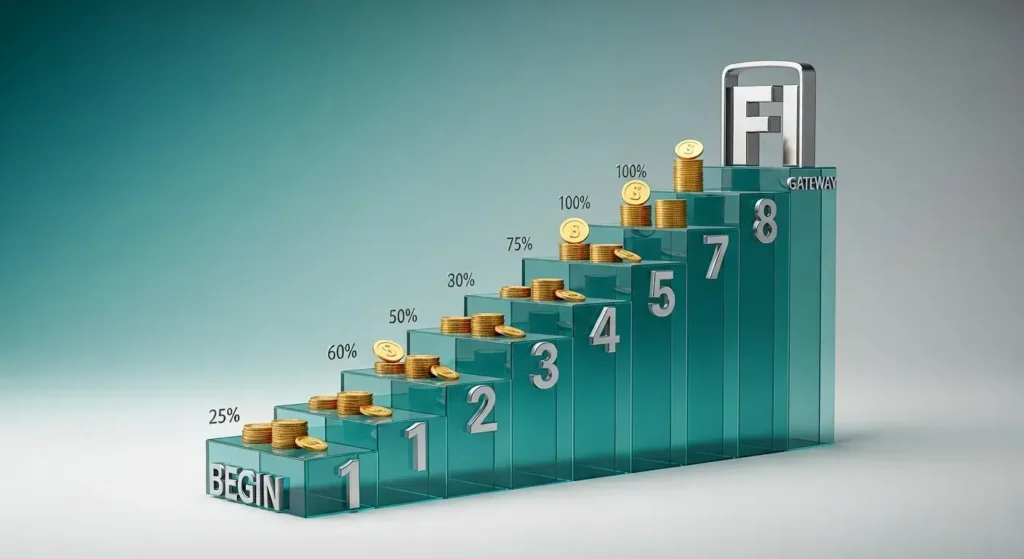
Complete roadmap to financial independence
Step 1: Calculate Your FIRE Number
Action:
- Track 12 months expenses
- Calculate annual spending
- Multiply by 25
- Know your target for financial independence
Example:
- Annual spending: $55,000
- FIRE number: $55,000 × 25 = $1,375,000
- Target set
Step 2: Maximize Savings Rate
Target: Save 30-70% of income
How:
- Increase income (career, side hustles)
- Decrease expenses (housing, transport, food)
- Gap = Savings rate
- Higher rate = Faster financial independence
Example:
- Income: $75,000
- Expenses: $40,000
- Savings: $35,000
- Rate: 47%
- Strong savings rate
For saving strategies, see how to save $1,000 in 30 days.
Step 3: Invest Aggressively
Strategy:
- Stock market (index funds)
- 80-100% stocks when young
- Simple portfolio
- Automatic investing
- Compound growth drives financial independence
Recommended:
- S&P 500 index fund (FXAIX, VOO)
- Or Total Stock Market (VTI)
- Low fees (under 0.1%)
- Set and forget
Avoid:
- Individual stocks (too risky)
- Active management (high fees)
- Market timing (impossible)
- Crypto as primary (too volatile)
To start building your financial independence portfolio with low-cost index funds, Vanguard offers industry-leading options with minimal fees to maximize your path to FIRE.
Step 4: Eliminate Debt
Priority order:
- Credit cards first (highest interest)
- Personal loans
- Student loans
- Car loans
- Mortgage last (lowest interest)
Debt delays financial independence:
- Interest = Money wasted
- Payments = Can’t invest
- Debt-free accelerates FIRE
For debt elimination, see how to pay off debt fast.
Step 5: Increase Income
Strategies:
- Career advancement
- Job hopping (20-30% raises)
- Side hustles
- Consulting
- Online business
- More income = Faster financial independence
Income > Expense cuts:
- Expense cuts have floor
- Income has no ceiling
- Focus on both
- Maximize gap
Step 6: Optimize Taxes
Strategies:
- Max 401(k) (tax deduction)
- Roth IRA (tax-free growth)
- HSA (triple tax advantage)
- Tax-loss harvesting
- Keep more money for financial independence
Example savings:
- $20k to 401(k)
- 24% tax bracket
- Save $4,800 in taxes
- Invest savings
- Accelerates FIRE
Step 7: Track Progress
Metrics:
- Net worth growth
- Savings rate
- Years to FIRE
- % of FIRE number reached
- Monitor progress to financial independence
Tools:
- Personal Capital (free)
- Spreadsheet
- Monthly reviews
- Stay motivated
Step 8: Prepare for Retirement
Before achieving financial independence:
- Healthcare plan (ACA, spouse, etc.)
- Withdrawal strategy
- Tax planning
- Location decision
- Activities/purpose
- Smooth transition
Financial Independence Timeline by Income
Realistic timelines to achieve financial independence.
$50,000 Income
Scenario:
- Income: $50,000
- Expenses: $35,000
- Savings: $15,000/year (30% rate)
- FIRE number: $875,000 ($35k × 25)
Timeline:
- 25 years to financial independence
- With investment growth (8%): ~22 years
- Retire: Early 50s if start at 30
Accelerators:
- Increase income to $65k: 15 years
- Decrease expenses to $30k: 18 years
- Both: 12 years to financial independence
$75,000 Income
Scenario:
- Income: $75,000
- Expenses: $45,000
- Savings: $30,000/year (40% rate)
- FIRE number: $1,125,000 ($45k × 25)
Timeline:
- 17 years to financial independence
- With investment growth: ~14 years
- Retire: Mid-40s if start at 30
Accelerators:
- Lean FIRE ($35k expenses): 11 years
- Increase income to $100k: 10 years
- Financial independence achievable by 40
$100,000 Income
Scenario:
- Income: $100,000
- Expenses: $50,000
- Savings: $50,000/year (50% rate)
- FIRE number: $1,250,000 ($50k × 25)
Timeline:
- 13 years to financial independence
- With investment growth: ~11 years
- Retire: Late 30s/Early 40s if start at 28
This is the “sweet spot” income level for financial independence.
$150,000+ Income
Scenario:
- Income: $150,000
- Expenses: $70,000
- Savings: $80,000/year (53% rate)
- FIRE number: $1,750,000 ($70k × 25)
Timeline:
- 11 years to financial independence
- With investment growth: ~9 years
- Retire: Late 30s if start at 30
- Or Fat FIRE ($100k expenses): 12-15 years
High income enables fast financial independence or Fat FIRE.
Key Insights
Savings rate matters more than income:
- $50k income, 50% rate = 17 years
- $100k income, 30% rate = 23 years
- Lower income, higher rate wins
Starting age matters:
- Start at 25: Retire at 40 (15 years)
- Start at 35: Retire at 50 (15 years)
- Start at 45: Retire at 60 (15 years)
- Same effort, different endpoints
Anyone can achieve financial independence with discipline.
Living in Financial Independence: What Changes?
Reality of life after achieving financial independence.
Day-to-Day Freedom
What changes:
- Wake up naturally (no alarm)
- Do what you want (no boss)
- Spend time on passions
- Travel mid-week
- Say no freely
- Complete schedule control
What stays same:
- Still budget (withdrawal limits)
- Still responsibilities
- Still need purpose
- Life’s challenges remain
- Money doesn’t solve everything
The First Year
Common experience:
- Month 1-3: “This is amazing!” (honeymoon)
- Month 4-6: “What do I do?” (searching)
- Month 7-9: “Found rhythm” (purpose)
- Month 10-12: “This is life” (acceptance)
Adjustment period normal in financial independence.
Purpose After Work
People find purpose in:
- Passion projects
- Volunteering
- Family time
- Creative pursuits
- Part-time passion work
- Learning/education
- Work was purpose, now choose own
Financial independence gives freedom to explore.
Healthcare Reality
Before 65 (Medicare):
- ACA marketplace
- $300-800/month typical
- Must budget for
- Part of expenses
After 65:
- Medicare coverage
- Lower costs
- Healthcare solved
Healthcare is major consideration in financial independence.
Social Changes
Potential issues:
- Friends still working
- “What do you do?” question
- Some envy
- Defending choice
- Social navigation
Solutions:
- Find FIRE community
- Focus on hobbies for social
- Don’t brag about FIRE
- Keep some busy
Financial Stress Reduction
What improves:
- No job loss fear
- No paycheck dependency
- Market drops less scary (long timeline)
- Expenses covered
- Significant stress relief
What doesn’t:
- Still check portfolio
- Market volatility noticed
- Withdrawal anxiety
- Healthcare costs
- Some financial awareness remains
Overall Satisfaction
Most report:
- Very happy with decision
- Would do again
- Freedom worth sacrifice
- Regret waiting
- Financial independence delivers on promise
Small percentage:
- Missed work structure
- Returned to work
- Chose Barista FIRE instead
- Not for everyone
Financial independence provides freedom, but individual must create purpose.
Common Financial Independence Mistakes
Errors that delay or derail financial independence.
Mistake 1: Lifestyle Inflation
The error:
- Get raise from $60k to $80k
- Increase spending $60k to $78k
- Still saving same amount
- No progress toward financial independence
The solution:
- Get raise
- Keep expenses constant
- Save all raises
- Accelerate FIRE
Example:
- Raise: $60k → $80k (+$20k)
- Save extra $20k yearly
- Cuts 5+ years off financial independence timeline
Mistake 2: Too Conservative Investing
The error:
- Fear of stocks
- 50% bonds at age 30
- 5% returns instead of 8%
- Delays financial independence by years
Impact:
- $500/month at 5%: $411k in 30 years
- $500/month at 8%: $679k in 30 years
- $268k lost to fear
The solution:
- Young = Aggressive (80-100% stocks)
- Time to recover from crashes
- Higher returns needed
- Accept volatility for financial independence
Mistake 3: Underestimating Healthcare
The error:
- Calculate FIRE number
- Forget healthcare costs
- Retire
- Healthcare: $800/month
- Budget broken
- Financial independence threatened
The solution:
- Include healthcare in FIRE number
- $800/month = $9,600/year
- Adds $240,000 to FIRE number
- Plan for reality
Mistake 4: Not Testing Retirement Budget
The error:
- Assume $40k/year enough
- Retire
- Actually need $55k
- Run out of money
- Financial independence fails
The solution:
- Live on retirement budget 6-12 months
- Before quitting job
- Test if realistic
- Adjust FIRE number if needed
- Verify assumptions
Mistake 5: Quitting Too Early
The error:
- 95% to FIRE number
- Quit job
- Market drops 30%
- Back to 70% of goal
- Forced to return to work
- One more year problem
The solution:
- Reach 110-120% of FIRE number
- Buffer for market drops
- More secure
- Safe withdrawal for financial independence
Frequently Asked Questions – FAQ 👈
Q: Can I achieve financial independence on average income?
A: Yes. Requires discipline and time, but absolutely achievable.
Proof:
- $60,000 income
- $40,000 expenses
- Save $20,000/year (33% rate)
- FIRE number: $1,000,000
- Timeline: 20-25 years
- Retire in 40s-50s
Keys:
- High savings rate (30-50%)
- Consistent investing
- Avoid lifestyle inflation
- Patient timeline
- Financial independence for anyone disciplined
Q: What about inflation? Will 4% rule still work?
A: The 4% rule includes inflation adjustment.
For detailed retirement planning calculators to track your progress toward financial independence, FireCalc provides Monte Carlo simulations to test your FIRE plan’s sustainability.
How it works:
- Year 1: Withdraw 4% ($40,000)
- Year 2: Withdraw $40,000 × 1.03 (inflation) = $41,200
- Year 3: $41,200 × 1.03 = $42,436
- Withdrawals increase with inflation
Trinity Study tested this:
- 95% success rate
- With inflation adjustments
- Over 30 years
- Works historically
Concern: Higher inflation future?
- Use 3.5% rule instead
- Extra safety margin
- Adjust as needed
- Flexible for financial independence
Q: Should I pay off mortgage before pursuing financial independence?
A: Depends on interest rate and timeline.
Low interest (under 4%):
- Keep mortgage
- Invest difference
- 8% investment return > 4% mortgage interest
- Better for financial independence
High interest (over 5%):
- Consider paying off
- Guaranteed return
- Peace of mind
- Reduces FIRE number
Most FIRE seekers:
- Keep low-rate mortgage
- Invest aggressively
- Faster to financial independence
Q: What if I hate retirement and want to work again?
A: Financial independence = Freedom to choose, including choosing to work.
Options after FIRE:
- Volunteer work
- Passion project business
- Part-time consulting
- Return to career
- All valid choices
Key difference:
- Working by choice (not necessity)
- Can quit anytime
- No financial pressure
- Freedom remains
Financial independence doesn’t mean never work again. Means work becomes optional.
Q: How much do I need for financial independence with kids?
A: Add $10-15k per child to annual expenses.
Example:
- No kids: $50k/year expenses
- 2 kids: $70k/year expenses
- FIRE number increases: $1.25M → $1.75M
- Significant impact
Strategies:
- Delay FIRE until kids independent
- Barista FIRE for healthcare
- Higher savings rate
- Family FIRE doable but harder
Your Financial Independence Action Plan
Step-by-step plan to achieve financial independence.
Month 1: Assessment & Planning
Week 1: Calculate current position
- Track all expenses (30 days)
- Calculate annual spending
- Determine FIRE number
- Know the target
Week 2: Assess timeline
- Current savings: $______
- Monthly savings capacity: $______
- Years to FIRE: Calculator
- Know the journey length
Week 3: Choose FIRE type
- Lean, Regular, Fat, Barista, or Coast?
- Based on lifestyle and timeline
- Adjust FIRE number accordingly
- Know your path to financial independence
Week 4: Create plan
- Income increase strategy
- Expense reduction plan
- Investment approach
- Roadmap complete
Months 2-6: Foundation Building
Actions:
- Maximize 401(k) contributions
- Open IRA (Roth or Traditional)
- Start taxable brokerage
- Automate all investing
- Systems in place
Targets:
- 30-50% savings rate achieved
- All investments automatic
- Budget optimized
- Momentum building toward financial independence
Months 7-12: Optimization
Actions:
- Increase income (ask for raise, start side hustle)
- Cut major expenses (housing, transportation)
- Eliminate high-interest debt
- Track net worth monthly
- Accelerating FIRE
Goal by year-end:
- Significant progress toward FIRE number
- Savings rate 40%+
- Investment returns growing
- Financial independence mindset established
Year 2-5: Momentum Phase
Focus:
- Maintain savings rate
- Avoid lifestyle inflation
- Continue income growth
- Watch compound interest work
- Steady progress to financial independence
Milestones:
- 25% to FIRE number
- 50% to FIRE number
- 75% to FIRE number
- Visible progress
Year 5-15: Final Push
Actions:
- Maximize catch-up contributions (if 50+)
- Consider geographic arbitrage
- Optimize withdrawal strategy
- Plan post-FIRE life
- Approaching financial independence
Preparation:
- Healthcare research
- Withdrawal plan
- Purpose planning
- Test retirement budget
- Ready for FIRE
Achievement: Financial Independence
When you reach FIRE number:
- Verify: 100%+ of target
- Test budget one year
- Plan transition
- Execute retirement
- Financial independence achieved
First year:
- Adjust to freedom
- Find purpose
- Enjoy life
- Living financial independence
🎥 BONUS
Want to see people living financial independence?
This video shows real FIRE stories:
FINAL THOUGHTS: Freedom Is Achievable
Here’s what most people don’t understand about financial independence:
They think it’s impossible.
“Retire at 40? Need millions? Only for tech bros.”
Give up before starting.
Never calculate FIRE number. Never try. Work until 65. Hope it’s enough.
Here’s the truth:
Financial independence is achievable for ordinary people with discipline.
Not easy. Not overnight. But absolutely possible.
The math works:
- $60,000 income
- $40,000 expenses
- Save $20,000/year
- 8% returns
- 20 years = $915,000
- Achieve financial independence by 50 starting at 30
Real people doing this:
- Teachers retiring at 45
- Nurses achieving FIRE at 48
- Software developers at 35
- Regular people
- You can too
After following this plan:
Year 1:
- Calculated FIRE number: $1,200,000
- Started saving 40%
- Automated investing
- “This is real”
Year 5:
- Net worth: $150,000
- 12.5% to financial independence
- Side hustle added
- Income up 30%
- “Making progress”
Year 10:
- Net worth: $450,000
- 37.5% to financial independence
- Compound growth visible
- “Going to make it”
Year 15:
- Net worth: $950,000
- 79% to financial independence
- Seeing finish line
- “Almost there”
Year 17:
- Net worth: $1,250,000
- Financial independence achieved
- Age 47
- Quit job
- Free
All from starting at 30 with average income and discipline.
The question isn’t “Can I achieve financial independence?”
The question is: “Will I commit to the path?”
30-50% savings rate. Consistent investing. Avoid lifestyle inflation. 15-25 years.
That’s the path to financial independence.
Others work until 65.
You choose freedom earlier.
That’s what financial independence provides: Choice.
Calculate your FIRE number today.
Start saving 30-50% this month.
Automate investing this week.
Your path to financial independence begins now.
Not someday. NOW.
Freedom is waiting.
INTERESTING TOPICS
Want to learn about what are index funds for FIRE investing?
Ready to understand how to invest for retirement in your 20s and 30s to achieve financial independence?
Need strategies for building multiple income streams to accelerate FIRE?
Want more financial insights delivered to you? Subscribe to our newsletter
and get weekly articles with practical strategies to grow your wealth sent straight to your inbox.
Obs: Sign up for our newsletter and receive a free Finance For Beginner eBook.
Disclaimer: This article is for educational purposes only and should not be considered financial advice. Budgeting approaches should be tailored to individual circumstances, income levels, and financial goals. The examples provided are for illustrative purposes and may not reflect your specific situation. The 50/30/20 rule is a guideline and may need adjustment based on your cost of living, debt obligations, and personal priorities. Consider consulting with a financial advisor for personalized guidance on managing your finances and creating a budget that works for your unique situation.
—— End of Article ——